
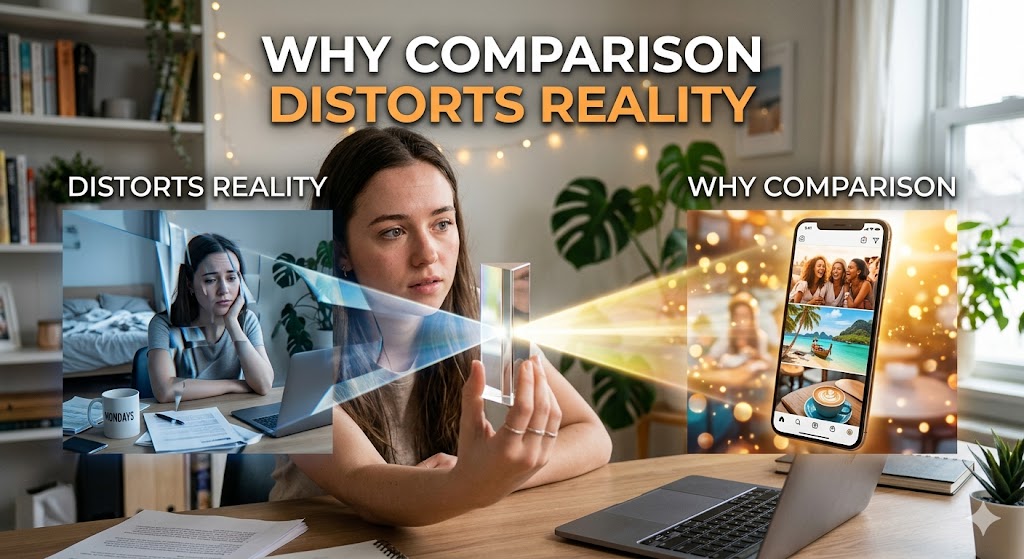
Why Comparison Distorts Reality
Comparison is one of the most common mental habits in human life, yet it is also one of the most misleading ways to interpret reality. Almost everyone does it in one form or another, whether consciously or unconsciously. People compare their income with others, their progress with peers, their relationships with social media images, their achievements with colleagues, and even their personal timeline with the highlight reels of strangers. At first glance, comparison seems harmless and even useful because it appears to provide a benchmark for self evaluation. However, what most people fail to realize is that comparison rarely shows the full picture. Instead, it selectively filters reality in a way that distorts perception, creates unnecessary pressure, and often leads to emotional dissatisfaction.
The core problem with comparison is that it removes context. When you compare yourself to another person, you are usually comparing your behind the scenes with their public presentation. You see their success but not their struggle, their confidence but not their doubt, their results but not their failures, their stability but not their uncertainty. Even in real life situations where you know someone closely, you still do not have access to every factor shaping their journey. Yet the human mind tends to simplify things into visible outcomes. This simplification creates a false belief that life is a straight line of equal conditions, when in reality every individual operates under different circumstances, timing, resources, opportunities, and hidden challenges.
Another major distortion created by comparison is selective exposure. The human brain naturally notices what stands out. When you compare yourself to others, you are not comparing against an average of their life, but against their peak moments. For example, someone might compare their financial situation to a friend who just bought a new car, without considering the years of debt, sacrifice, risk, or external support that made it possible. Social media intensifies this distortion because it is built entirely on curated moments. People rarely post their failures, their financial struggles, their emotional breakdowns, or their uncertain days. Instead, they share achievements, celebrations, and milestones. Over time, this creates a false environment where success appears more common and effortless than it truly is.
Comparison also distorts reality by ignoring individual timelines. Life does not progress at the same speed for everyone. Some people achieve early success, while others experience delayed breakthroughs. Some build stability quickly, while others take longer to find direction. When comparison enters this dynamic, it creates unnecessary pressure to match someone else’s timing. A person may feel behind simply because another person achieved a milestone earlier, even though their own path may naturally unfold differently. This leads to frustration, impatience, and sometimes abandonment of meaningful progress simply because it does not match external expectations.
There is also the issue of unfair measurement. People often compare different stages of development as if they are equal. For instance, a beginner might compare their progress with someone who has spent years mastering a skill. A small business owner might compare their early revenue with a well established company that has been operating for decades. These comparisons ignore the accumulation of experience, mistakes, learning curves, and compounding effort that create visible success over time. When unequal stages are measured against each other, the result is always a distorted conclusion that undervalues personal progress.
Another subtle way comparison distorts reality is by shifting focus away from personal growth. Instead of asking “Am I improving compared to who I was yesterday,” people begin to ask “Am I better than this person.” This external orientation weakens self awareness. Growth becomes relative rather than absolute. The danger here is that someone can actually be improving significantly in their life but still feel unsuccessful because someone else appears further ahead. This creates a situation where progress is no longer measured by development but by ranking, and ranking is always unstable because there will always be someone ahead and someone behind.
Comparison also creates emotional noise that interferes with clear thinking. When people constantly measure themselves against others, they experience emotions such as envy, insecurity, pride, or anxiety depending on the direction of comparison. These emotions can cloud judgment and lead to poor decisions. For example, someone feeling behind might rush into financial decisions, career changes, or lifestyle choices just to “catch up” with others. On the other hand, someone who feels ahead might become complacent and stop improving. In both cases, the emotional reaction to comparison replaces rational decision making.
One of the most overlooked effects of comparison is identity confusion. When people constantly observe others and measure themselves against them, they may begin to adopt goals, lifestyles, or expectations that do not align with their true values. This happens because comparison subtly shifts attention outward. Instead of building a life based on personal priorities, individuals begin to imitate what appears successful in others. Over time, this leads to a disconnect between who they are and what they are trying to become. Even when external success is achieved, internal satisfaction may still be missing because the direction was never personally defined.
Comparison also distorts effort perception. People often underestimate their own progress because they are too focused on what others have achieved. This creates a bias where personal effort feels insignificant. For instance, someone may ignore years of consistent learning or discipline simply because they have not reached a visible milestone that someone else has achieved. Meanwhile, they fail to recognize that their foundation is being built gradually, and that long term success is often the result of invisible accumulation rather than sudden leaps.
Another reality distortion caused by comparison is the illusion of equality in opportunity. People tend to assume that because they can see someone’s result, they had the same access to resources, support systems, or starting conditions. In truth, life is highly unequal in its distribution of advantages. Some people begin with financial support, strong networks, educational access, or early exposure to opportunities. Others start with limitations that are not immediately visible. Comparison erases these differences and replaces them with a false sense of fairness, which leads to inaccurate judgments about personal effort or worth.
At a deeper level, comparison also alters self perception. The more someone compares themselves to others, the more their self image becomes dependent on external reference points. This means identity becomes unstable because it changes depending on who they are observing at any given time. If they compare upward, they feel inadequate. If they compare downward, they feel superior. Neither state is grounded in reality because both are dependent on shifting external variables rather than internal truth.
It is important to understand that comparison is not entirely useless. When used carefully and intentionally, it can provide inspiration, learning opportunities, and benchmarks for improvement. The problem arises when comparison becomes the primary lens through which life is evaluated. At that point, it stops being a tool and becomes a distortion mechanism. The healthiest approach is to use comparison as information, not identity. It should help you understand possibilities, not define your worth.
A more accurate way to view progress is through personal consistency and long term trajectory. Instead of asking how you compare to others, a more grounded question is how your current actions compare to your past actions. This shifts focus from competition to development. It also allows a clearer understanding of whether you are actually improving, regardless of external noise. When progress is measured internally, reality becomes more stable because it is based on your own evolution rather than fluctuating external standards.
Another healthier perspective is to recognize that everyone is solving different problems. While one person may appear ahead in one area, they may be struggling in another area that is not visible. Life is multidimensional, and reducing it to a single comparison point oversimplifies its complexity. What appears like advantage in one dimension may come with hidden costs in another. This understanding helps reduce unnecessary pressure and restores a more balanced view of human experience.
Ultimately, comparison distorts reality because it replaces complexity with simplicity, context with outcome, and individuality with ranking. It encourages people to overlook their unique journey and instead measure themselves against incomplete information. The result is often dissatisfaction, impatience, and misaligned expectations. When people begin to recognize these distortions, they can gradually shift toward a more grounded and self aware way of evaluating their lives.
A clearer reality emerges when individuals focus less on where others appear to be and more on how they are growing within their own path. Life becomes more meaningful when progress is measured by direction rather than comparison. In the absence of constant comparison, people are able to see their journey more accurately, appreciate their progress more genuinely, and make decisions based on clarity rather than distortion.

EarnSmartOnline.com.ng is dedicated to helping readers make smarter financial decisions through practical guides on online income, personal finance, technology, digital business, and wealth creation. Our goal is to provide reliable, easy-to-understand, and actionable content that empowers individuals to earn smarter, build sustainable income streams and achieve long-term financial success.
Recommended: Start Earning Online
- Ultimate Affiliate Marketing Program — learn affiliate marketing with a done-for-you sales system ($15). Check it out
- The Newbie Affiliate Guide — the beginner-friendly starter guide (~$6.68). Check it out
- Easy Dollar Maker — earn in dollars uploading AI images and videos from your phone ($17). Check it out
Disclosure: These are affiliate links. If you buy through them, I may earn a commission at no extra cost to you.



