
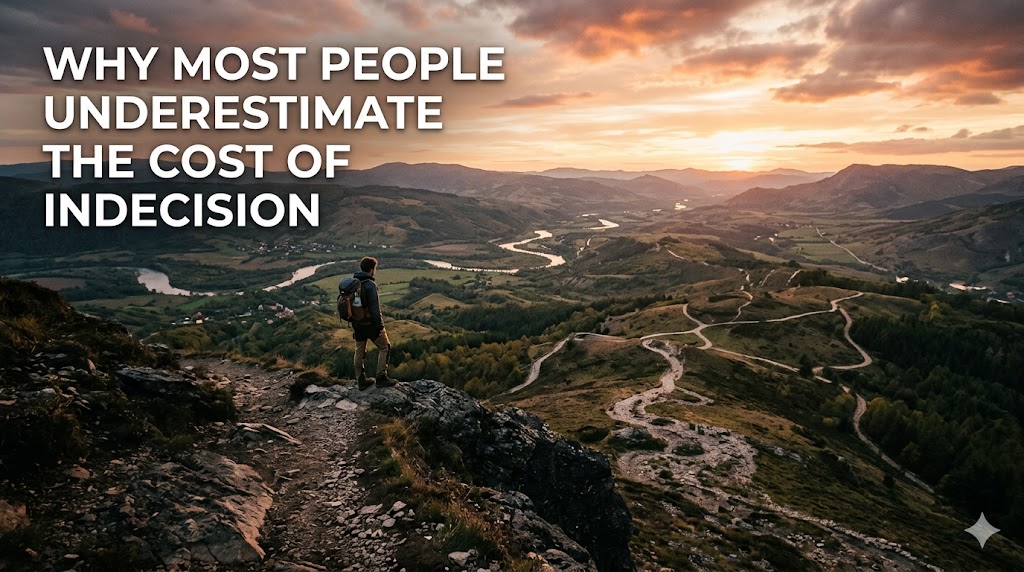
Why Most People Underestimate the Cost of Indecision
Every day, people make countless decisions. Some are small and insignificant, while others have the power to completely change the direction of a life. Yet one of the most overlooked realities in personal growth, financial success, relationships, and career development is that indecision itself carries a cost. Many people spend so much time worrying about making the wrong choice that they fail to realize that refusing to make a choice is often the most expensive decision of all. The cost of indecision is rarely visible in the moment, which is why most people underestimate it. They focus on what they might lose by acting, while completely ignoring what they are already losing by waiting.
Indecision often disguises itself as caution, intelligence, or careful planning. People tell themselves they are gathering more information, waiting for the perfect opportunity, or making sure they do not make a mistake. While thoughtful consideration is important, there comes a point where analysis stops being productive and starts becoming destructive. Opportunities do not wait forever. Markets change, people move on, industries evolve, and circumstances shift. What appears to be a harmless delay today can become a major regret tomorrow.
One of the greatest costs of indecision is lost opportunity. Every opportunity comes with a window of time. Whether it is a business idea, an investment opportunity, a job application, a relationship, or a personal goal, there is often a period during which action produces the greatest reward. People who hesitate frequently miss these windows. By the time they finally decide to act, the conditions that made the opportunity attractive may no longer exist. What they fail to understand is that while they were busy trying to avoid risk, they were unknowingly accepting another risk: the risk of missing out entirely.
Indecision also creates a hidden emotional burden. A decision that remains unresolved continues to occupy mental space. It lingers in the background of the mind, consuming attention and energy. People often underestimate how exhausting it is to constantly think about choices they refuse to make. The brain continues revisiting the same possibilities, weighing the same options, and replaying the same scenarios. This mental loop drains focus and reduces productivity. The longer a decision remains unresolved, the more energy it consumes.
Many people believe that making no decision protects them from failure. In reality, indecision often produces its own form of failure. A person who never applies for a better job because they fear rejection remains stuck where they are. A person who never starts a business because they fear losing money continues to wonder what could have been. A person who never expresses their feelings because they fear embarrassment may lose a meaningful relationship forever. In each case, the individual avoids one possible negative outcome only to guarantee another.
The financial consequences of indecision can be enormous. Some people spend years waiting for the perfect time to invest, start saving, launch a project, or acquire new skills. While they wait, inflation continues to erode purchasing power, competitors continue to gain experience, and opportunities continue to disappear. Wealth is often built through consistent action over long periods of time. Delayed decisions shorten the time available for growth and compounding. Many financial regrets are not the result of poor decisions but rather the result of decisions that were never made.
Indecision can also damage confidence. Confidence is built through action and experience. Every decision made provides feedback, lessons, and opportunities for growth. People who avoid making decisions deny themselves these learning experiences. Over time, they become less certain of their ability to navigate challenges. Ironically, the more they avoid decisions, the more intimidating decisions become. What starts as hesitation gradually evolves into a habit of self-doubt.
Another reason people underestimate the cost of indecision is because the consequences are often invisible. If someone makes a bad investment, the loss is easy to see. If someone chooses the wrong career path, the consequences may eventually become obvious. But what about the opportunities never pursued? What about the relationships never started? What about the businesses never launched? These losses rarely appear on a balance sheet. They leave no physical evidence. Yet they can have a far greater impact on a person’s life than any visible mistake.
History repeatedly demonstrates that progress belongs to those willing to make decisions. Every innovation, breakthrough, and achievement began when someone chose action over uncertainty. Successful people are not successful because they always make perfect decisions. They are successful because they understand that imperfect action often produces better results than endless hesitation. They recognize that information gained through action is frequently more valuable than information gathered through endless analysis.
Fear is one of the primary drivers of indecision. People fear failure, criticism, rejection, loss, and uncertainty. However, uncertainty is a permanent feature of life. No decision comes with a guarantee. Waiting for complete certainty is like waiting for the ocean to stop producing waves before learning to swim. The perfect moment rarely arrives. Those who achieve meaningful progress learn to act despite uncertainty rather than waiting for uncertainty to disappear.
The workplace provides countless examples of the cost of indecision. Leaders who delay difficult decisions often create larger problems. Businesses that hesitate to adapt to changing markets frequently lose relevance. Employees who postpone skill development often find themselves unprepared for future opportunities. In fast-moving environments, the ability to make timely decisions can be a significant competitive advantage.
Relationships also suffer from indecision. People delay conversations that need to happen. They avoid expressing their feelings. They postpone resolving conflicts. In many cases, the damage caused by waiting becomes greater than the damage that could have resulted from taking action. Relationships require communication, honesty, and timely decisions. Indecision often creates distance, confusion, and missed connections.
One of the most important lessons about decision-making is understanding that every choice involves trade-offs. There is no path without risk. Choosing one opportunity means giving up another. Choosing safety may mean sacrificing growth. Choosing growth may require accepting uncertainty. The mistake many people make is assuming that avoiding a decision eliminates risk. In reality, it simply exchanges one type of risk for another.
The cost of indecision compounds over time. A single delayed decision may seem insignificant, but repeated delays can shape an entire life. Small opportunities missed today become larger opportunities unavailable tomorrow. Small habits of hesitation eventually become patterns of behavior. Over years and decades, these patterns influence careers, finances, relationships, and personal fulfillment.
Many people spend more time researching decisions than actually implementing them. They read books, watch videos, seek advice, and gather opinions. While preparation has value, there is a point where additional information provides diminishing returns. Eventually, action becomes the only way to gain meaningful insight. Experience often teaches lessons that theory cannot.
The most successful individuals understand that mistakes are part of the process. They do not view every decision as a final verdict on their future. Instead, they view decisions as experiments. Some outcomes will be positive, while others will provide lessons. This mindset reduces the fear associated with making choices and increases the willingness to act.
There is also a powerful psychological benefit to decisiveness. Making a decision creates momentum. It transforms uncertainty into movement. Even when challenges arise, progress becomes possible because action has begun. Momentum builds confidence, clarity, and motivation. People often discover that many of their fears were exaggerated once they take the first step.
At its core, indecision is expensive because time is expensive. Time is the one resource that cannot be recovered. Money lost can often be earned again. Opportunities may occasionally return. Knowledge can be acquired. But time spent waiting is gone forever. Every year spent postponing an important decision is a year that cannot be reclaimed.
The reality is that life rewards movement. Progress belongs to those willing to act despite uncertainty, learn despite mistakes, and adapt despite setbacks. The greatest risk is often not making the wrong decision but making no decision at all. Most people underestimate the cost of indecision because they focus on visible losses while ignoring invisible ones. They see the dangers of action but fail to see the dangers of delay.
In the end, every person must choose whether they want to be guided by fear or by possibility. Decisions shape destinies. Opportunities favor those who move. Growth belongs to those willing to step into uncertainty. The cost of indecision is not merely the absence of progress. It is the accumulation of missed opportunities, wasted time, lost confidence, and unrealized potential. Understanding this truth may be the first step toward making better decisions and creating a future defined not by hesitation, but by action.

EarnSmartOnline.com.ng is dedicated to helping readers make smarter financial decisions through practical guides on online income, personal finance, technology, digital business, and wealth creation. Our goal is to provide reliable, easy-to-understand, and actionable content that empowers individuals to earn smarter, build sustainable income streams and achieve long-term financial success.
Recommended: Start Earning Online
- Ultimate Affiliate Marketing Program — learn affiliate marketing with a done-for-you sales system ($15). Check it out
- The Newbie Affiliate Guide — the beginner-friendly starter guide (~$6.68). Check it out
- Easy Dollar Maker — earn in dollars uploading AI images and videos from your phone ($17). Check it out
Disclosure: These are affiliate links. If you buy through them, I may earn a commission at no extra cost to you.



