
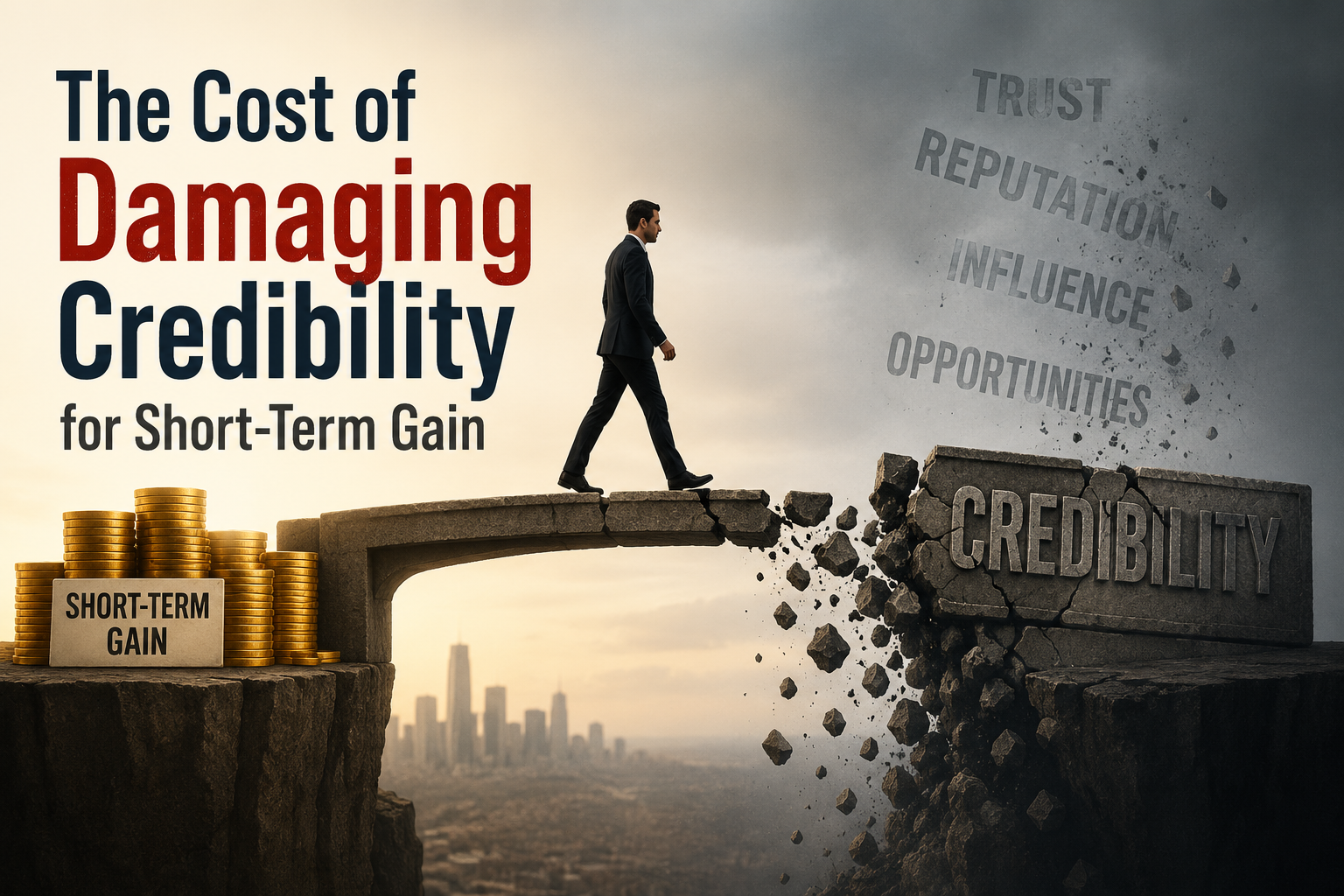
The Cost of Damaging Credibility for Short-Term Gain
Credibility is one of those invisible assets that people only fully understand when it is already damaged. In the beginning, it feels like something flexible, something you can stretch a little when the pressure of short term needs becomes too strong. A promise can be bent, a detail can be exaggerated, a commitment can be delayed, and it may even seem harmless if the immediate benefit is attractive enough. But credibility does not behave like money that can be easily recovered after spending. It behaves more like trust in a fragile system. Once it is weakened, every future interaction becomes more expensive, more difficult, and more uncertain.
In many real life situations, people are tempted to trade credibility for short term gain without fully calculating the long term consequences. It could be a business owner overstating what a product can do just to secure a sale. It could be a worker exaggerating skills to get a job they are not fully prepared for. It could be a content creator inflating results or misleading an audience just to gain attention quickly. At the moment of decision, the short term reward feels tangible and immediate, while the cost of damaged credibility feels distant and abstract. That distance creates a dangerous illusion that the trade is beneficial.
The problem is that credibility compounds. When it is intact, it grows silently. People begin to trust your word without needing verification. Opportunities arrive faster because others reduce the friction of doubt when dealing with you. Your name begins to carry weight that works on your behalf even when you are not present. This is why credible individuals often seem to progress faster with less effort over time. They are not just relying on skill or intelligence. They are benefiting from accumulated trust.
When credibility is damaged, the opposite compounding effect begins. Even small claims start to require proof. Even honest statements are received with skepticism. People begin to double check your words, and in some cases, they avoid depending on you altogether. This creates a silent tax on every future opportunity. You may still be capable, but your capability is no longer assumed. It must be constantly demonstrated, repeatedly and often under stricter conditions than others.
Short term gain often blinds people to this invisible tax. The immediate benefit feels like progress, especially when it solves a pressing need. A financial gap is filled, an opportunity is secured, or attention is gained. But what is not immediately visible is the erosion of future leverage. The very foundation that makes future growth easier becomes weaker. Over time, this leads to a situation where each success becomes harder to achieve than the last, even if personal skill has improved.
One of the most dangerous aspects of damaging credibility is that it does not always produce instant consequences. In fact, in some environments, dishonesty or exaggeration can produce rapid rewards. This reinforces the illusion that the behavior is effective. But systems built on trust are slow to punish and slow to forgive. The consequences accumulate quietly until a threshold is reached, and then the collapse of trust appears sudden. What feels like a sudden loss is often the result of many small compromises that were previously ignored.
In professional environments, credibility is often more valuable than talent. Talent can open doors, but credibility keeps them open. A talented person who lacks credibility may get initial attention but struggles to maintain long term relationships or leadership positions. Meanwhile, a moderately skilled but highly credible person often becomes the preferred choice for important responsibilities. This is because people are not just evaluating ability. They are evaluating reliability, predictability, and trustworthiness.
The cost of losing credibility is not only external. It also affects internal decision making. Once a person begins to rely on shortcuts that compromise trust, they often start recalibrating their own standards. What once felt unacceptable begins to feel negotiable. Over time, this shifts identity. Instead of becoming someone who builds long term value, they become someone who constantly manages short term survival. This shift is subtle but powerful, because identity determines consistency, and consistency determines outcomes.
Another hidden cost is the narrowing of future opportunities. When people trust you less, they become less willing to involve you in high value situations. You may still be included in low risk or low impact roles, but significant opportunities tend to go to those with stronger reputations. This creates a ceiling that is not based on capability but on perception. Even if you improve, the market’s perception of you may lag behind your actual growth for a long time.
Restoring credibility is significantly harder than maintaining it. Building it requires consistent alignment between words and actions over time. Repairing it requires not only consistency but also patience from others, and patience is something that cannot be demanded. It must be earned gradually through repeated evidence of change. This means that the cost of damaging credibility is not just the initial loss, but also the long recovery period that follows.
Short term thinking often ignores this asymmetry. People assume that if a gain is immediate, the loss can also be quickly reversed. But trust does not operate on symmetrical terms. It is easier to lose than to regain. A single moment of dishonesty can undo years of trust building, while rebuilding that trust may take years of consistent behavior, if it is rebuilt at all.
In relationships, whether personal or professional, credibility acts as the emotional currency that holds everything together. When it weakens, even honest interactions begin to feel uncertain. People may still engage with you, but they do so cautiously. This caution reduces depth, openness, and collaboration. Over time, relationships become transactional rather than cooperative, which reduces their long term value.
In business, credibility influences customer retention, partnership strength, and brand perception. A business that prioritizes short term profit through misleading claims may experience temporary growth, but it often struggles with long term sustainability. Customers may return once based on expectation, but they rarely return twice after feeling misled. And in modern environments where information spreads quickly, reputational damage can multiply faster than any marketing effort can repair.
The deeper issue is that credibility is not just about what others think of you. It is also about how aligned your actions are with reality. When this alignment is strong, decision making becomes simpler because you operate within clear boundaries. When it is weak, you must constantly manage contradictions between appearance and reality, which increases stress and reduces clarity.
Ultimately, credibility is a form of long term leverage. It reduces friction, increases trust, and multiplies opportunity. It is built slowly through consistency and easily damaged through short term compromise. The temptation to trade it for immediate reward will always exist, especially in high pressure environments. But every time that trade is made, the future becomes more expensive.
The true cost of damaging credibility is not only what is lost in the moment, but what becomes permanently harder to access in the future. Opportunities require more proof, relationships require more caution, and growth requires more effort. What was once natural becomes conditional. What was once effortless becomes negotiated.
In the long run, credibility determines how far skill, effort, and opportunity can actually take a person. Without it, even strong capability is limited. With it, even modest ability can compound into significant outcomes. This is why protecting credibility is not just an ethical choice, but a strategic one. The short term gain that comes from compromising it is almost always outweighed by the long term cost that follows, even if that cost is not immediately visible.

EarnSmartOnline.com.ng is dedicated to helping readers make smarter financial decisions through practical guides on online income, personal finance, technology, digital business, and wealth creation. Our goal is to provide reliable, easy-to-understand, and actionable content that empowers individuals to earn smarter, build sustainable income streams and achieve long-term financial success.
Recommended: Start Earning Online
- Ultimate Affiliate Marketing Program — learn affiliate marketing with a done-for-you sales system ($15). Check it out
- The Newbie Affiliate Guide — the beginner-friendly starter guide (~$6.68). Check it out
- Easy Dollar Maker — earn in dollars uploading AI images and videos from your phone ($17). Check it out
Disclosure: These are affiliate links. If you buy through them, I may earn a commission at no extra cost to you.



