
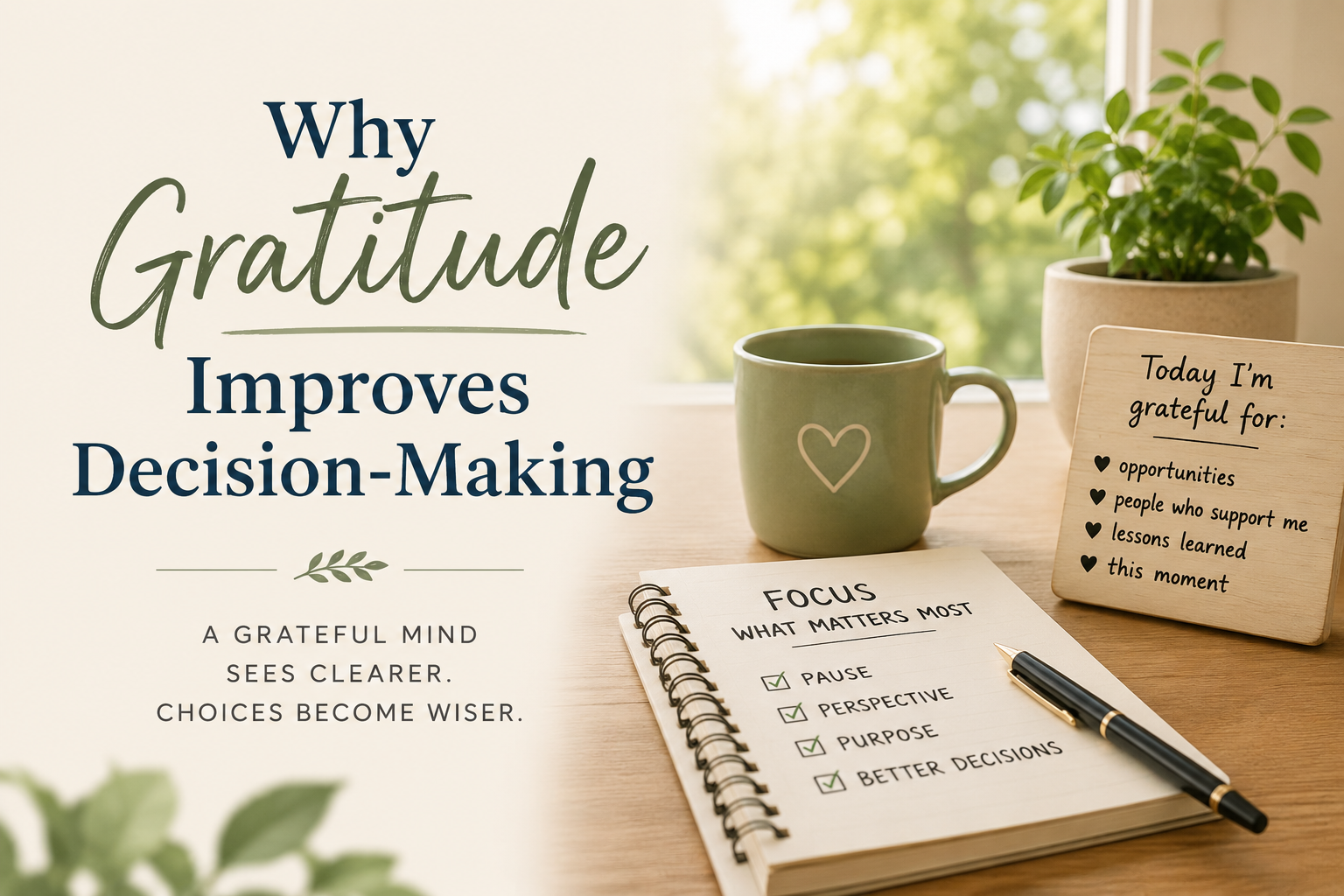
Why Gratitude Improves Decision-Making
Gratitude is often discussed as a moral virtue or emotional habit that makes people more positive and pleasant to be around, but its deeper influence goes far beyond feelings. One of the most powerful yet underrated effects of gratitude is its ability to improve decision-making. When people regularly practice gratitude, they are not just becoming emotionally healthier, they are also training their minds to think more clearly, weigh options more wisely, and choose better long term outcomes. Understanding why gratitude improves decision-making helps reveal how mental state directly shapes life outcomes in business, relationships, and personal growth.
At its core, decision-making is heavily influenced by emotional noise. Humans rarely make choices in a purely logical state. Instead, decisions are filtered through stress, fear, comparison, insecurity, and desire for immediate reward. Gratitude acts as a mental reset that reduces this emotional interference. When a person focuses on what they already have instead of what they lack, the brain shifts away from scarcity driven thinking. This shift alone is powerful because scarcity thinking often leads to rushed, defensive, or short sighted decisions. By reducing this pressure, gratitude creates space for clarity.
Why gratitude improves decision-making also becomes clear when we consider how it affects perspective. A grateful mind naturally expands its view of reality. Instead of focusing on a single problem or limitation, it begins to recognize existing resources, support systems, and opportunities. This broader awareness allows for more balanced evaluation of choices. People who lack gratitude often exaggerate problems and underestimate solutions, while grateful individuals tend to assess situations more realistically. This balance is critical in making decisions that are not emotionally biased or distorted.
Another important aspect is how gratitude affects impulsivity. Many poor decisions come from the urge to act quickly in order to escape discomfort. Whether it is financial decisions, career moves, or emotional reactions in relationships, impulsivity often overrides long term thinking. Gratitude slows this reaction pattern. When a person is grounded in appreciation, they are less likely to chase instant relief or gratification. Instead, they become more patient, allowing time for better analysis. This patience significantly improves the quality of outcomes over time.
Why gratitude improves decision-making can also be understood through its impact on emotional regulation. Strong emotions such as anger, envy, and frustration often cloud judgment. These emotions narrow focus and push individuals toward reactive choices rather than strategic ones. Gratitude reduces the intensity of these negative emotions by redirecting attention toward positive aspects of life. This does not mean problems disappear, but it creates emotional stability that prevents decisions from being dominated by temporary feelings. A calm mind naturally evaluates options more effectively than a disturbed one.
Gratitude also improves decision-making by enhancing self awareness. When people practice gratitude consistently, they become more reflective about their thoughts and behaviors. This reflection helps them recognize patterns in their past decisions, both good and bad. Self awareness is essential because it allows individuals to identify what has worked for them before and what has consistently led to failure. Without this awareness, people tend to repeat the same mistakes. With gratitude, there is a stronger tendency to pause and learn from experience before making new choices.
Another dimension of why gratitude improves decision-making lies in its effect on comparison. Many poor decisions are driven by unhealthy comparison with others. People often make choices based on what others are doing rather than what is actually suitable for their own situation. Gratitude reduces this tendency by shifting focus from external comparison to internal appreciation. When someone is genuinely grateful for their current position, they are less likely to make irrational decisions just to keep up with others. This leads to more authentic and sustainable life choices.
Gratitude also strengthens long term thinking. A grateful mindset naturally acknowledges the value of past support, present stability, and future possibilities. This continuity of thinking encourages individuals to consider long term consequences before making decisions. Instead of focusing only on immediate gain or convenience, they become more aware of how present choices affect future outcomes. This is especially important in areas like financial planning, career development, and relationship building where short term decisions often carry long term consequences.
Why gratitude improves decision-making is also connected to its effect on resilience. Life constantly presents challenges and setbacks, and emotional instability during these moments can lead to poor decisions. Gratitude builds resilience by helping individuals recognize that even in difficult situations, there are still elements of value and learning. This mindset prevents panic driven choices. Instead of reacting to failure or pressure, grateful individuals are more likely to pause, reassess, and adjust their approach strategically.
In addition, gratitude improves decision-making by strengthening interpersonal relationships. Many decisions in life are influenced by other people, whether in professional environments or personal connections. Gratitude encourages empathy and appreciation for others, which leads to better communication and reduced conflict. When relationships are stable, decision-making becomes easier because there is less emotional distraction and misunderstanding. People are able to collaborate, seek advice, and consider different perspectives more effectively.
Another often overlooked reason why gratitude improves decision-making is its influence on mental energy. Negative thinking consumes a significant amount of cognitive resources. Worry, regret, and dissatisfaction drain attention that could otherwise be used for problem solving. Gratitude conserves this mental energy by reducing unnecessary mental burden. With more available cognitive capacity, individuals can process information more efficiently and make clearer decisions. This improvement is subtle but extremely powerful over time.
Gratitude also enhances confidence in decision-making. When people recognize the value of what they already have and acknowledge their past progress, they develop a stronger sense of self trust. This self trust reduces indecision and hesitation. Instead of overthinking every possible outcome, they become more comfortable making choices and adjusting when necessary. This flexibility is crucial because effective decision-making is not about perfection but about adaptability.
Ultimately, why gratitude improves decision-making comes down to one central truth. The quality of decisions is deeply influenced by the quality of mental state. Gratitude creates a mental environment that is calmer, clearer, more balanced, and more future oriented. It reduces emotional distortion, expands perspective, and strengthens patience and self awareness. These combined effects naturally lead to better choices in almost every area of life.
In a world filled with pressure, distraction, and constant comparison, gratitude acts as a stabilizing force. It brings the mind back to clarity and helps individuals see situations as they truly are rather than through the lens of fear or lack. Over time, this shift does not just improve isolated decisions, it transforms the overall direction of a person’s life. Better thinking leads to better choices, and better choices lead to better outcomes. This is the quiet but powerful reason why gratitude improves decision-making in such a profound and lasting way.

EarnSmartOnline.com.ng is dedicated to helping readers make smarter financial decisions through practical guides on online income, personal finance, technology, digital business, and wealth creation. Our goal is to provide reliable, easy-to-understand, and actionable content that empowers individuals to earn smarter, build sustainable income streams and achieve long-term financial success.
Recommended: Start Earning Online
- Ultimate Affiliate Marketing Program — learn affiliate marketing with a done-for-you sales system ($15). Check it out
- The Newbie Affiliate Guide — the beginner-friendly starter guide (~$6.68). Check it out
- Easy Dollar Maker — earn in dollars uploading AI images and videos from your phone ($17). Check it out
Disclosure: These are affiliate links. If you buy through them, I may earn a commission at no extra cost to you.



