
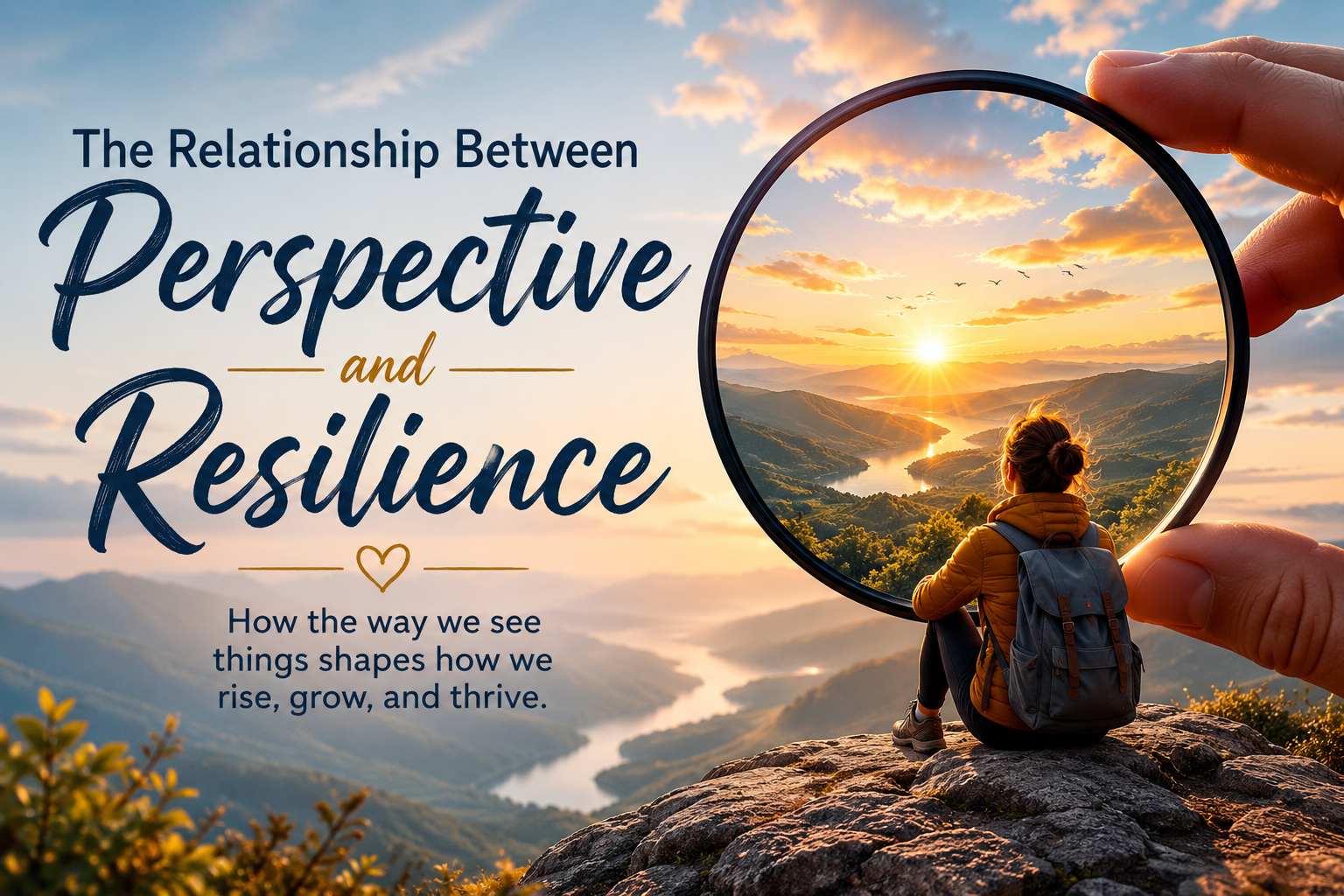
The Relationship Between Perspective and Resilience
Perspective and resilience are two forces that quietly shape the direction of a human life. They are not always visible in the moment, and yet they determine how people respond when pressure increases, when expectations collapse, when plans fail, and when life refuses to behave according to design. At the center of every comeback story, every reinvention, and every quiet survival through difficult seasons, there is always a shift in how reality is interpreted. That shift is perspective. And resilience is what becomes possible when perspective is strong enough to hold a person steady instead of letting them break under pressure.
Most people think resilience is something like emotional toughness, a kind of internal hardness that allows a person to absorb pain without reacting. But that is only part of the picture. Real resilience is not just about enduring pressure. It is about how meaning is assigned to that pressure. Two people can experience the same failure, the same rejection, or the same loss, yet walk away with completely different outcomes. One person collapses into self doubt and withdrawal, while the other becomes more focused, more strategic, and more intentional. The difference is not the event itself. The difference is the interpretation of the event.
Perspective is the internal lens through which experience is filtered. It is the mental framework that determines whether a challenge is seen as a threat or as feedback. When perspective is narrow, every setback feels like a final statement about identity. A mistake becomes proof of inadequacy. A delay becomes evidence of failure. A rejection becomes confirmation that progress is impossible. But when perspective is expanded, the same experiences become information. A mistake becomes data. A delay becomes timing. A rejection becomes redirection. Nothing changes in the external world, but everything changes in the internal response.
This is where resilience is born. Resilience is not simply the ability to survive difficulty. It is the ability to remain mentally flexible in the presence of difficulty. Flexibility depends on perspective. A rigid perspective produces fragile people. A flexible perspective produces adaptable people. The rigid mind interprets events in absolute terms. It says things like everything is ruined, nothing ever works for me, this always happens, or I can never recover from this. These are not facts. They are interpretations shaped by limited perspective. And because the interpretation is extreme, the emotional response becomes extreme as well. That emotional overload is what breaks resilience.
On the other hand, a flexible perspective introduces space between events and meaning. It allows a person to pause before concluding what something means. That pause is powerful. In that space, resilience begins to form. Instead of reacting instantly with emotional conclusions, the person begins to ask better questions. What can this teach me. What part of this is temporary. What part of this is within my control. What would this look like if I was observing it from a distance instead of being inside it. These questions shift the mind from emotional reaction to strategic interpretation.
There is also a deeper layer to this relationship between perspective and resilience, and it has to do with identity. Many people do not just experience failure, they attach failure to identity. Instead of saying I failed at this attempt, they unconsciously shift into I am a failure. That shift is subtle but powerful. Once failure becomes identity, resilience weakens because every challenge now feels personal and defining. The mind is no longer dealing with an event, it is defending the self. And when identity is under attack, emotional stability becomes harder to maintain.
A strong perspective separates identity from experience. It understands that outcomes are not fixed definitions of self but temporary expressions of effort, timing, and circumstance. This separation is what protects resilience. It allows a person to fail without collapsing internally. It allows learning without shame. It allows correction without self destruction. When identity is stable and not constantly rewritten by external outcomes, resilience becomes natural instead of forced.
Another important dimension is time. Perspective determines how a person sees time, and time perception influences resilience more than most people realize. A short term perspective makes every difficulty feel permanent. If something is painful today, it feels like it will always be painful. If progress is slow this week, it feels like progress will never happen. But a long term perspective changes emotional intensity. It introduces the understanding that most conditions are temporary and that current states are only snapshots in a longer timeline.
This is why people with long term perspective often appear calmer under pressure. They are not necessarily experiencing less difficulty. They are simply interpreting it within a broader timeline. A setback becomes a phase, not a destiny. A delay becomes part of a process, not a final outcome. This expanded timeline creates emotional stability, and emotional stability strengthens resilience.
Environment also plays a role in shaping perspective. People often inherit the perspectives of their surroundings without questioning them. If someone is surrounded by constant negativity, limited thinking, and repeated narratives of failure, their perspective becomes compressed. That compression weakens resilience because it reduces mental options. There are fewer ways to interpret situations, fewer ways to respond, and fewer possibilities for recovery. In contrast, environments that expose individuals to growth oriented thinking expand perspective. They introduce alternative interpretations of the same experiences, which increases psychological flexibility and strengthens resilience over time.
One of the most powerful aspects of perspective is that it can be trained. It is not fixed. It is shaped through reflection, exposure, and intentional questioning. People who develop strong resilience are often those who have learned to reinterpret their experiences repeatedly until emotional charge reduces and clarity increases. They do not deny difficulty, but they refuse to let difficulty define meaning. Instead of asking why is this happening to me, they gradually shift toward what is this building in me.
This shift is not immediate. It is built through repetition. Each time a person successfully reframes a difficult experience, resilience increases slightly. Over time, these small shifts accumulate into a stable mental structure that can withstand larger pressures. What once would have caused emotional collapse begins to feel manageable. What once felt like defeat begins to feel like redirection.
Perspective also influences recovery speed. Two people may fall at the same point, but the one with a stronger perspective recovers faster. This is because they do not spend as much time stuck in emotional interpretation loops. They move more quickly into analysis and adjustment. They extract meaning instead of remaining in emotional reaction. That speed of recovery is one of the clearest indicators of resilience in real life.
It is also important to recognize that resilience is not about ignoring pain. It is about placing pain within a meaningful framework. Without perspective, pain feels chaotic and overwhelming. With perspective, pain becomes structured and interpretable. This structure does not eliminate difficulty, but it reduces confusion. And confusion is often what amplifies suffering more than the event itself.
At its highest level, the relationship between perspective and resilience becomes almost circular. Perspective builds resilience, and resilience reinforces perspective. As a person successfully navigates difficulties, their perspective naturally expands. And as their perspective expands, their ability to handle future difficulties increases. This creates a feedback loop of psychological strengthening over time.
Ultimately, the way a person sees their world determines how well they can survive it. Not because reality changes, but because meaning changes. Perspective is the architecture of meaning, and resilience is the strength of the structure built upon it. When perspective is narrow, resilience is fragile. When perspective is broad, resilience becomes almost unbreakable. And in the long run, it is not the absence of difficulty that defines a strong life, but the ability to interpret difficulty in a way that allows continued movement forward.

EarnSmartOnline.com.ng is dedicated to helping readers make smarter financial decisions through practical guides on online income, personal finance, technology, digital business, and wealth creation. Our goal is to provide reliable, easy-to-understand, and actionable content that empowers individuals to earn smarter, build sustainable income streams and achieve long-term financial success.
Recommended: Start Earning Online
- Ultimate Affiliate Marketing Program — learn affiliate marketing with a done-for-you sales system ($15). Check it out
- The Newbie Affiliate Guide — the beginner-friendly starter guide (~$6.68). Check it out
- Easy Dollar Maker — earn in dollars uploading AI images and videos from your phone ($17). Check it out
Disclosure: These are affiliate links. If you buy through them, I may earn a commission at no extra cost to you.



