
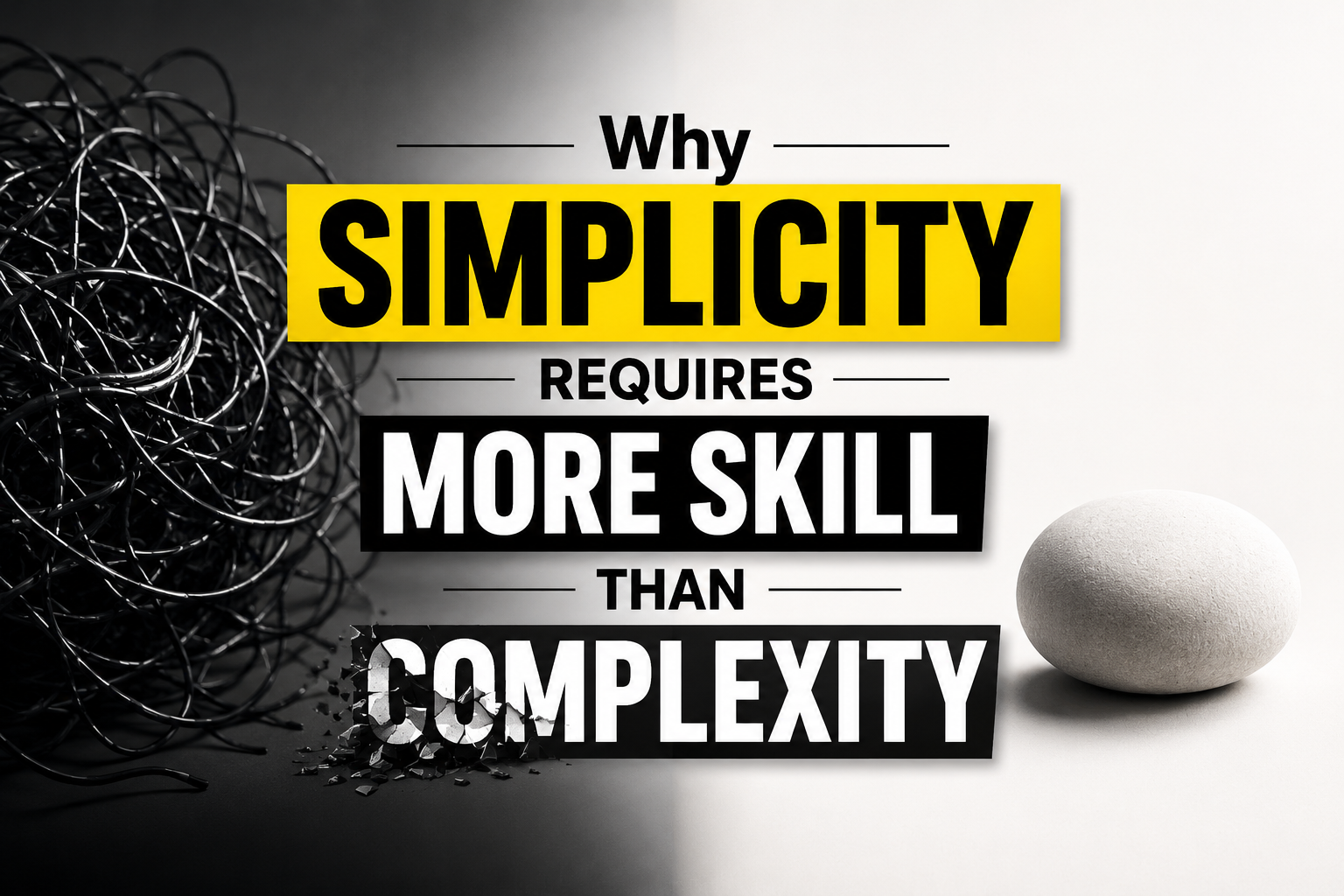
Why Simplicity Requires More Skill Than Complexity
Most people assume that complexity is a sign of intelligence. In many environments, the longer something looks, the more layered it feels, or the more technical it sounds, the easier it becomes to associate it with expertise. This belief has shaped how people write, speak, build systems, and even make decisions. Yet in reality, complexity is often the easiest thing to produce. Simplicity is the real test of understanding, discipline, and mastery. It takes far more skill to make something simple than to make it complicated.
Complexity usually happens naturally when clarity is missing. When someone does not fully understand a concept, they tend to add more explanations, more terms, more steps, and more layers in an attempt to cover the gaps. It becomes a way of hiding uncertainty. In contrast, simplicity demands full understanding. You cannot simplify what you do not deeply understand. You cannot reduce noise if you cannot distinguish what is essential from what is not. This is why simplicity is not the starting point of mastery but the result of it.
In communication, this difference becomes very clear. A person who is unsure of what they are saying often speaks in long, winding sentences, filled with unnecessary details and repeated ideas. They try to convince through volume rather than precision. But someone who truly understands their subject can explain it in a few clear sentences without losing meaning. The ability to compress meaning without distortion is a rare skill. It requires not only knowledge but also discipline to remove everything that is not needed.
This principle applies far beyond language. In business, for example, many struggling systems are complicated, not because complexity is necessary, but because clarity has not been achieved. Processes multiply, approvals stack up, tools accumulate, and responsibilities overlap. Each addition is meant to solve a problem, but without simplification, these additions create new problems. Over time, the system becomes heavy, slow, and difficult to manage. On the other hand, successful businesses often look deceptively simple from the outside. Their systems are clean, their messaging is clear, and their execution is focused. But that simplicity is not accidental. It is engineered through repeated refinement, testing, and elimination of what does not work.
Simplicity also requires courage. When you simplify something, you expose its core. There is no longer a place to hide inefficiency, confusion, or unnecessary elements. This can be uncomfortable because complexity often creates the illusion of safety. If something fails inside a complex system, it is easy to blame another part of the system. But when something is simple, responsibility becomes clearer. There is nowhere to shift the blame. This is why many people unconsciously resist simplicity. It forces honesty.
Another reason simplicity is difficult is because it goes against the human tendency to overcomplicate. The mind is naturally creative and associative. It connects ideas, builds patterns, and expands possibilities. While this is powerful, it also leads to unnecessary expansion. Without discipline, thinking becomes excessive rather than precise. The skill of simplicity is the ability to stop that expansion at the right point. It is knowing when enough is enough.
In design, this principle is well understood. The most effective designs are not the ones with the most features, but the ones where every feature has a purpose. When something is well designed, it feels effortless to use. The complexity is hidden behind the experience, not displayed on the surface. This creates the illusion that it was easy to build, when in fact it required significant effort to remove everything unnecessary.
The same applies to problem solving. A complex solution often feels impressive at first glance, but over time it becomes fragile. Each additional layer introduces more points of failure. Simpler solutions, on the other hand, are more robust because they rely on fewer assumptions and fewer dependencies. Achieving that level of simplicity requires deep thinking, because you must understand the problem well enough to strip it down to its core components.
One of the hidden challenges of simplicity is that it is not immediately rewarding. Complexity often looks more impressive in the short term. People may admire something that appears detailed, layered, and sophisticated. Simplicity, by contrast, can look ordinary. It does not always attract attention. This creates a psychological bias where people equate visible effort with value. But true mastery often hides effort inside invisibility. The work is not in adding more, but in knowing what to remove.
This is why editing is often harder than writing. Anyone can add words to a page, but it takes skill to remove words without losing meaning. It takes judgment to decide what strengthens the message and what weakens it. In the same way, building anything simple requires multiple rounds of refinement. You build, then you remove. You improve, then you reduce. You test, then you eliminate. Over time, what remains is not what was first created, but what survived careful selection.
Simplicity also improves performance. When systems are simple, decisions become faster. There is less confusion, fewer variables, and clearer direction. This reduces mental load and increases efficiency. In contrast, complexity slows everything down. It introduces hesitation, uncertainty, and misalignment. People spend more time figuring out what to do than actually doing it. In environments where speed matters, simplicity becomes a competitive advantage.
However, achieving simplicity is not about ignoring complexity. It is about mastering it. You must first be capable of handling complexity before you can reduce it effectively. If you do not understand how something works in detail, you cannot safely simplify it. This is why true simplicity is usually built on a foundation of deep expertise. The expert sees what others cannot see, including what is unnecessary.
There is also a psychological discipline involved in simplicity. It requires resisting the urge to add more features, more explanations, or more steps. It requires confidence in minimal solutions. Many people struggle with this because they equate more with better. They believe that adding something increases value. But in reality, value often comes from clarity, not accumulation. Knowing when to stop is as important as knowing what to start.
In life, simplicity also creates peace. A complicated life is often filled with unnecessary commitments, distractions, and obligations. Each one demands attention, energy, and emotional investment. Over time, this creates pressure and exhaustion. A simpler life reduces these demands. It focuses energy on what truly matters. But achieving this kind of simplicity requires difficult decisions about what to keep and what to let go.
Ultimately, simplicity is not the absence of effort. It is the result of effort applied in the right direction. It is the outcome of thinking deeply enough to identify the core of a problem, and disciplined enough to remove everything that does not serve that core. It is easy to mistake simplicity for lack of sophistication, but in truth, it is one of the highest forms of sophistication.
The paradox is that the more skilled you become, the simpler your work appears. Behind every simple outcome is a long process of analysis, testing, correction, and refinement. What the world sees is the final clarity, not the hidden struggle to achieve it. This is why simplicity is not the beginning of mastery. It is the visible evidence of it.

EarnSmartOnline.com.ng is dedicated to helping readers make smarter financial decisions through practical guides on online income, personal finance, technology, digital business, and wealth creation. Our goal is to provide reliable, easy-to-understand, and actionable content that empowers individuals to earn smarter, build sustainable income streams and achieve long-term financial success.
Recommended: Start Earning Online
- Ultimate Affiliate Marketing Program — learn affiliate marketing with a done-for-you sales system ($15). Check it out
- The Newbie Affiliate Guide — the beginner-friendly starter guide (~$6.68). Check it out
- Easy Dollar Maker — earn in dollars uploading AI images and videos from your phone ($17). Check it out
Disclosure: These are affiliate links. If you buy through them, I may earn a commission at no extra cost to you.



