
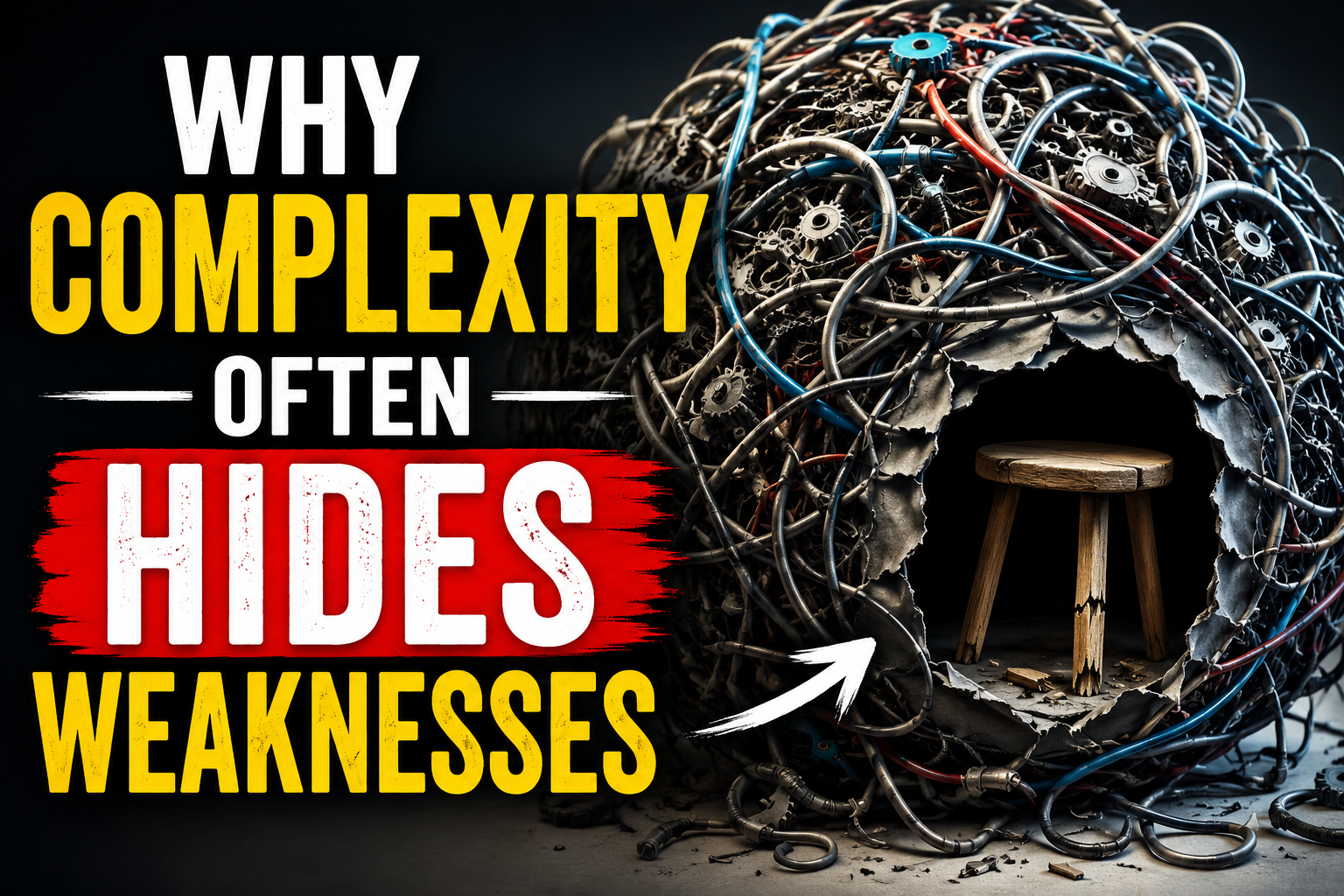
Why Complexity Often Hides Weaknesses
Why Complexity Often Hides Weaknesses is not just a statement about systems, it is a reflection of how people, businesses, and even entire industries sometimes build layers of activity to cover gaps that are not immediately visible. Complexity can look impressive from the outside, it can feel intelligent, and it can even create a sense of authority. Yet beneath that surface, complexity often acts like a curtain that hides inefficiency, confusion, and structural weakness. The more complicated something becomes, the easier it is to avoid confronting what is actually not working.
In many cases, simplicity exposes truth because it forces clarity. When a system is simple, every part must function properly or the entire system fails in a way that is easy to see. Complexity, however, allows broken parts to hide behind other moving parts. This creates an environment where problems are not solved, they are distributed. Instead of fixing the root issue, more layers are added to compensate. Over time, this creates a structure that looks advanced but is actually fragile.
One of the main reasons complexity often hides weaknesses is because it reduces visibility. When too many steps are involved in a process, it becomes difficult to trace outcomes back to their origin. This makes accountability unclear. People begin to focus on managing the appearance of performance rather than improving the actual performance itself. In such environments, inefficiencies can exist for long periods without being noticed because they are masked by the surrounding structure.
Complex systems also tend to create dependency. When too many components rely on each other in complicated ways, removing or changing one element becomes risky. This leads to resistance to improvement. Even when a weakness is known, it is often ignored because addressing it would require untangling the entire structure. As a result, the weakness remains in place and the complexity continues to grow around it, making the system even harder to fix in the future.
Another way complexity hides weaknesses is by overwhelming perception. When something appears difficult to understand, people are less likely to question it. They assume that complexity equals expertise. This perception allows weak ideas, poor designs, or inefficient systems to survive simply because they are not easily understood. In contrast, simple systems invite scrutiny. They are easier to analyze, test, and challenge, which makes weaknesses more visible and more likely to be corrected.
In organizations, complexity often grows from the desire to appear sophisticated. Teams may add processes, tools, and layers of approval in an attempt to create structure. However, without careful design, these additions do not always improve effectiveness. Instead, they can slow down decision flow and hide bottlenecks. A process that takes too many steps can make it difficult to identify where delays actually occur. This allows underperformance to continue without correction.
Why Complexity Often Hides Weaknesses also becomes clear when examining communication systems. When communication is simple, misunderstandings are quickly identified and corrected. But when communication is layered through multiple channels, messages become distorted. Important details are lost or altered as they pass through different levels. This creates confusion that can be mistaken for complexity of the task itself, when in reality it is a weakness in how information is being transmitted.
Another important aspect is that complexity often shifts focus from outcomes to procedures. When too much attention is placed on following steps, people begin to believe that completing the process is the same as achieving the result. This creates a situation where systems appear functional on paper, but the actual results may be weak or inconsistent. The structure remains intact, but the purpose behind it becomes diluted.
Complexity also provides emotional comfort for weak systems. When things are complicated, failure can be explained away through numerous factors. This reduces the pressure to identify a single root cause. Instead of saying something is not working because of a clear issue, complexity allows for vague explanations. This protects weak systems from being questioned directly, because responsibility becomes diffused across many parts.
In contrast, simple systems do not offer this protection. When something is simple, failure is direct and visible. There are fewer places to hide. This is why strong systems often appear simple. Their strength comes from clarity, not complexity. Every part exists for a clear reason, and every function can be understood without confusion. This transparency makes it easier to maintain quality and detect problems early.
Another reason complexity hides weaknesses is because it creates an illusion of progress. When new layers are added, it can feel like improvement is happening. However, adding more does not always mean improving. Sometimes it simply means expanding without solving the core issue. This illusion can be dangerous because it replaces real improvement with the appearance of activity. Over time, effort is mistaken for effectiveness.
Complexity also reduces adaptability. When systems become too complicated, changing direction becomes slow and difficult. This means that when weaknesses are discovered, responding to them takes time. In fast changing environments, this delay can allow small problems to grow into major failures. Simple systems, on the other hand, can adjust quickly because they are not weighed down by unnecessary structure.
There is also a psychological element involved. Humans often associate complexity with intelligence. This bias can prevent people from questioning systems that appear advanced. As a result, weak foundations can persist simply because they are wrapped in complexity that discourages deeper examination. This is why sometimes the most impressive looking systems are not the most effective.
Ultimately, Why Complexity Often Hides Weaknesses is a reminder that clarity is more powerful than appearance. Strength is not measured by how many layers exist in a system, but by how well each part performs its function. Complexity can delay discovery of problems, but it cannot eliminate them. At some point, weaknesses in any system will surface, and when they do, the most complex systems often suffer the most damage because their problems have been hidden for too long.
Simplicity forces honesty. It demands that every component earns its place. Complexity, when unmanaged, allows inefficiency to survive under the protection of structure. This is why true strength often appears simple, while hidden weakness often appears complex. The challenge is not to avoid complexity entirely, but to ensure that it does not become a cover for unresolved problems.
In the end, understanding Why Complexity Often Hides Weaknesses helps in building better systems, making better decisions, and recognizing that clarity is not a lack of depth, but a sign of true strength. When systems are designed with purpose and transparency, weaknesses cannot hide for long, and improvement becomes a natural outcome rather than a forced effort.

EarnSmartOnline.com.ng is dedicated to helping readers make smarter financial decisions through practical guides on online income, personal finance, technology, digital business, and wealth creation. Our goal is to provide reliable, easy-to-understand, and actionable content that empowers individuals to earn smarter, build sustainable income streams and achieve long-term financial success.
Recommended: Start Earning Online
- Ultimate Affiliate Marketing Program — learn affiliate marketing with a done-for-you sales system ($15). Check it out
- The Newbie Affiliate Guide — the beginner-friendly starter guide (~$6.68). Check it out
- Easy Dollar Maker — earn in dollars uploading AI images and videos from your phone ($17). Check it out
Disclosure: These are affiliate links. If you buy through them, I may earn a commission at no extra cost to you.



