
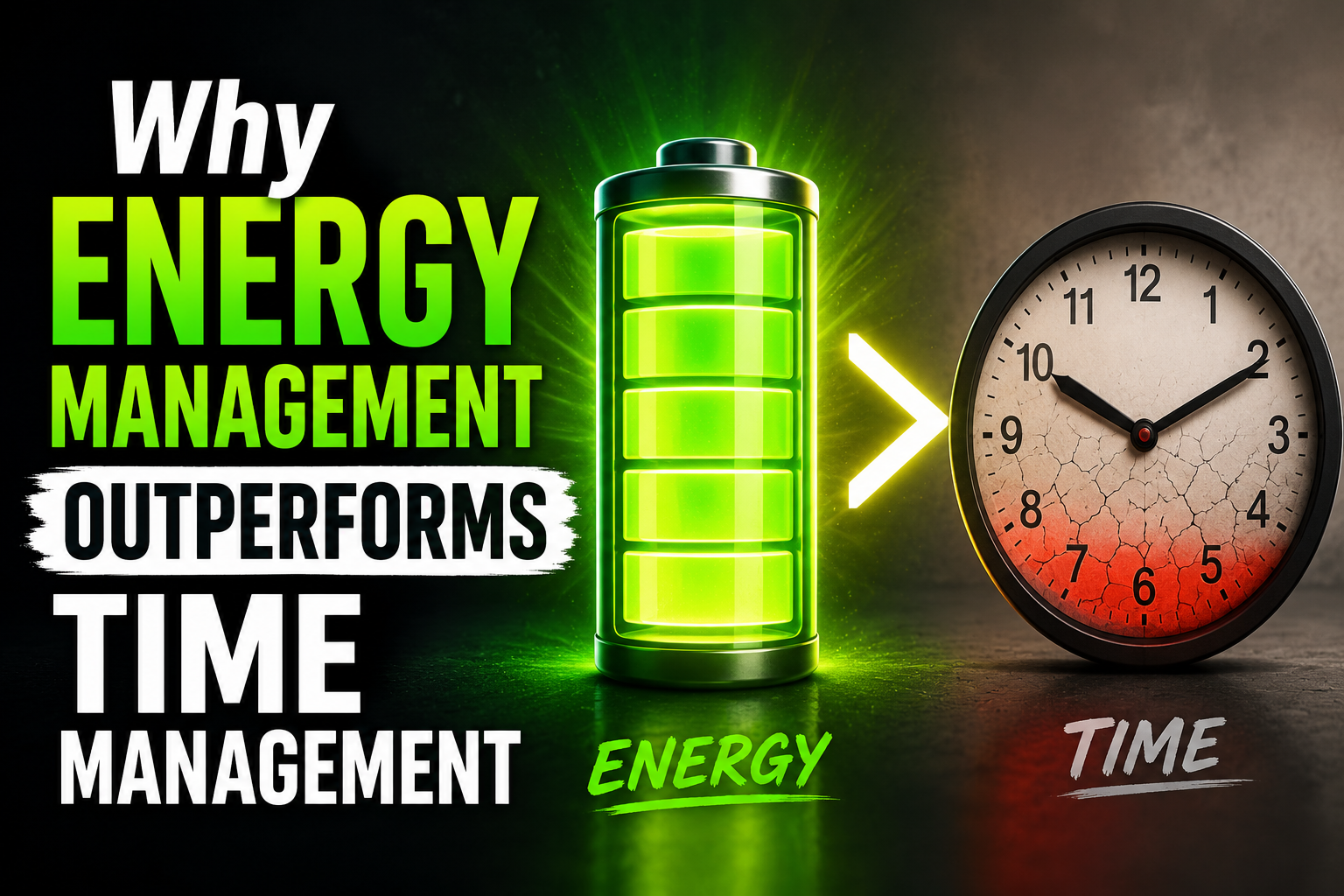
Why Energy Management Outperforms Time Management
Energy is often treated like an unlimited resource, something people assume will naturally rise and fall with motivation, discipline, or external pressure. Time management became popular because it offered structure to this assumption. If you could schedule your hours, block your calendar, and prioritize tasks, then productivity would follow. But in reality, many people who are extremely organized with their time still feel exhausted, inconsistent, and unproductive. The missing variable is energy, not time.
Time is fixed. Everyone gets the same twenty four hours in a day regardless of skill, income, or intention. Energy is not fixed. It fluctuates based on sleep, nutrition, stress levels, emotional stability, environment, focus cycles, and even the quality of relationships around you. This is why two people can have identical schedules and produce completely different results. One operates at high energy and executes deeply. The other operates at low energy and struggles through tasks despite perfect planning.
The core misunderstanding is believing that productivity failure is a scheduling problem when it is often a biological and psychological one. A person can block three hours for deep work, but if their mental clarity is low, that time becomes shallow effort, distraction, and mental fatigue rather than meaningful output. Time management assumes execution is automatic once time is allocated. Energy management recognizes that execution depends on internal capacity.
Energy is the real currency behind performance. When energy is high, focus sharpens, decision making improves, and resistance to difficult tasks decreases. When energy is low, even simple tasks feel heavy and complicated. This is why people often procrastinate not because they lack discipline, but because their energy state makes initiation feel overwhelming. The brain naturally avoids tasks that require high cognitive or emotional cost when energy reserves are depleted.
Another important distinction is that time management treats all hours as equal. Energy management reveals that hours are not equal at all. A focused hour in a peak mental state can produce more than five unfocused hours in a drained state. This is why some people achieve more in the morning before distractions accumulate, while others perform better at night when their environment becomes quieter and mental pressure reduces. The value is not in the hour itself, but in the energy available within that hour.
Energy also determines the quality of decision making. Many poor life decisions are not made because people lack information, but because they are mentally fatigued when making them. After long hours of stress or constant stimulation, the brain shifts toward shortcuts and emotional reactions instead of structured thinking. This leads to impulsive spending, avoidance of important tasks, or unnecessary conflict. Time management does not account for this, but energy management places it at the center of productivity.
Another overlooked factor is emotional energy. People often think energy is only physical, but emotional load consumes just as much internal capacity. Stress, unresolved tension, anxiety, and constant comparison drain energy even when a person is physically rested. Someone can sleep eight hours and still feel exhausted if their emotional environment is unstable. This explains why some individuals struggle to perform even when they appear to have enough time available.
Energy management also exposes the hidden cost of multitasking. On paper, multitasking seems like a way to maximize time. In reality, it fragments energy. Every task switch forces the brain to reset focus, which increases cognitive load and reduces depth. Over time, this leads to mental fatigue faster than focused work would. People often feel busy but unproductive because their energy is being divided rather than directed.
Another key insight is that energy is deeply influenced by habits. Small daily behaviors compound into either energy creation or energy depletion. Poor sleep patterns, irregular meals, constant digital stimulation, and lack of movement reduce baseline energy over time. On the other hand, consistent sleep, structured routines, physical activity, and intentional rest cycles increase energy stability. This means productivity is less about pushing harder and more about maintaining internal systems that preserve energy.
Time management often encourages pushing through fatigue. Energy management challenges this idea. Pushing through low energy states repeatedly leads to diminishing returns. Work becomes slower, more error prone, and mentally draining. In contrast, working with energy patterns leads to strategic output. High energy periods are used for deep work, while low energy periods are reserved for light tasks, reflection, or recovery. This alignment creates sustainable productivity instead of burnout cycles.
There is also a strong link between energy and focus. Focus is not simply a skill, it is a reflection of available mental energy. When energy is high, distractions lose power. When energy is low, even small interruptions can completely break concentration. This is why people often struggle to stay consistent with important tasks even when they are highly motivated. Motivation alone cannot override depleted energy systems for long periods.
Modern environments make energy management even more important. Constant notifications, information overload, and social pressure continuously drain attention. Without energy awareness, people try to compensate by adding more structure to their time, but structure alone cannot repair depletion. What is needed is recovery, not just scheduling. This includes intentional breaks, reduced digital noise, and periods of cognitive rest.
Another important dimension is that energy builds momentum. When someone starts a task with sufficient energy, completion becomes easier, which increases confidence, which in turn increases future energy availability. This creates a positive cycle. On the other hand, starting tasks with low energy leads to incomplete work, frustration, and avoidance, which reduces future energy even further. Over time, these patterns shape a person’s entire productivity identity.
Energy management also changes how priorities are understood. Instead of asking what should be done first based on urgency alone, the question becomes what should be done when my energy is at its peak. This shift allows individuals to match their most valuable tasks with their highest cognitive capacity. It reduces wasted effort and increases output quality without increasing working hours.
Ultimately, time management gives structure, but energy management gives performance. One organizes the day, the other determines what actually gets accomplished inside that day. Without energy, time becomes empty potential. With energy, even limited time becomes highly productive.
The most effective approach is not to abandon time management but to build it on top of energy awareness. This means designing your day around your natural energy rhythms, protecting recovery time as seriously as work time, and understanding that productivity is not about how much time you have, but how much energy you bring into that time.
When people learn to manage energy instead of chasing perfect schedules, work stops feeling like constant struggle and becomes more aligned, focused, and sustainable. The difference is not small. It is the difference between being consistently busy and being consistently effective.

EarnSmartOnline.com.ng is dedicated to helping readers make smarter financial decisions through practical guides on online income, personal finance, technology, digital business, and wealth creation. Our goal is to provide reliable, easy-to-understand, and actionable content that empowers individuals to earn smarter, build sustainable income streams and achieve long-term financial success.
Recommended: Start Earning Online
- Ultimate Affiliate Marketing Program — learn affiliate marketing with a done-for-you sales system ($15). Check it out
- The Newbie Affiliate Guide — the beginner-friendly starter guide (~$6.68). Check it out
- Easy Dollar Maker — earn in dollars uploading AI images and videos from your phone ($17). Check it out
Disclosure: These are affiliate links. If you buy through them, I may earn a commission at no extra cost to you.



