
Why Some People Build Legacies While Others Build Expenses
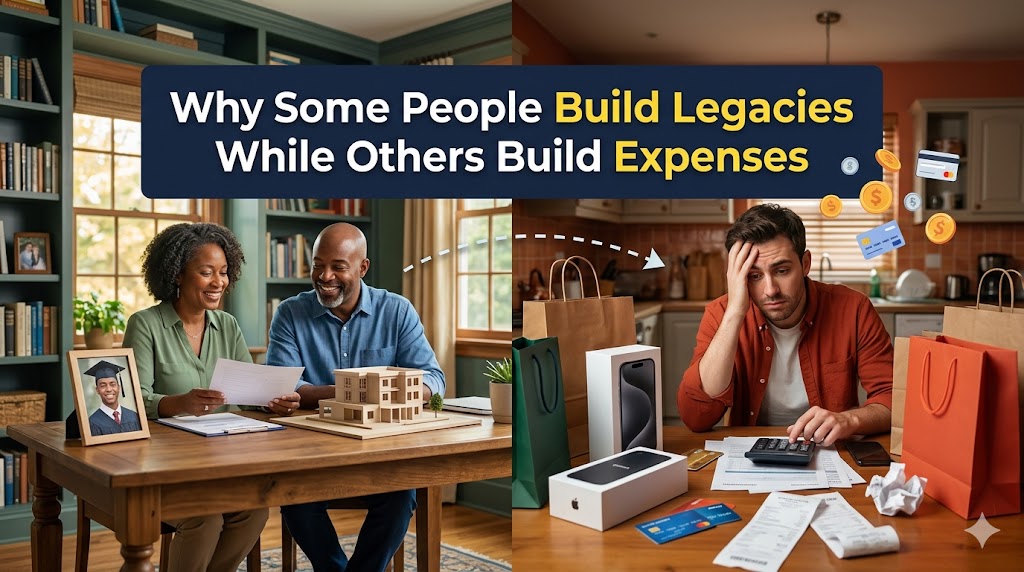
Some people spend their lives building things that last beyond them while others spend their lives building things that disappear the moment their income stops. At first glance both groups may look similar. They work, they earn, they spend, and they survive within the same economic system. But beneath the surface, there is a quiet difference in thinking, priorities, and decision making that eventually separates those who leave a legacy from those who only accumulate expenses. Legacy builders are not always the richest in income, but they are often the richest in impact, structure, and continuity. Expense builders may earn well, but their results dissolve into lifestyle maintenance with nothing left behind.
The difference begins with how each group interprets value. For many people, value is something they consume. If it feels good, looks good, or provides comfort, then it is considered valuable. This mindset naturally leads to spending patterns that prioritize immediate satisfaction over long term positioning. Expenses become the default output of their income. Money enters and immediately transforms into consumption. There is no delay, no structure, and no conversion into something that can grow or persist. Over time, their financial life becomes a cycle of earning and spending with no accumulation of lasting assets or systems.
Legacy builders see value differently. They treat value as something that should multiply or endure. When they spend money, they are not only asking what it gives them now, but what it creates later. This creates a natural bias toward building systems, acquiring assets, developing skills, or investing in opportunities that can expand over time. Instead of converting income directly into consumption, they convert a portion of it into future capacity. That capacity might be knowledge, ownership, networks, intellectual property, or businesses. The key distinction is that their money is not ending its journey at consumption, it is continuing its journey into creation.
Another important difference lies in time perspective. Expense builders often operate within short time horizons. Their thinking is anchored around the present month, present year, or present emotional state. This short horizon makes long term consequences feel distant and less relevant. As a result, financial decisions are often guided by immediate comfort or social comparison. If others are upgrading their lifestyle, there is pressure to match it. If income increases, lifestyle expands accordingly. This creates a fragile structure where every increase in earnings is quickly absorbed by increased spending.
Legacy builders operate with extended time horizons. They think in years, decades, and sometimes generations. This shifts their decision making entirely. A purchase or investment is not evaluated only by its immediate benefit but by its long term return on life, influence, or stability. This time expansion creates patience, and patience creates accumulation. While others are optimizing for comfort today, they are optimizing for freedom later. Over time, this compounding mindset creates a visible gap in outcomes.
Discipline also plays a major role in the separation. Expense builders often rely on motivation or external pressure to manage money. Without structure, spending tends to expand to fill available income. There is little internal resistance to consumption, especially in environments that constantly encourage buying, upgrading, and displaying. This leads to a lifestyle where financial control is weak and reactive rather than intentional.
Legacy builders operate with systems of discipline that guide behavior even when motivation is low. They design rules for themselves that protect their long term goals. This might include fixed investment percentages, strict budgeting, or consistent reinvestment into growth oriented activities. The important point is not the specific method, but the presence of structure. Structure removes emotion from financial decisions and replaces it with consistency. Over time, consistency becomes more powerful than occasional large efforts.
Identity also quietly influences the outcome. Expense builders often identify themselves as consumers. Their sense of progress is tied to what they can afford to buy or display. This creates a loop where identity reinforces spending behavior, and spending behavior reinforces identity. Even when income grows, the identity remains anchored to consumption, so financial behavior does not fundamentally change.
Legacy builders tend to identify themselves as creators or builders. Their sense of progress is tied to what they are constructing, not what they are consuming. This could be a business, a skill set, a reputation, or a body of work. Because identity is anchored to creation, financial decisions naturally support building rather than spending. Money becomes a tool, not a destination. This subtle shift in identity has long term consequences that compound quietly over time.
Another key difference is how each group handles surplus income. When expense builders experience extra money, the immediate instinct is to upgrade lifestyle. Better phone, better clothes, better environment, or more comfort. These upgrades feel like progress, but they are actually just increased maintenance costs. Once lifestyle inflates, it rarely deflates easily, which locks the individual into higher ongoing expenses.
Legacy builders treat surplus income differently. They see it as fuel for expansion. Instead of increasing consumption, they increase capacity. This might mean investing in a business, acquiring an income generating asset, or learning a high value skill. Surplus becomes a tool for leverage rather than comfort. Over time, this creates a widening gap between income and dependency. One group increases their obligations, while the other increases their freedom.
Environment also plays a hidden role. Expense builders are often surrounded by reinforcement loops that normalize consumption. Social circles may prioritize appearance, status, and short term enjoyment. In such environments, spending is not only normal but expected. Financial restraint can even feel like social exclusion. This makes it harder to break the cycle because behavior is constantly reinforced externally.
Legacy builders tend to be influenced by environments where creation, discipline, and long term thinking are normalized. This does not necessarily mean wealthier environments, but more intentional ones. Conversations often revolve around growth, opportunity, and improvement rather than consumption. Over time, this shapes behavior without constant internal struggle. Environment becomes an ally rather than a pressure system.
Risk perception is another dividing factor. Expense builders often perceive risk as something to avoid entirely, especially when it comes to investments or long term commitments. This fear leads to over saving without strategy or overspending without structure. In both cases, money is not actively positioned for growth.
Legacy builders understand that risk is part of growth, but they manage it through knowledge, diversification, and patience. They do not avoid risk blindly, nor do they chase it recklessly. Instead, they evaluate it strategically. This balanced approach allows them to participate in opportunities that expense builders often ignore due to uncertainty.
Perhaps the most important difference is understanding of compounding. Expense builders tend to underestimate how small consistent actions accumulate over time. A little saved, a little invested, a little built daily may seem insignificant in the short term. Because of this perception, consistency is often broken whenever immediate needs arise. The long term effect is that nothing compounds significantly.
Legacy builders respect compounding deeply. They understand that small actions, repeated consistently, create exponential outcomes over time. Whether it is money, skills, relationships, or reputation, they focus on systems that grow silently in the background. This long term trust in compounding allows them to stay consistent even when progress feels slow.
In the end, the difference between building a legacy and building expenses is not just about income level. It is about direction. One group directs their resources outward into consumption that ends with them. The other directs their resources into structures that outlive them. One builds a lifestyle that must constantly be funded. The other builds systems that continue to produce even in their absence.
The transformation from expense builder to legacy builder does not happen overnight. It begins with awareness, followed by small shifts in behavior, and eventually a complete restructuring of priorities. It requires resisting immediate gratification in favor of delayed expansion. It requires seeing money not as a reward for survival but as a tool for creation.
Over time, these small shifts compound into entirely different life outcomes. One path leads to constant renewal of effort just to maintain a lifestyle. The other leads to growing influence, independence, and continuity. That is the quiet but powerful difference between those who build expenses and those who build legacies.

EarnSmartOnline.com.ng is dedicated to helping readers make smarter financial decisions through practical guides on online income, personal finance, technology, digital business, and wealth creation. Our goal is to provide reliable, easy-to-understand, and actionable content that empowers individuals to earn smarter, build sustainable income streams and achieve long-term financial success.
Recommended: Start Earning Online
- Ultimate Affiliate Marketing Program — learn affiliate marketing with a done-for-you sales system ($15). Check it out
- The Newbie Affiliate Guide — the beginner-friendly starter guide (~$6.68). Check it out
- Easy Dollar Maker — earn in dollars uploading AI images and videos from your phone ($17). Check it out
Disclosure: These are affiliate links. If you buy through them, I may earn a commission at no extra cost to you.



