
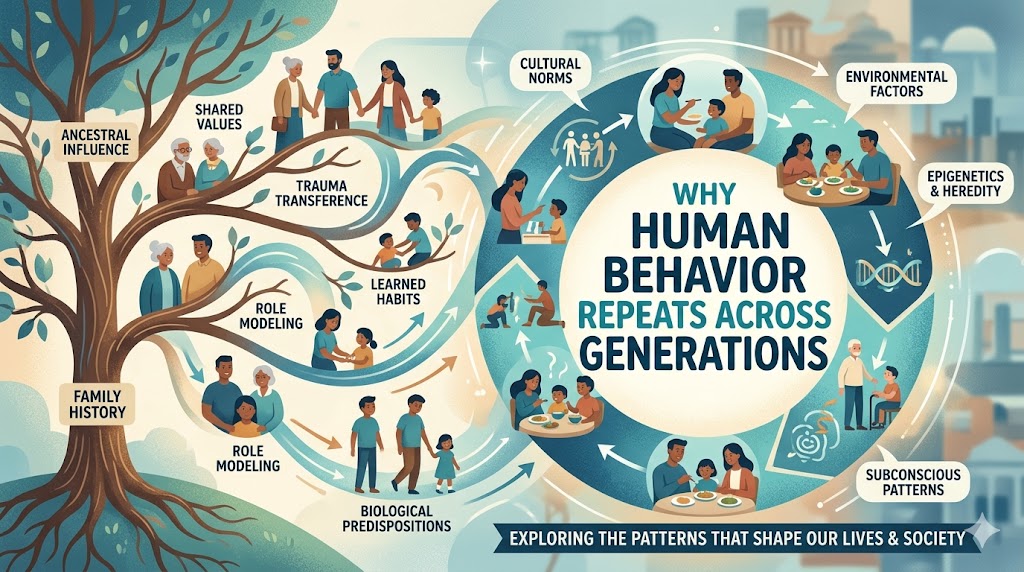
Why Human Behavior Repeats Across Generations
Human behavior often looks like it evolves from one generation to the next, but when you observe closely over long periods, something surprising becomes clear. The surface changes, technology changes, culture shifts, language evolves, yet the core patterns of how humans think, react, desire, fear, and make decisions remain strikingly consistent. This is why the same mistakes, the same ambitions, the same conflicts, and the same cycles of success and failure appear again and again across families, communities, and entire societies. What changes is not the engine of human behavior but the environment around it.
At the center of this repetition is the way human beings learn. Most behavior is not consciously designed. It is absorbed. Children grow up watching how adults around them handle money, relationships, conflict, discipline, opportunity, and responsibility. Without being explicitly taught, they begin to normalize what they see. If a child grows up in a household where financial stress is constant and money is always discussed in terms of scarcity, that mindset becomes their internal reference point. Even if they later earn more, they often carry the same emotional relationship with money into adulthood. This is how patterns quietly move from one generation to another without needing formal instruction.
Another powerful reason behavior repeats is that humans rely heavily on emotional memory rather than logical correction. People may intellectually understand that a behavior is harmful, but emotionally they still respond in the way they were conditioned. For example, someone who grew up in an environment where love was conditional may unconsciously repeat the same relational dynamics, choosing partners or responding in ways that recreate familiar emotional territory. The brain tends to prefer familiarity over uncertainty, even when familiarity is not beneficial. This preference makes repetition more likely than transformation.
Economic behavior also tends to repeat across generations because of learned limitations. People do not only inherit money or lack of money, they inherit beliefs about money. A family that believes wealth is for “other people” unconsciously passes down a psychological ceiling. Even when opportunities become available, those opportunities are filtered through inherited beliefs. This is why two people in the same environment can respond completely differently to the same chance. One sees possibility, the other sees risk or impossibility, not because of intelligence but because of inherited perception.
Social environment reinforces this repetition even further. Communities tend to stabilize behavior through collective reinforcement. If a certain way of thinking or acting is dominant in a group, individuals who deviate from it often feel social pressure to conform. Over time, this creates a loop where behavior is not just inherited from family but reinforced by peers, institutions, and cultural expectations. Even when individuals try to break away, the surrounding environment often pulls them back into familiar patterns.
Technology and modern progress give the illusion that human behavior is changing faster than it actually is. While tools evolve rapidly, the way humans use them often reflects ancient instincts. Social media, for example, amplifies the same desires that have always existed: validation, comparison, status, belonging, and attention. The platform changes, but the underlying psychology does not. This is why similar behavioral outcomes appear across different generations using different technologies. The medium changes, but the motivation remains constant.
Fear is another strong force behind behavioral repetition. Humans are wired to avoid uncertainty and potential loss. This leads people to choose familiar paths even when better options exist. Parents who experienced financial instability may discourage their children from taking risks, not because risk is inherently bad, but because their emotional memory associates risk with danger. These fears are often passed down indirectly through cautionary advice, tone, and emotional expression rather than explicit instruction. Over time, entire generations can inherit not just habits but risk tolerance levels.
Education alone is not always enough to break these cycles because knowledge does not automatically override conditioning. A person may learn new principles in school or through experience, but when under stress or pressure, they often revert to deeply ingrained behavioral patterns. Stress reduces deliberate thinking and increases instinctive responses. This is why people who are trying to change often find themselves repeating the same behaviors during difficult moments. The deeper the emotional imprint, the harder it is to override with logic alone.
Another layer of repetition comes from identity formation. People tend to act in ways that align with who they believe they are. If someone grows up seeing themselves as “not good with money,” “not academic,” or “not entrepreneurial,” they unconsciously make decisions that reinforce that identity. Even when external opportunities suggest otherwise, internal identity acts like a filter that shapes behavior. This is one of the most powerful mechanisms behind generational repetition, because identity is often inherited before it is questioned.
Time pressure also plays a role in keeping behaviors unchanged. Real transformation requires reflection, experimentation, and discomfort. However, many people are focused on immediate survival, which leaves little room for long-term behavioral restructuring. When individuals are constantly reacting to daily pressures, they rarely step back to analyze why they behave the way they do. Without reflection, repetition becomes default.
Interestingly, repetition is not always negative. Some behavioral patterns persist across generations because they are effective. Discipline, resilience, cooperation, and persistence are also passed down, and they can create long-term stability and success. The problem is not repetition itself, but unconscious repetition. When behavior is repeated without awareness, both positive and negative patterns are transmitted without evaluation.
One of the most overlooked aspects of generational behavior is how deeply environment shapes perception of possibility. People do not only inherit actions, they inherit imagination limits. If no one in a person’s environment has ever built something, traveled far, or achieved a certain level of success, those outcomes may feel abstract or unrealistic. This does not mean people lack ambition, but their ambition is often shaped by what they have seen as achievable. Exposure becomes one of the strongest forces that can either expand or restrict generational behavior patterns.
Breaking generational repetition requires more than intention. It requires interruption of automatic thinking. This happens when individuals begin to observe their own behavior instead of reacting unconsciously. Self-awareness creates a gap between stimulus and response, and within that gap lies the possibility of change. Without awareness, behavior flows like a river following its natural path. With awareness, the direction can be questioned and redirected.
However, awareness alone is not sufficient. New environments are often necessary to sustain new behavior. When someone tries to change while remaining in the same environment that reinforced old patterns, the pressure to revert is extremely strong. Environment acts like gravity on behavior. Changing surroundings, influences, and inputs can significantly increase the likelihood of breaking inherited cycles.
Ultimately, the repetition of human behavior across generations is not a mystery but a reflection of how humans are built. We are learning systems shaped by observation, emotion, environment, and identity. What we call “tradition” in some cases is simply repeated behavior that was never questioned deeply enough to be rewritten. The cycle continues not because people lack intelligence, but because awareness is unevenly distributed.
When individuals begin to recognize these patterns, they gain a rare advantage. They are no longer simply participants in inherited systems, but observers of those systems. From that position, change becomes possible. Not immediate, not effortless, but possible. And once change becomes possible in one generation, the repetition is no longer guaranteed.

EarnSmartOnline.com.ng is dedicated to helping readers make smarter financial decisions through practical guides on online income, personal finance, technology, digital business, and wealth creation. Our goal is to provide reliable, easy-to-understand, and actionable content that empowers individuals to earn smarter, build sustainable income streams and achieve long-term financial success.
Recommended: Start Earning Online
- Ultimate Affiliate Marketing Program — learn affiliate marketing with a done-for-you sales system ($15). Check it out
- The Newbie Affiliate Guide — the beginner-friendly starter guide (~$6.68). Check it out
- Easy Dollar Maker — earn in dollars uploading AI images and videos from your phone ($17). Check it out
Disclosure: These are affiliate links. If you buy through them, I may earn a commission at no extra cost to you.



