
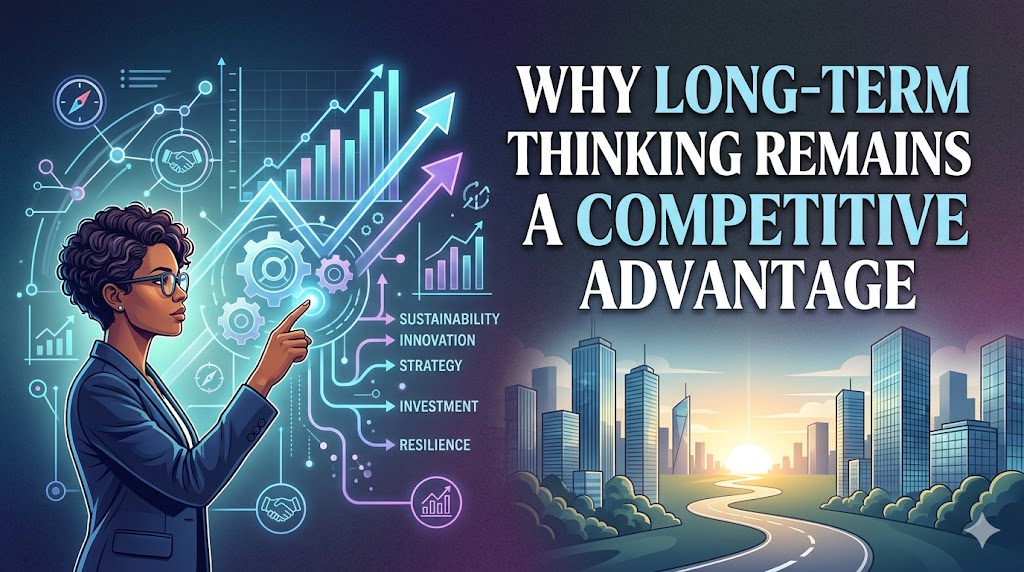
Why Long-Term Thinking Remains a Competitive Advantage
Most people underestimate how much their thinking horizon determines their outcomes in life. In reality, the gap between those who think in weeks and those who think in years is often wider than the gap between skill levels, education, or even starting resources. Long-term thinking is not just a personality trait or a motivational idea, it is a competitive advantage that shapes decisions, filters distractions, and compounds results over time. In a world increasingly driven by speed, instant gratification, and short attention spans, the ability to think long-term has become rarer and therefore more valuable.
At its core, long-term thinking is the ability to prioritize future outcomes over immediate comfort. It requires a person to consistently choose actions that may feel unrewarding today but produce significantly greater results later. This mindset affects how people save money, build careers, develop relationships, and even manage their health. While short-term thinkers focus on what they can get now, long-term thinkers focus on what they can build. That difference alone creates two completely different life trajectories.
One of the clearest ways to understand this advantage is through the principle of compounding. Compounding is not only financial, it applies to skills, habits, knowledge, and reputation. A person who practices a skill daily for years becomes exponentially better than someone who practices only when motivated. A person who saves consistently over time builds financial stability that feels invisible at first but becomes undeniable later. The same principle applies to relationships built on trust, businesses built on consistency, and careers built on continuous learning. Long-term thinking allows people to stay in the game long enough for compounding to work in their favor.
Short-term thinking, on the other hand, interrupts compounding. It constantly resets progress in pursuit of immediate reward. This is why many people work hard for years but see very little improvement in their financial or personal lives. They switch directions too quickly, abandon strategies too early, and prioritize quick wins over meaningful systems. The result is effort without accumulation. They are always starting over while long-term thinkers are quietly building momentum.
Another reason long-term thinking creates an advantage is that it improves decision quality. When people think only about immediate consequences, they are more likely to make emotionally driven decisions. They accept poor deals because they want money quickly. They abandon learning opportunities because progress feels slow. They quit healthy habits because results are not visible fast enough. However, when decisions are evaluated through a long-term lens, emotional pressure reduces and clarity increases. The question changes from “What do I gain today” to “What does this cost or benefit me over time.” That shift alone filters out many destructive choices.
Long-term thinking also builds resilience. Life is naturally unpredictable, and short-term thinkers are easily shaken by setbacks because they expect immediate success. When results do not come quickly, they assume failure and move on. Long-term thinkers interpret setbacks differently. They see them as part of the process rather than a final outcome. This perspective allows them to persist through difficulty, and persistence is often the dividing line between success and failure in any field. Most opportunities are not lost because people lack ability, but because they stop too early.
In economic terms, long-term thinking creates leverage. People who think long-term are more likely to invest in assets that grow over time rather than consume resources immediately. They are more likely to build skills that increase in value rather than chase trends that fade quickly. They are also more likely to focus on systems rather than isolated actions. Systems scale, habits compound, and strategies evolve. This is how small consistent actions eventually outperform large but inconsistent efforts.
Another overlooked advantage of long-term thinking is how it affects reputation. Reputation is one of the most powerful forms of capital in both personal and professional life. However, it cannot be rushed. It is built through repeated behavior over time. Short-term thinkers may gain quick attention, but they often damage trust in the process. Long-term thinkers focus on reliability, consistency, and integrity because they understand that trust accumulates slowly but pays dividends indefinitely. A strong reputation opens doors that money alone cannot.
In career development, long-term thinking separates those who stagnate from those who grow continuously. People who think short-term often optimize for immediate salary or convenience, while long-term thinkers optimize for skill growth and positioning. They choose roles that may not pay the most today but offer learning, exposure, and future opportunities. Over time, this leads to a significant gap in capability and earning potential. Employers and markets reward individuals who become increasingly valuable, not just those who seek immediate compensation.
Long-term thinking also plays a major role in entrepreneurship. Businesses that succeed are rarely those that focus only on quick profits. Sustainable businesses invest in customer relationships, brand trust, and product improvement over time. They prioritize retention over acquisition hype and stability over rapid expansion. Many businesses fail not because they lack initial traction, but because they are built on short-term extraction rather than long-term value creation. Entrepreneurs who think long-term build foundations strong enough to survive market changes.
In personal life, long-term thinking shapes health outcomes, relationships, and emotional stability. People who prioritize immediate pleasure often neglect habits that protect their future well-being. Over time, these small neglects accumulate into larger problems. On the other hand, individuals who think long-term are more likely to exercise consistently, manage stress better, and make choices that preserve their future quality of life. The same applies to relationships, where patience, communication, and commitment build deeper connections than impulsive decisions ever can.
One of the strongest aspects of long-term thinking is that it reduces competition. Most people are competing for short-term rewards, attention, and validation. That space is crowded and highly competitive. However, fewer people are willing to invest in long-term growth because it requires patience and delayed gratification. This means that those who do think long-term often operate in less crowded environments, where their efforts stand out more and face less resistance.
Another important dimension is that long-term thinking improves emotional stability. Short-term thinkers often experience cycles of excitement and frustration because they expect rapid outcomes. When things go well, they feel high motivation. When results slow down, they feel disappointment. Long-term thinkers develop emotional consistency because they are not dependent on immediate outcomes. They are focused on trajectory rather than temporary fluctuations. This emotional balance helps them make better decisions under pressure.
In a rapidly changing world, long-term thinking also provides adaptability. While short-term thinkers chase current trends, long-term thinkers focus on underlying principles that remain stable over time. This allows them to adjust strategies without losing direction. They are not tied to one outcome or one method. Instead, they are guided by a broader vision that can survive change. This flexibility ensures they remain relevant even when external conditions shift.
Ultimately, long-term thinking is a form of self-control applied to time. It is the ability to delay gratification not just for minutes or days, but for years. It is understanding that most valuable things in life take time to build and that shortcuts often lead to collapse. It is choosing to plant seeds instead of searching for instant fruit. And over time, those seeds grow into systems, skills, and opportunities that short-term thinking can never access.
The real advantage of long-term thinking is not just better results, but better positioning. It places a person ahead of trends, ahead of reactions, and ahead of most competition. While others are constantly resetting, long-term thinkers are compounding. While others are chasing immediate reward, long-term thinkers are building future control. And while others are focused on survival, long-term thinkers are quietly constructing advantage after advantage until success becomes a natural outcome rather than a forced effort.

EarnSmartOnline.com.ng is dedicated to helping readers make smarter financial decisions through practical guides on online income, personal finance, technology, digital business, and wealth creation. Our goal is to provide reliable, easy-to-understand, and actionable content that empowers individuals to earn smarter, build sustainable income streams and achieve long-term financial success.
Recommended: Start Earning Online
- Ultimate Affiliate Marketing Program — learn affiliate marketing with a done-for-you sales system ($15). Check it out
- The Newbie Affiliate Guide — the beginner-friendly starter guide (~$6.68). Check it out
- Easy Dollar Maker — earn in dollars uploading AI images and videos from your phone ($17). Check it out
Disclosure: These are affiliate links. If you buy through them, I may earn a commission at no extra cost to you.



