
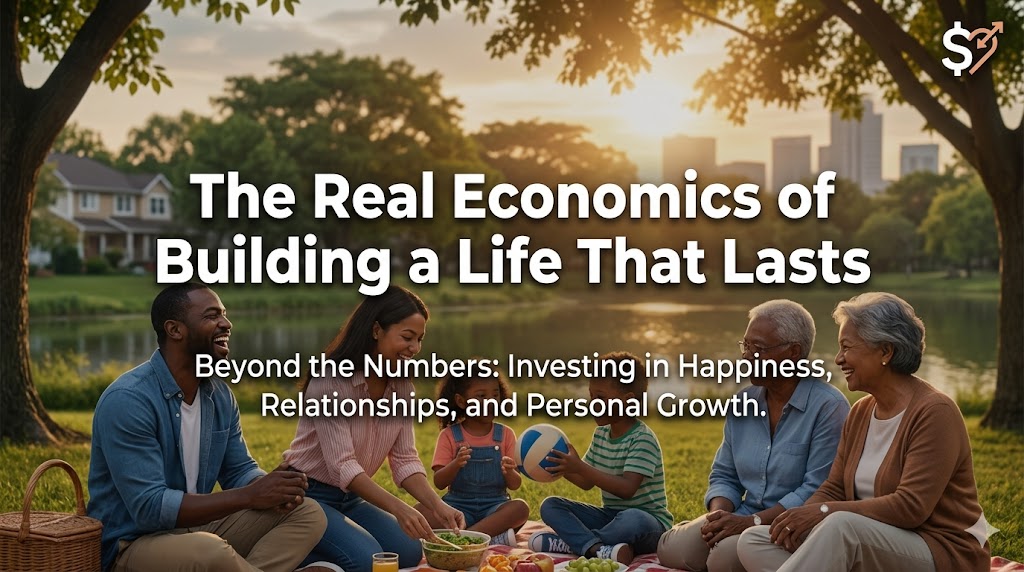
The Real Economics of Building a Life That Lasts
Building a life that lasts is often discussed as a matter of ambition, discipline, or even luck, but underneath all of that sits something far more practical and less emotional. It is economics. Not just money economics, but the deeper logic of how time, attention, decisions, relationships, skills, and resources compound or collapse over time. The real economics of building a life that lasts is about understanding that every choice has a cost, every habit has a return, and every season of neglect eventually shows up as a bill you must pay later, often with interest you did not expect.
Most people misunderstand life planning because they think in moments instead of systems. They focus on what feels good now rather than what continues to produce value later. But life does not reward intensity in short bursts as much as it rewards consistency over long periods. This is where the idea of compounding becomes important. Compounding is not only a financial principle. It is how relationships deepen, how skills mature, how health either improves or deteriorates, and how reputation quietly grows or decays. A life that lasts is built by small actions that seem insignificant in the moment but become powerful when repeated over years.
One of the most overlooked truths in this economic framework is opportunity cost. Every decision you make removes another possible path. When time is spent on distractions, it is not just time that is lost, but also the future value that time could have created if invested differently. Many people do not feel this loss immediately, which is why it is often ignored. But over time, the difference between intentional living and reactive living becomes enormous. A life that lasts is built by people who understand that saying yes to one thing is always saying no to something else, even if that trade is invisible in the moment.
Another major pillar is the idea of skill accumulation. Skills are the currency of long term survival and growth. Unlike money, which can be lost or gained quickly, skills tend to accumulate and open new doors over time. However, not all skills are equal. Some skills are tied to temporary trends, while others remain relevant across decades. The real economic advantage comes from building skills that either solve persistent human problems or improve your ability to adapt. Over time, skill accumulation reduces dependency on luck and increases control over outcomes, which is essential for stability in life.
Relationships also function as a form of long term economic infrastructure. People often underestimate how much their network shapes their access to opportunities, information, emotional stability, and even motivation. A life that lasts is rarely built in isolation. Instead, it is supported by a web of trust, reciprocity, and shared history. However, relationships also require maintenance, and neglect has a cost. Just like financial assets, relationships can depreciate if not nurtured. The economics of relationships is simple but often ignored. What you invest in people tends to return over time, but what you ignore eventually withdraws value from your life.
Time allocation is another critical factor. Time is the only truly non renewable resource, and how it is distributed determines the shape of an entire life. People often think they lack time, but in reality, they misallocate it. Small fragments of wasted time do not feel significant, yet they accumulate into years of lost potential. On the other hand, consistent use of time for learning, building, and reflecting creates exponential outcomes. A life that lasts is built by people who treat time as capital rather than as something to be filled casually.
Financial decisions are part of this broader system, but they are not the entire picture. Money is simply a storage system for value created through time, skill, and decisions. The real economic mistake many people make is believing that earning more money alone will fix structural problems in their life. Without discipline, planning, and awareness, higher income often leads to higher consumption rather than higher stability. True financial strength is not about how much you earn, but how effectively your money extends your freedom and reduces future pressure.
Health is another hidden economic layer that often gets ignored until it becomes expensive to fix. Every habit related to sleep, diet, movement, and stress management either contributes to long term vitality or slowly increases future cost. Poor health reduces productivity, limits opportunities, and increases dependency. In economic terms, it is one of the most expensive forms of neglect because the cost is delayed but inevitable. A life that lasts requires treating health as a long term investment rather than a short term comfort trade.
Decision quality is another silent driver of life outcomes. Many people focus on effort, but effort without direction produces limited results. Better decisions reduce unnecessary struggle and increase efficiency across all areas of life. Over time, decision making itself becomes a compound skill. People who consistently improve how they evaluate risks, interpret information, and choose priorities eventually experience smoother life trajectories. In contrast, repeated poor decisions create cycles of correction that consume energy and slow progress.
Another important dimension is adaptability. The world is constantly changing, and systems that fail to adapt eventually become obsolete. This applies not only to businesses or careers but also to individuals. A life that lasts is not rigid. It evolves with new information, shifting environments, and unexpected challenges. Adaptability ensures survival in uncertain conditions and allows individuals to reposition themselves when circumstances change. Without adaptability, even strong foundations can become weaknesses over time.
There is also the economic reality of focus. Attention is limited, and whatever receives consistent attention grows stronger in influence over your life. When attention is scattered, progress becomes shallow across multiple areas. When attention is concentrated, progress becomes deep and meaningful. Focus determines depth, and depth determines resilience. A life that lasts is not built by chasing everything at once but by committing deeply to what matters most and resisting constant distraction.
Reputation plays a longer game than most people realize. It is an accumulated record of behavior that eventually influences how others treat you, what opportunities you receive, and how much trust is extended toward you. Reputation is slow to build but extremely difficult to repair once damaged. In economic terms, it acts like a silent credit system that operates in the background of every interaction. A life that lasts is supported by a reputation that opens doors rather than closes them.
Ultimately, the real economics of building a life that lasts comes down to one principle. Value creation over time. Everything that grows sustainably in life is built on the ability to create value consistently across different dimensions. Whether it is through skills, relationships, health, decisions, or discipline, the common factor is contribution that compounds rather than consumption that fades. When a person shifts from short term thinking to long term value creation, their entire life structure begins to stabilize. Over time, this stability becomes the foundation for freedom, resilience, and meaning.

EarnSmartOnline.com.ng is dedicated to helping readers make smarter financial decisions through practical guides on online income, personal finance, technology, digital business, and wealth creation. Our goal is to provide reliable, easy-to-understand, and actionable content that empowers individuals to earn smarter, build sustainable income streams and achieve long-term financial success.
Recommended: Start Earning Online
- Ultimate Affiliate Marketing Program — learn affiliate marketing with a done-for-you sales system ($15). Check it out
- The Newbie Affiliate Guide — the beginner-friendly starter guide (~$6.68). Check it out
- Easy Dollar Maker — earn in dollars uploading AI images and videos from your phone ($17). Check it out
Disclosure: These are affiliate links. If you buy through them, I may earn a commission at no extra cost to you.



