
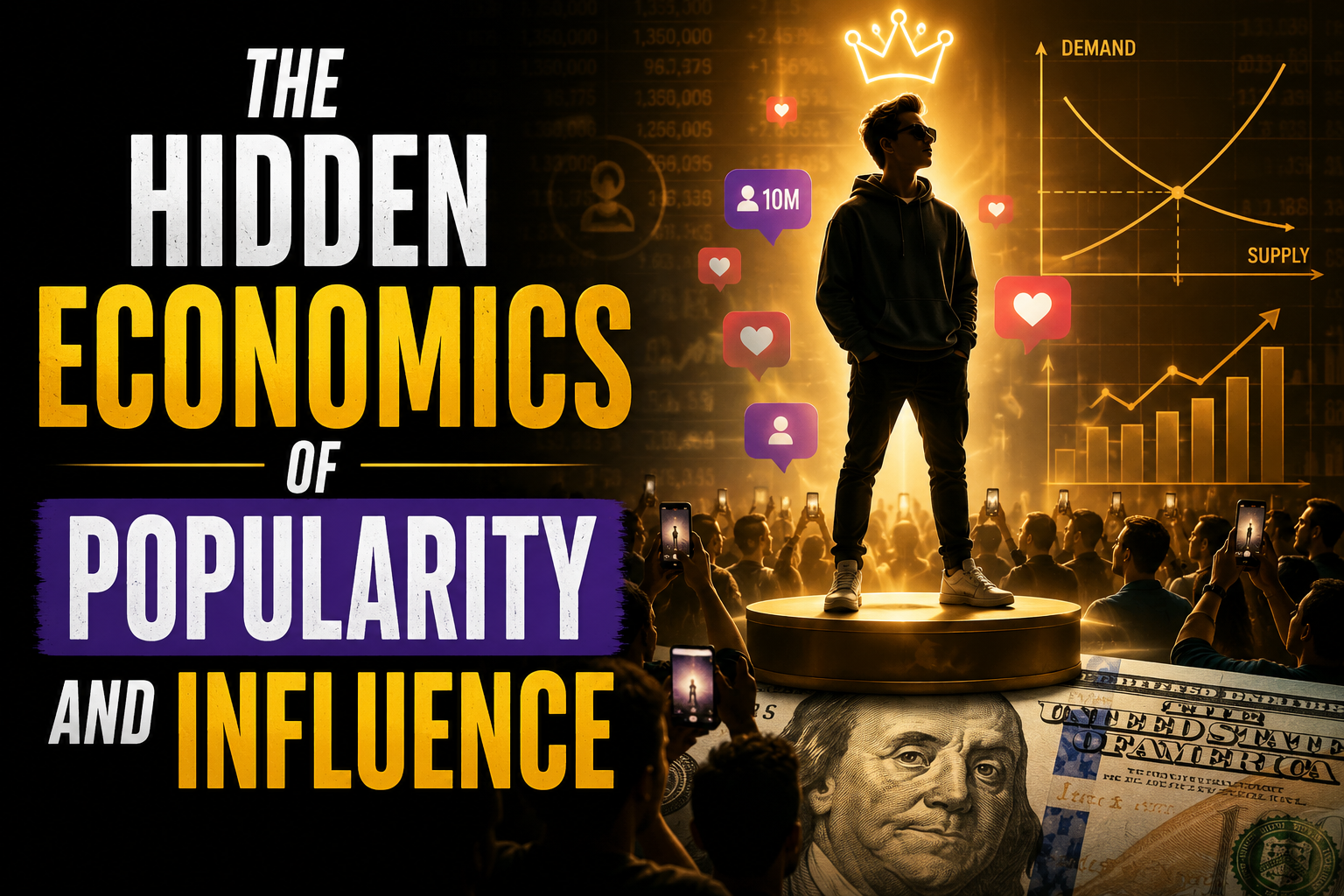
The Hidden Economics of Popularity and Influence
Popularity looks like noise on the surface, but underneath it is a very structured economic system that quietly decides who gets attention, who gets paid, and who gets ignored. Most people assume influence is about talent, beauty, confidence, or luck, but those are only surface ingredients. The deeper reality is that popularity behaves like a marketplace where attention is the currency, trust is the exchange rate, and consistency is the supply chain. Once you understand this, you stop seeing influence as random and start seeing it as predictable behavior patterns shaped by human psychology and scarcity.
Attention is the first layer of this hidden economy. Human beings do not distribute attention evenly. They concentrate it where emotional triggers are strongest. This is why entertainment spreads faster than education, and why conflict travels faster than peace. Attention flows toward novelty, certainty reduction, emotional contrast, and social proof. Anything that creates a strong internal reaction tends to capture attention, and whoever consistently captures attention becomes economically valuable. This is not about being loud, it is about being noticeable in a crowded mental environment where everyone is competing for limited cognitive space.
But attention alone is unstable. It is like income without savings. It comes fast and disappears just as quickly. This is where trust enters the system. Trust is what converts temporary attention into lasting influence. People do not follow what they see once, they follow what they believe will remain consistent over time. Trust is built through repetition, predictability, and alignment between words and behavior. When trust is high, influence becomes cheaper to maintain because less effort is required to regain attention. When trust is low, every new interaction feels like starting from zero.
Influence also depends heavily on perceived value. Value in this economy is not always about usefulness in a traditional sense. It is about relevance to the emotional or practical needs of an audience. A person becomes influential when others believe that paying attention to them produces a benefit, whether that benefit is knowledge, entertainment, inspiration, identity reinforcement, or social validation. In many cases, influence grows not because someone is objectively better, but because they are consistently positioned as more relevant.
Scarcity plays a major role in shaping popularity. Humans are wired to assign higher value to things that feel limited. When attention appears rare or difficult to access, it becomes more desirable. This is why overexposure can reduce influence, while controlled visibility can increase it. People often misinterpret silence or distance as depth or importance, which artificially increases perceived value. Influence grows when access is managed in a way that maintains curiosity without satisfying it too quickly.
Another hidden driver is social proof. Humans are deeply influenced by what they believe others are paying attention to. Popularity often feeds on itself because visibility creates more visibility. Once a certain threshold is reached, influence begins to grow exponentially rather than linearly. This is why early momentum is more important than perfection. Once people see that others are paying attention, they assume there must be value present, even before evaluating it directly.
Networks are also part of this economic system. Influence does not exist in isolation. It is distributed through connections. A person is often as influential as the network they are embedded in. Being connected to other influential nodes increases perceived authority, even if personal output remains unchanged. This is why association can sometimes outperform individual effort in shaping public perception. In many cases, influence is transferred rather than created from scratch.
There is also a psychological cost attached to popularity that most people ignore. Attention creates pressure to maintain identity consistency in front of others. The more visible a person becomes, the more their behavior is constrained by expectations. This is why some individuals struggle after gaining sudden influence. They are no longer just acting freely, they are managing perception. Influence therefore becomes both an asset and a responsibility, with tradeoffs that increase as visibility expands.
The speed of information distribution has also reshaped this economy. In earlier systems, influence was slow and localized. Today, it is global and instant. A single piece of content can shift perception across thousands or millions of people in a short time. This increases both opportunity and volatility. Influence can rise quickly but also decay quickly if it is not reinforced. Stability in this environment depends on continuous relevance rather than one time success.
Another important element is identity alignment. People do not just follow ideas, they follow identities they want to associate with. Influence grows when an individual or brand becomes a symbol of something larger than themselves. This could be ambition, rebellion, intelligence, simplicity, or success. Once someone becomes a representation of a desired identity, people begin to engage with them not just for content, but for self reflection. This deepens emotional attachment and increases loyalty.
Consistency is one of the most underestimated forces in this system. Many people assume virality is the key to influence, but virality without consistency is temporary. Consistency builds familiarity, and familiarity builds trust. Over time, repeated exposure reduces resistance and increases acceptance. This is why individuals who show up regularly often outperform those who occasionally go viral but disappear afterward. The market rewards reliability more than intensity.
Timing also shapes influence more than people realize. The same idea can fail in one moment and succeed in another depending on cultural readiness. Influence depends on alignment with current emotional, economic, or social conditions. This means success is not only about what is said, but when it is said. Being early can be ignored, and being late can be irrelevant. The optimal position is often slightly ahead of awareness but close enough to be understood.
Emotional resonance is another key factor. People are more likely to share and engage with content that reflects their internal state. This is why emotional storytelling often outperforms factual presentation. Influence spreads when people feel understood. When something expresses what others are thinking but cannot articulate, it becomes powerful. This creates a psychological bond that strengthens engagement.
At the core of all this is human behavior predictability. While individuals believe they are unique in their decisions, large groups behave in highly predictable patterns. This is what makes popularity an economic system rather than a mystery. Once these patterns are understood, influence becomes less about guessing and more about positioning. It becomes about aligning with existing psychological flows rather than resisting them.
Ultimately, the hidden economics of popularity and influence is not about becoming famous for its own sake. It is about understanding how attention moves, how trust accumulates, and how perception is shaped. Those who understand this system can navigate it intentionally instead of accidentally. They can build influence that lasts longer, spreads further, and creates more value. In a world where attention is limited and competition is constant, understanding this economy becomes a form of advantage that quietly determines who is seen, who is heard, and who is remembered.

EarnSmartOnline.com.ng is dedicated to helping readers make smarter financial decisions through practical guides on online income, personal finance, technology, digital business, and wealth creation. Our goal is to provide reliable, easy-to-understand, and actionable content that empowers individuals to earn smarter, build sustainable income streams and achieve long-term financial success.
Recommended: Start Earning Online
- Ultimate Affiliate Marketing Program — learn affiliate marketing with a done-for-you sales system ($15). Check it out
- The Newbie Affiliate Guide — the beginner-friendly starter guide (~$6.68). Check it out
- Easy Dollar Maker — earn in dollars uploading AI images and videos from your phone ($17). Check it out
Disclosure: These are affiliate links. If you buy through them, I may earn a commission at no extra cost to you.



