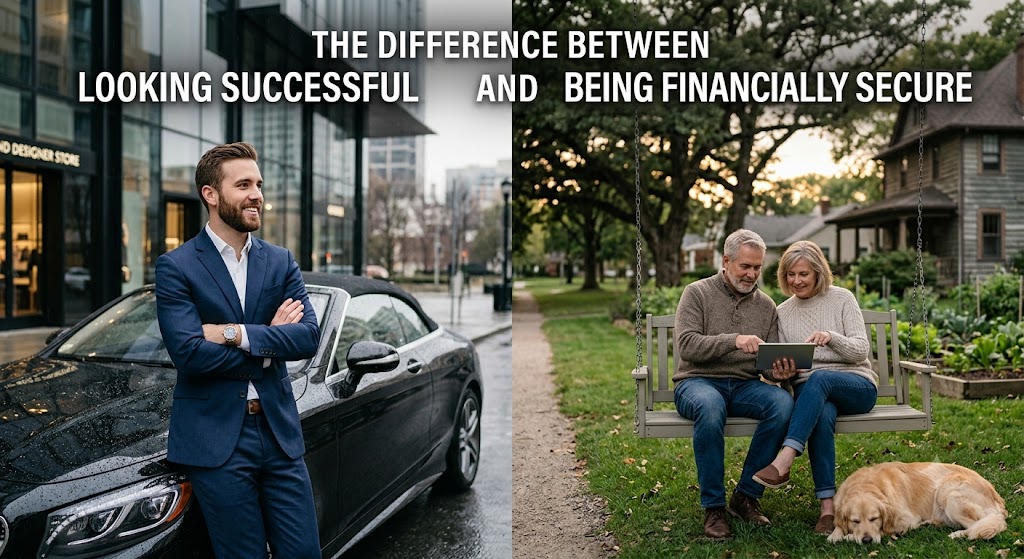
The Difference Between Looking Successful and Being Financially Secure
The Difference Between Looking Successful and Being Financially Secure is one of the most important conversations anyone can have in today’s world. Everywhere you look, people are surrounded by images of expensive cars, luxury holidays, designer clothes, beautiful houses, premium gadgets, and lifestyles that seem to represent success. Social media has made it easier than ever to create an attractive image that suggests wealth, influence, and achievement. Unfortunately, what many people see online or even in real life is often only the surface. Behind many impressive lifestyles are enormous debts, financial stress, unpaid bills, sleepless nights, and constant pressure to maintain appearances. At the same time, many people who are genuinely wealthy and financially secure live surprisingly ordinary lives, choosing peace over attention and long-term stability over temporary admiration.
The Difference Between Looking Successful and Being Financially Secure becomes obvious once you stop judging financial success by appearance alone. Looking successful is largely about perception. It is about what people believe they see. Financial security, however, is about reality. It is about having enough resources to meet your present needs, prepare for future uncertainties, and enjoy life without living in constant fear of financial disaster. One depends heavily on other people’s opinions, while the other depends on personal financial discipline and sound decision-making.
Many people spend years chasing appearances because society often rewards visible success more quickly than invisible financial wisdom. Someone driving a luxury vehicle immediately attracts attention. Someone quietly investing a portion of every income does not. Someone wearing expensive watches may receive admiration. Someone building an emergency fund rarely receives applause. Yet when unexpected hardship arrives, it is usually the invisible habits that determine who survives comfortably and who struggles desperately.
One of the biggest financial mistakes people make is confusing income with wealth. A person earning a very high salary may appear successful because of expensive purchases, but if nearly every pound, dollar, or naira earned is immediately spent, that person remains financially vulnerable. Another individual earning a much smaller income but consistently saving, investing, and avoiding unnecessary debt may enjoy far greater financial security over time. Wealth is not measured by how much money passes through your hands. Wealth is measured by how much you keep, grow, and protect.
The modern economy makes it dangerously easy to look richer than you really are. Credit cards, buy now pay later services, personal loans, vehicle financing, mortgages, and flexible payment plans allow people to acquire expensive possessions long before they can truly afford them. While responsible borrowing certainly has its place, many individuals use debt simply to impress others. The result is a lifestyle built on future income rather than current financial strength.
There is nothing inherently wrong with enjoying beautiful things. The problem begins when luxury becomes a performance rather than a reward. When purchases are made primarily to gain approval, impress strangers, or compete with friends, financial decisions become emotional instead of logical. Emotional spending often creates financial problems that last far longer than the excitement of the purchase itself.
Social media has dramatically increased the pressure to look successful. Every day millions of carefully edited photographs and videos showcase luxurious lifestyles, expensive meals, international travel, designer fashion, and seemingly effortless wealth. What most viewers forget is that social media rarely tells the complete story. It does not reveal outstanding loans, credit card balances, financial anxiety, relationship problems caused by money, or the years of sacrifices behind genuine success. Instead, it presents carefully selected highlights that create unrealistic expectations.
The Difference Between Looking Successful and Being Financially Secure becomes even clearer when emergencies occur. A financially secure person may lose a job yet continue paying bills comfortably because savings, investments, or multiple income streams provide protection. Someone who only looks successful may experience immediate financial panic because every monthly payment depends entirely on the next pay cheque. Financial security is not tested during times of abundance. It reveals itself during times of uncertainty.
One powerful indicator of financial security is the presence of an emergency fund. Unexpected expenses are not unusual events. Cars break down. Medical emergencies occur. Businesses experience slow periods. Jobs disappear. Family responsibilities increase. Financially secure individuals expect these possibilities and prepare for them. Those focused solely on appearances often spend every available penny on maintaining a lifestyle, leaving nothing available when life becomes unpredictable.
Another significant difference lies in spending habits. People focused on looking successful often upgrade constantly. They replace perfectly functional phones with newer models every year. They purchase fashionable clothes simply because trends change. They move into larger houses before they truly need the additional space. They dine at expensive restaurants regularly to maintain a particular image. Every decision is influenced by visibility.
Financially secure individuals think differently. They ask whether a purchase creates genuine value rather than admiration. They understand the difference between needs and wants. They delay gratification because they recognise that every unnecessary expense represents money that could have been invested or saved for future opportunities.
The ability to delay gratification has been identified repeatedly as one of the strongest predictors of long-term financial success. It is easy to spend money immediately. It requires discipline to save, invest, and wait patiently for future rewards. Financial security is rarely built through dramatic events. Instead, it grows through thousands of consistent, often unnoticed decisions repeated over many years.
The Difference Between Looking Successful and Being Financially Secure also appears in attitudes towards debt. Those chasing appearances frequently view debt as a shortcut to luxury. They believe future earnings will solve today’s borrowing. Unfortunately, life rarely follows perfect financial plans. Job losses, inflation, economic downturns, health issues, or changing family circumstances can quickly transform manageable debt into overwhelming financial pressure.
Financially secure people approach debt carefully. They understand that borrowing should ideally create future value rather than finance temporary pleasure. They are more likely to borrow for productive investments, education, business expansion, or property that appreciates over time rather than constantly financing depreciating lifestyle purchases.
True financial security is closely connected to freedom. A financially secure individual has options. They can leave an unhealthy workplace without immediate financial collapse. They can take calculated business risks. They can support family members during difficult times. They can retire with dignity instead of fear. Financial freedom creates choices that appearances alone can never provide.
Many wealthy individuals deliberately avoid displaying excessive luxury. This often surprises people who assume wealth must always be visible. In reality, countless millionaires drive modest vehicles, wear simple clothing, and live below their financial means. Their priority is preserving and growing wealth rather than attracting attention. They understand that every pound, dollar, or naira spent unnecessarily reduces future investment potential.
The psychology behind looking successful is deeply rooted in human behaviour. People naturally desire acceptance, admiration, and social status. Throughout history, visible possessions have often been associated with achievement. Modern advertising intensifies these desires by suggesting happiness, confidence, attractiveness, and respect can all be purchased through products. Companies spend billions encouraging consumers to associate consumption with identity.
Financial security requires resisting many of these psychological influences. It requires recognising that self-worth should never depend on visible possessions. Confidence built on material displays is fragile because it constantly requires additional spending to maintain. Confidence built on genuine financial stability grows stronger over time because it depends on reality rather than appearance.
Another difference concerns long-term thinking. Looking successful often focuses on today’s impression. Financial security focuses on tomorrow’s possibilities. Someone determined to impress others may willingly sacrifice retirement savings, investment opportunities, or business capital simply to maintain an attractive lifestyle today. Someone pursuing financial security willingly sacrifices temporary admiration to create lasting prosperity.
Investment plays an essential role in achieving financial security. Money sitting idle gradually loses purchasing power because of inflation. Financially secure individuals understand the importance of allowing money to generate additional income through investments. Whether through shares, businesses, property, retirement accounts, or other productive assets, investing transforms earned income into long-term wealth.
People obsessed with appearances often overlook investing because investments rarely produce immediate visible rewards. A diversified investment portfolio does not receive compliments from neighbours. Compound interest is invisible during its early years. Yet over decades these quiet financial decisions frequently outperform expensive lifestyles built entirely on consumption.
The Difference Between Looking Successful and Being Financially Secure becomes particularly evident during retirement. Many individuals who spent decades appearing wealthy discover too late that they accumulated very few income-producing assets. Once employment income stops, maintaining appearances becomes impossible. Those who prioritised financial security enjoy retirement supported by investments, savings, pensions, and passive income rather than relying entirely on continued employment.
Family financial habits also reflect this difference. Parents focused primarily on appearances may unintentionally teach children that success is measured by visible possessions. Children grow up believing expensive brands, luxury cars, and fashionable lifestyles define achievement. Parents pursuing financial security teach different lessons. They demonstrate budgeting, saving, investing, generosity, patience, and responsible decision-making. These lessons often become valuable financial inheritance long before any money is transferred.
One overlooked aspect of financial security is peace of mind. Constant financial pressure affects physical health, emotional wellbeing, relationships, and productivity. People living beyond their means frequently experience anxiety every time bills arrive or unexpected expenses appear. Their impressive lifestyle becomes a source of ongoing stress.
Financial security produces a different emotional experience. Knowing that bills can be paid comfortably, emergencies can be handled, and future goals are funded creates confidence that cannot be purchased through luxury goods. Peace becomes one of the greatest returns on wise financial management.
Comparison remains one of the greatest enemies of financial security. It encourages unnecessary spending simply to keep pace with friends, colleagues, neighbours, or strangers online. Yet comparisons are always incomplete because nobody truly knows another person’s financial reality. The person displaying luxury today may secretly be drowning in debt. The modest neighbour quietly investing for decades may possess remarkable wealth.
Financial wisdom begins when people stop competing financially with others and start measuring progress against their own goals. The objective is not to own the biggest house on the street. The objective is to build a life that remains stable regardless of economic uncertainty.
Another common misunderstanding involves business ownership. Many assume every business owner displaying success is financially secure. In reality, businesses may generate substantial revenue while producing very little actual profit. Some entrepreneurs maintain impressive offices, expensive company vehicles, and luxurious lifestyles despite struggling with cash flow. Revenue creates visibility. Profit creates sustainability.
Financial security requires understanding numbers beyond appearances. Net worth matters more than visible possessions. Cash flow matters more than revenue. Assets matter more than liabilities. Financial literacy helps people distinguish between impressive appearances and genuine financial strength.
Many celebrities provide valuable lessons in this area. History contains countless examples of famous athletes, musicians, actors, and entertainers who earned enormous fortunes only to declare bankruptcy later. Their lifestyles suggested limitless wealth, yet poor financial management eventually exposed the difference between high earnings and lasting financial security. Income alone never guarantees wealth. Wise management determines long-term outcomes.
At the same time, countless ordinary people quietly build significant wealth without attracting public attention. Teachers, engineers, nurses, small business owners, civil servants, and skilled professionals consistently investing over several decades often achieve remarkable financial independence despite never appearing extravagantly wealthy. Their success develops slowly, quietly, and sustainably.
The Difference Between Looking Successful and Being Financially Secure also influences career decisions. Someone concerned primarily with appearances may accept higher-paying work that destroys work-life balance simply to maintain expensive commitments. Financially secure individuals often possess greater flexibility to choose meaningful work because they have reduced financial pressure through disciplined planning.
Minimalism has gained popularity partly because many people recognise the emotional burden of excessive consumption. Owning fewer unnecessary possessions often reduces expenses while increasing satisfaction. Financial security frequently grows faster when people intentionally simplify their lifestyles rather than constantly expanding them.
Another essential principle involves understanding opportunity cost. Every financial decision involves choosing one opportunity instead of another. Spending a large amount on luxury fashion may also mean sacrificing investment returns that could have multiplied significantly over time. Purchasing an expensive car may delay business investment, property ownership, or retirement savings. Financially secure people consistently evaluate these trade-offs before spending.
The influence of friends and social circles cannot be ignored. People often adopt the spending habits of those around them. If everyone within a social group constantly upgrades possessions, extravagant spending begins to feel normal. Financial security sometimes requires the courage to make different choices despite social pressure. Saying no to unnecessary expenses often protects future opportunities.
Generosity also reveals an interesting distinction. Individuals genuinely secure financially often give more freely because generosity does not threaten their stability. Those desperately maintaining appearances may appear wealthy while struggling to help others because their finances remain fragile. Real abundance creates capacity for meaningful generosity.
Education remains one of the strongest investments anyone can make. Financial literacy teaches budgeting, investing, taxation, insurance, retirement planning, risk management, and wealth preservation. Unfortunately, many education systems devote little attention to practical money management. As a result, many adults earn substantial incomes without understanding how to convert income into lasting wealth.
Building financial security does not require becoming obsessed with money. Instead, it requires viewing money as a tool rather than a trophy. Money should provide security, opportunity, flexibility, and the ability to create value for others. When money becomes merely a symbol of status, financial decisions often become irrational.
The journey towards financial security begins with honesty. Individuals must accurately assess income, expenses, debts, assets, and financial goals. Pretending financial problems do not exist only delays improvement. Honest evaluation allows realistic planning and measurable progress.
Budgeting remains one of the simplest yet most powerful financial tools available. Contrary to popular belief, budgets do not restrict freedom. They create intentional freedom by ensuring money serves meaningful priorities rather than disappearing through impulsive spending. Every successful financial plan begins with knowing exactly where money goes.
Increasing income certainly helps, but higher earnings alone rarely solve poor financial habits. Many people experience lifestyle inflation whenever income rises. Every salary increase immediately funds larger expenses instead of greater investments. Financial security improves when income grows faster than lifestyle.
Developing multiple income streams further strengthens financial security. Depending entirely on one employer or one source of revenue increases vulnerability. Investments, rental income, dividends, freelance work, digital businesses, royalties, or side businesses create additional financial resilience. These extra streams often become invaluable during economic uncertainty.
Patience remains an underrated financial advantage. Society celebrates rapid success stories, but genuine wealth usually develops gradually. Compound growth rewards consistency more than speed. Small, disciplined investments made regularly over many years frequently outperform dramatic but inconsistent financial efforts.
The Difference Between Looking Successful and Being Financially Secure ultimately reflects two very different philosophies of life. One seeks external validation. The other pursues internal stability. One prioritises admiration today. The other prioritises freedom tomorrow. One depends on appearances. The other depends on substance.
Ironically, many financially secure people eventually enjoy the ability to purchase luxuries without financial strain because they delayed gratification earlier in life. Their wealth supports their lifestyle rather than their lifestyle consuming their wealth. They purchase expensive items because they can genuinely afford them, not because they need others to believe they can.
For anyone seeking lasting prosperity, the goal should never be merely to look rich. The goal should be to build a financial foundation capable of supporting life’s uncertainties, opportunities, responsibilities, and dreams. Expensive possessions may attract temporary attention, but financial security provides something far more valuable. It provides confidence, resilience, flexibility, peace of mind, and the freedom to live according to personal values rather than public expectations.
At the end of the day, neighbours cannot pay your bills. Followers cannot fund your retirement. Likes cannot eliminate debt. Admiration cannot replace an emergency fund. Appearance cannot substitute for investments. The applause of strangers fades quickly, but sound financial decisions continue working quietly for years. That is the true difference between looking successful and being financially secure. One impresses the world for a moment, while the other protects your future for a lifetime.

EarnSmartOnline.com.ng is dedicated to helping readers make smarter financial decisions through practical guides on online income, personal finance, technology, digital business, and wealth creation. Our goal is to provide reliable, easy-to-understand, and actionable content that empowers individuals to earn smarter, build sustainable income streams and achieve long-term financial success.
Recommended: Start Earning Online
- Ultimate Affiliate Marketing Program — learn affiliate marketing with a done-for-you sales system ($15). Check it out
- The Newbie Affiliate Guide — the beginner-friendly starter guide (~$6.68). Check it out
- Easy Dollar Maker — earn in dollars uploading AI images and videos from your phone ($17). Check it out
Disclosure: These are affiliate links. If you buy through them, I may earn a commission at no extra cost to you.