
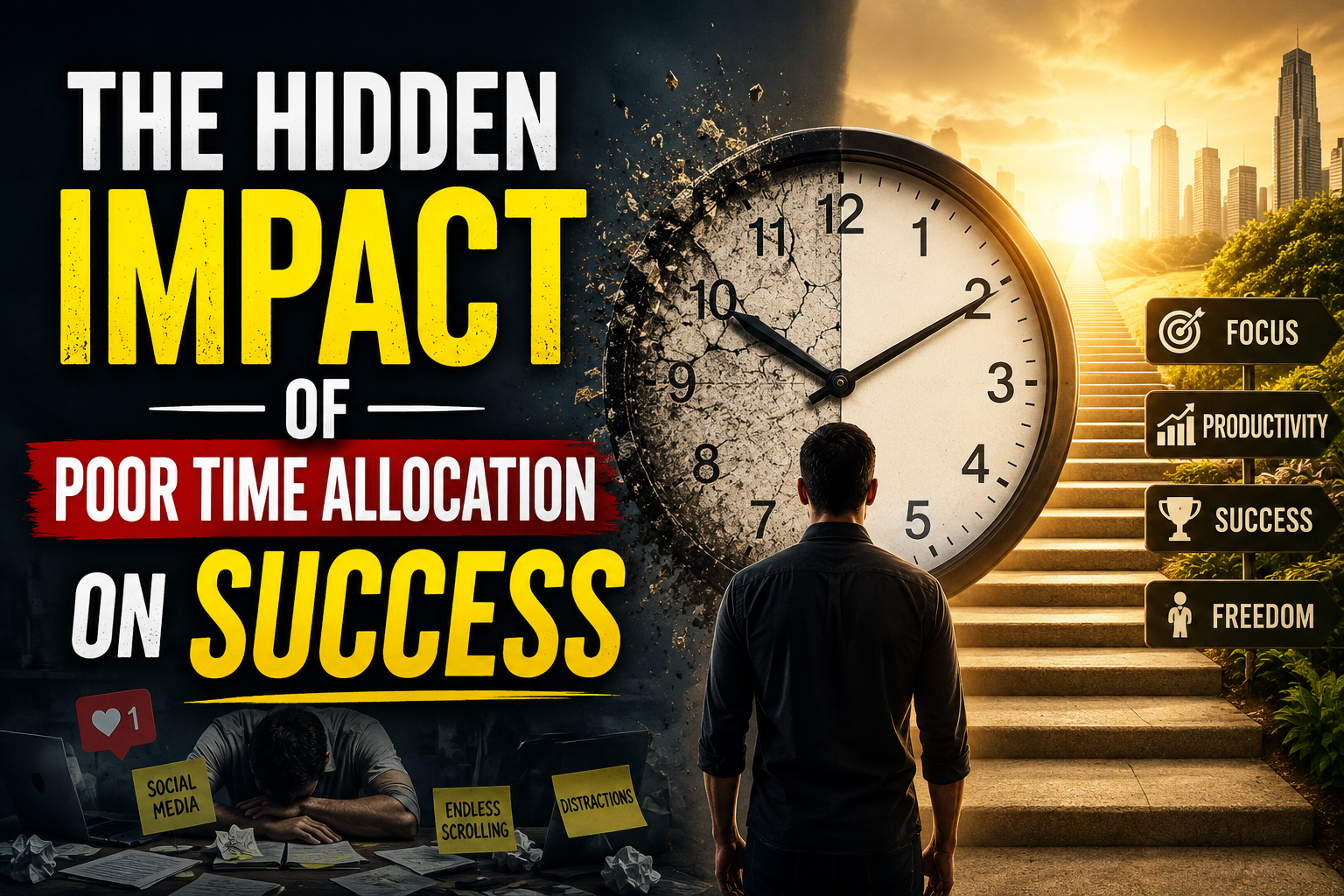
The Hidden Impact of Poor Time Allocation on Success
Time is the one resource every human being receives equally. Rich or poor, educated or uneducated, young or old, everyone gets twenty four hours each day. Yet despite having the same amount of time, people experience vastly different outcomes in life. Some individuals steadily build successful careers, strong relationships, thriving businesses, and financial security, while others struggle year after year without making meaningful progress. One of the biggest reasons for this difference is not intelligence, talent, luck, or even hard work. It is the way people allocate their time.
Poor time allocation is one of the most overlooked obstacles to success. Many people assume that failure happens because they lack opportunities or resources. While these factors can certainly play a role, countless opportunities are often wasted because time is spent on activities that produce little or no value. Success is rarely determined by how busy a person is. Instead, it is determined by how effectively that person invests their limited hours.
One of the hidden dangers of poor time allocation is that its effects are not immediately visible. If someone wastes an hour today, they may not notice any significant consequence. If they spend several hours scrolling through social media, watching unnecessary videos, or engaging in unproductive activities, life may seem unchanged tomorrow. However, when these small habits continue for months and years, the accumulated impact becomes enormous.
Imagine two individuals who each have one extra hour available every day. One spends that hour learning a valuable skill, reading educational material, or building a side business. The other spends that same hour consuming entertainment with no long term benefit. At the end of a single day, the difference between them is almost invisible. At the end of five years, however, the gap may be life changing. One person has gained thousands of hours of growth while the other has gained little beyond temporary amusement.
Poor time allocation often disguises itself as productivity. Many people fill their schedules with activities that make them feel busy without actually moving them closer to their goals. They attend unnecessary meetings, respond to every notification, engage in endless conversations, and constantly switch between tasks. By the end of the day, they feel exhausted, yet they have achieved very little. Being busy and being productive are not the same thing.
Successful people understand that not all hours are equally valuable. Certain activities generate significantly greater returns than others. Learning, planning, creating, networking, exercising, and solving meaningful problems often produce benefits that compound over time. In contrast, excessive entertainment, procrastination, gossip, and distractions provide little lasting value. The ability to distinguish between high value and low value activities is one of the defining characteristics of successful individuals.
Another hidden consequence of poor time allocation is missed opportunities. Opportunities rarely announce themselves with warning signs. They often appear unexpectedly and require preparation. A person who consistently invests time in learning and self improvement is more likely to recognize and seize opportunities when they arise. On the other hand, someone who spends years neglecting personal development may find themselves unprepared when valuable opportunities appear.
This principle applies in nearly every area of life. A professional who dedicates time to developing new skills becomes more competitive in the job market. An entrepreneur who invests time in understanding customers gains an advantage over competitors. A student who consistently studies develops knowledge that opens future doors. In each case, success is not simply the result of effort. It is the result of directing effort toward the right activities.
Poor time allocation also creates stress and frustration. Many people constantly feel overwhelmed because they spend their time reacting rather than planning. They move from one urgent task to another without establishing priorities. As a result, important responsibilities are neglected until they become emergencies. This cycle creates pressure, anxiety, and a sense of losing control.
When time is allocated effectively, life becomes more manageable. Important tasks receive attention before they become urgent. Goals are broken into smaller actions. Progress becomes measurable. Instead of constantly feeling behind, individuals gain a sense of direction and momentum. Effective time management is not about doing more things. It is about doing the right things at the right time.
Financial success is another area heavily influenced by time allocation. Many people focus exclusively on earning money while ignoring how they spend their nonworking hours. Yet some of the most important financial decisions occur outside the workplace. Time spent learning about investing, budgeting, entrepreneurship, and personal finance can produce returns that far exceed the value of temporary entertainment.
The same principle applies to health. Poor time allocation often leads people to neglect exercise, proper sleep, and healthy eating habits. They convince themselves they are too busy to prioritize their well being. Unfortunately, this decision often leads to long term health problems that consume even more time and resources later. Investing time in health today is often one of the most profitable decisions a person can make.
Relationships also suffer when time is poorly allocated. Many individuals unintentionally devote more attention to devices, work, or distractions than to family and friends. Over time, relationships weaken because meaningful connections require consistent investment. Just as financial wealth grows through repeated deposits, strong relationships grow through repeated moments of attention and care.
One reason poor time allocation is so common is that human beings naturally prefer immediate rewards over delayed rewards. Watching a movie provides instant pleasure. Browsing social media offers immediate entertainment. Learning a new skill or building a business often requires effort without immediate results. Because of this psychological tendency, many people repeatedly choose short term satisfaction over long term gain.
The problem is not occasional relaxation. Rest and recreation are important parts of a balanced life. The real issue arises when low value activities consistently consume time that could be invested in growth. Success is often the result of making slightly better choices repeatedly over long periods. Small decisions accumulate just as interest accumulates in a bank account.
Technology has amplified the challenge of time allocation. Modern devices are designed to capture and hold attention. Notifications, endless content feeds, and digital entertainment compete aggressively for every available moment. Without conscious discipline, hours can disappear without producing any meaningful benefit. This makes intentional time management more important than ever before.
People who achieve lasting success tend to understand a simple truth: every yes is also a no. Saying yes to one activity means saying no to another. Spending hours on distractions means sacrificing hours that could have been used for learning, creating, exercising, or building relationships. Every decision carries an opportunity cost, whether it is recognized or not.
Successful individuals are often selective about how they spend their time because they recognize its limited nature. Money lost today can potentially be earned again. Opportunities missed may sometimes return. Time, however, is irreversible. Once an hour has passed, it can never be recovered. This reality makes time the most valuable asset any person possesses.
Poor time allocation often results from a lack of clarity. People who do not know what they want tend to drift toward whatever is easiest or most entertaining. In contrast, people with clear goals find it easier to prioritize activities that support those goals. Clarity acts as a filter that helps separate important tasks from distractions.
The cumulative effect of proper time allocation is extraordinary. A person who consistently invests time in learning, skill development, health, relationships, and meaningful work gradually builds advantages that become difficult to match. These advantages may appear small at first, but they compound over years and decades.
Ultimately, success is not merely a product of talent, intelligence, or luck. It is often the result of thousands of daily decisions regarding where attention and effort are directed. Poor time allocation quietly undermines progress, limits opportunities, creates stress, and prevents growth. Effective time allocation, on the other hand, creates momentum, improves productivity, strengthens relationships, enhances financial outcomes, and increases the likelihood of long term achievement.
Every person has the same twenty four hours, but not everyone uses them in the same way. The difference between success and stagnation often lies not in how much time people have, but in how wisely they choose to invest it. Those who learn to allocate their time intentionally gain a powerful advantage that compounds throughout every aspect of life. Over time, this advantage can become the foundation upon which extraordinary success is built.

EarnSmartOnline.com.ng is dedicated to helping readers make smarter financial decisions through practical guides on online income, personal finance, technology, digital business, and wealth creation. Our goal is to provide reliable, easy-to-understand, and actionable content that empowers individuals to earn smarter, build sustainable income streams and achieve long-term financial success.
Recommended: Start Earning Online
- Ultimate Affiliate Marketing Program — learn affiliate marketing with a done-for-you sales system ($15). Check it out
- The Newbie Affiliate Guide — the beginner-friendly starter guide (~$6.68). Check it out
- Easy Dollar Maker — earn in dollars uploading AI images and videos from your phone ($17). Check it out
Disclosure: These are affiliate links. If you buy through them, I may earn a commission at no extra cost to you.



