
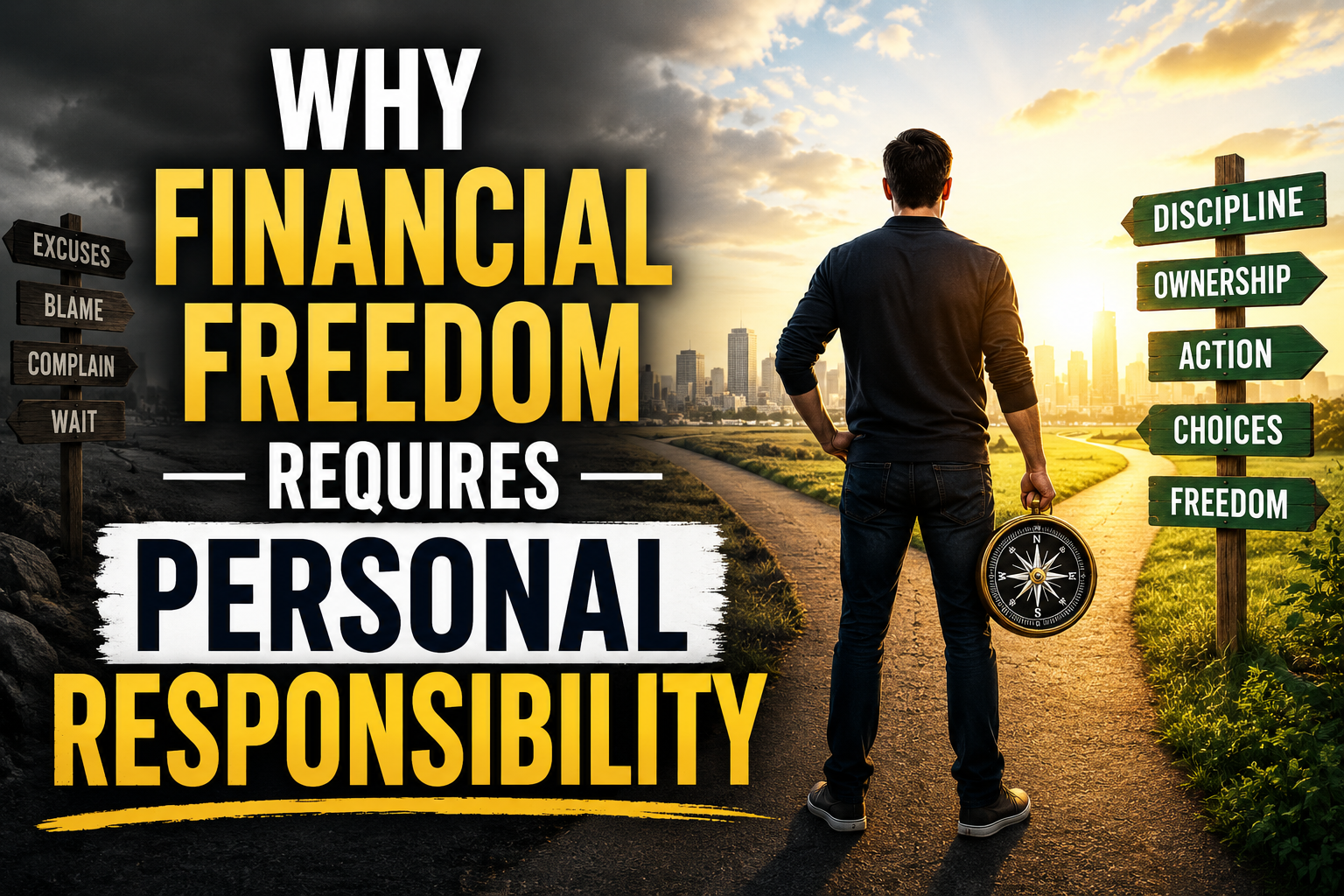
Why Financial Freedom Requires Personal Responsibility
Financial freedom is one of the most discussed goals in modern society, yet it remains one of the least understood in practical terms. Many people associate it with earning more money, winning a lottery, securing a high paying job, or finding a shortcut that eliminates financial stress overnight. However, real financial freedom is not an external event or a sudden breakthrough. It is the result of consistent personal responsibility applied over time. It is the ability to manage money in a way that creates stability today while building security for tomorrow. Without personal responsibility, financial freedom becomes an illusion that people chase but rarely achieve. Why Financial Freedom Requires Personal Responsibility.
At its core, financial freedom is not just about income. It is about behavior. Two individuals can earn the same amount of money and live completely different financial realities. One may build savings, invest, avoid unnecessary debt, and steadily grow wealth. The other may struggle constantly, living paycheck to paycheck despite earning well. The difference is not luck or opportunity but responsibility. Financial freedom begins when a person stops blaming external conditions alone and starts taking ownership of financial decisions, no matter how small they seem.
Personal responsibility in finance means understanding that every financial decision has a consequence. Spending without planning leads to instability. Borrowing without strategy leads to long term pressure. Saving without consistency leads to missed opportunities. Investing without knowledge leads to loss. When individuals accept that their financial outcomes are directly connected to their choices, they begin to shift from a reactive mindset to a proactive one. This shift is where transformation starts, because financial freedom is built on control rather than chance.
One of the clearest examples of personal responsibility in financial life is budgeting. A budget is not just a financial tool; it is a discipline framework. It forces clarity on income, expenses, priorities, and goals. People who avoid budgeting often do so because they prefer financial flexibility without structure, but that flexibility usually leads to chaos. A responsible individual understands that structure does not limit freedom, it creates it. When money is assigned a purpose before it is spent, financial stress reduces significantly, and control increases.
Debt is another area where personal responsibility plays a defining role. In many cases, debt is not inherently bad, but unmanaged debt becomes a barrier to financial independence. Personal responsibility means asking critical questions before taking on obligations: Is this necessary? Can it be repaid comfortably? Does it improve long term financial position or just satisfy a short term desire? Many financial struggles are not caused by low income but by poor debt decisions made repeatedly over time. Financial freedom requires the discipline to delay gratification and avoid financial commitments that compromise future stability.
Saving money also reflects personal responsibility in action. Saving is often misunderstood as what remains after spending, but responsible financial behavior treats saving as a priority, not an afterthought. This mindset shift is powerful. It ensures that future security is not dependent on leftover money, but on intentional allocation. Even small, consistent savings build momentum over time. The discipline of saving teaches patience, planning, and foresight, all of which are essential traits for financial independence.
Beyond saving, investing is where responsibility becomes long term wealth building. However, investing without understanding can be just as harmful as not investing at all. Personal responsibility requires learning before committing money. It involves researching options, understanding risk, and avoiding emotional decisions driven by fear or hype. Many people avoid investing because they fear loss, while others rush in without knowledge and suffer consequences. Financial freedom grows when individuals take responsibility for educating themselves before making financial moves, rather than relying blindly on advice or trends.
Another important dimension of financial responsibility is lifestyle control. As income increases, many people increase their spending at the same rate, or even faster. This pattern is known as lifestyle inflation, and it is one of the silent killers of wealth building. Personal responsibility means resisting the pressure to match external appearances or societal expectations. It means understanding that financial progress is not always visible. Sometimes the most powerful financial growth happens quietly in savings accounts, investments, and reduced liabilities rather than in visible consumption.
Emotional discipline also plays a major role in financial responsibility. Money decisions are often influenced by emotions such as fear, envy, excitement, or insecurity. Impulse spending, panic selling, and unnecessary financial risks are often emotional reactions rather than rational decisions. Financial freedom requires emotional awareness and control. A responsible individual learns to separate feelings from financial decisions. This does not mean eliminating emotions, but managing them in a way that does not compromise long term goals. Why Financial Freedom Requires Personal Responsibility.
Accountability is another key pillar of personal responsibility. Many people struggle financially but rarely evaluate their own habits honestly. It is easier to blame the economy, employers, government policies, or bad luck. While external factors do influence financial situations, long term outcomes are still heavily shaped by individual responses. Accountability means regularly reviewing financial behavior, identifying mistakes, and making adjustments. Without accountability, the same patterns repeat, and financial progress remains stagnant.
Education is also a form of responsibility that is often overlooked. Financial systems are complex, and without basic understanding, individuals are more likely to make costly mistakes. Learning how money works, understanding interest rates, developing budgeting skills, and gaining knowledge about investments are all part of taking responsibility for one’s financial future. Relying entirely on others to manage or explain financial decisions often leads to dependency rather than independence. Financial freedom grows stronger when knowledge replaces confusion.
Ultimately, financial freedom is not a destination reserved for a select few. It is a structured outcome built through consistent responsibility. It requires patience, discipline, and a willingness to delay immediate gratification for long term stability. It is not about how much money a person starts with, but how they manage what they have. Many people assume financial freedom is far away or reserved for high earners, but in reality, it begins with simple daily choices such as how money is spent, saved, and prioritized.
In conclusion, financial freedom cannot exist without personal responsibility because money itself does not create freedom, behavior does. Income provides opportunity, but responsibility determines outcome. Every financial decision either builds stability or reduces it. The path to financial independence is not hidden or overly complex; it is built on consistent habits, honest self evaluation, and disciplined action. When individuals accept full responsibility for their financial lives, they unlock the ability to shape their future rather than be controlled by financial circumstances. That is the true essence of financial freedom.

EarnSmartOnline.com.ng is dedicated to helping readers make smarter financial decisions through practical guides on online income, personal finance, technology, digital business, and wealth creation. Our goal is to provide reliable, easy-to-understand, and actionable content that empowers individuals to earn smarter, build sustainable income streams and achieve long-term financial success.
Recommended: Start Earning Online
- Ultimate Affiliate Marketing Program — learn affiliate marketing with a done-for-you sales system ($15). Check it out
- The Newbie Affiliate Guide — the beginner-friendly starter guide (~$6.68). Check it out
- Easy Dollar Maker — earn in dollars uploading AI images and videos from your phone ($17). Check it out
Disclosure: These are affiliate links. If you buy through them, I may earn a commission at no extra cost to you.



