
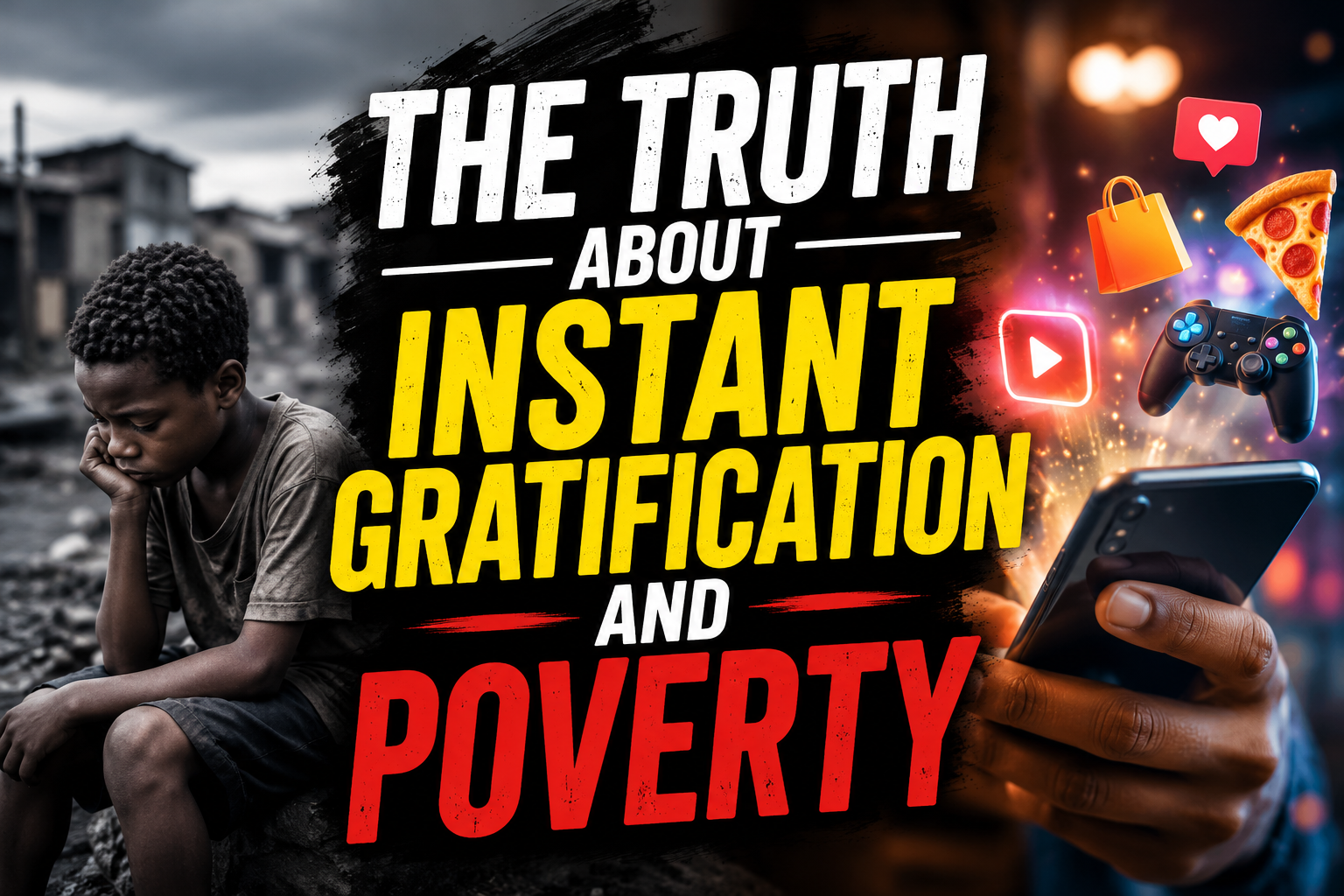
The Truth About Instant Gratification and Poverty
The Truth About Instant Gratification and Poverty is one of the most important financial realities that many people experience daily but rarely understand deeply. In today’s world, especially in developing economies like Nigeria and many parts of Africa, poverty is not always caused by lack of opportunity alone. In many cases, it is fueled by behavior patterns that people repeat unconsciously over time. One of the strongest of these patterns is the addiction to instant gratification. This is the habit of choosing immediate pleasure or satisfaction over long term benefit, even when the long term option is clearly better.
Instant gratification is not just about money. It affects how people eat, spend, think, save, and even how they plan their lives. It is the reason many people who earn income still find themselves broke before the end of the month. It is also the reason why some individuals never seem to build anything meaningful despite working hard every day. The truth is that hard work alone is not enough if financial discipline is missing. Without control over impulses, money simply passes through hands without creating lasting value.
One of the clearest examples of instant gratification is how people handle small amounts of money. When someone receives income, there is often a strong urge to spend quickly on things that provide immediate pleasure such as food outside, fashion items, gadgets, entertainment, or social activities. These things are not necessarily bad on their own, but when they consistently take priority over savings, investment, and planning, they slowly build a cycle of financial instability. The person begins to live from one income to the next without any form of financial backup.
Poverty becomes stronger when this behavior is repeated over time. Instead of building financial security, the individual builds a lifestyle that depends entirely on continuous income flow. The moment income stops or reduces, the person becomes financially vulnerable. This is why many people who lose jobs or face unexpected expenses struggle deeply, even if they were earning well before. The absence of delayed gratification means there is no cushion to fall back on.
Another powerful effect of instant gratification is the inability to build long term assets. Wealth is not created by spending everything you earn. Wealth is created by consistently converting income into assets such as savings, investments, skills, or business systems. However, when someone prioritizes immediate consumption, there is nothing left to build with. Over time, this creates a gap between people who accumulate assets and those who only consume income.
It is also important to understand that instant gratification is heavily influenced by environment and culture. Social pressure plays a major role. Many people feel the need to look successful even when they are not financially stable. This leads to unnecessary spending on appearance, lifestyle, and social validation. In reality, this kind of spending often pushes people deeper into financial struggle. They appear comfortable on the outside but are financially stressed on the inside.
Another hidden aspect of instant gratification is emotional spending. Many people spend money not because they need something, but because they want to feel better emotionally. Stress, frustration, boredom, and peer pressure often trigger spending decisions. For example, someone may decide to buy things online or go out to spend money simply to feel temporary relief. Unfortunately, this relief is short lived and often followed by regret when financial pressure increases later.
The relationship between instant gratification and poverty becomes clearer when you observe long term patterns. People who struggle financially are not always those who earn the least. In many cases, they are people who lack discipline in managing what they earn. On the other hand, many financially stable individuals are not necessarily the highest earners at the beginning, but they are consistent in delaying pleasure for future gain. They understand that every small decision today affects their financial position tomorrow.
One of the most powerful shifts a person can make is learning how to delay gratification. This means choosing to sacrifice immediate enjoyment for future stability. It can be as simple as saving a portion of income instead of spending everything, or investing in a skill instead of buying unnecessary items. Over time, these small decisions compound into financial growth. The difference between those who escape poverty and those who remain in it is often not income level, but decision patterns.
Financial discipline is not something people are born with. It is something that can be developed gradually. It starts with awareness. Once a person understands that every spending decision is either building or destroying their financial future, behavior begins to change. For example, instead of buying something impulsively, the person begins to ask whether the purchase is necessary or whether the money can be used for something more productive.
Another important factor is goal setting. People who have clear financial goals are less likely to fall into the trap of instant gratification. When there is a strong vision of what they are trying to achieve, such as building a business, achieving financial independence, or supporting family responsibilities, it becomes easier to resist unnecessary spending. Purpose gives direction to money decisions.
It is also important to highlight that escaping instant gratification does not mean living a life of suffering or deprivation. It simply means balance and control. It means making conscious choices instead of emotional ones. It means understanding that enjoyment is better when it is planned and not when it destroys financial stability. A person who manages money wisely can still enjoy life while building long term security.
Technology and social media have also made instant gratification worse in modern times. People are constantly exposed to lifestyles that they may not be financially ready for. This creates pressure to spend beyond their means. However, financial reality does not change because of online appearances. What matters is actual financial health, not digital perception. Those who understand this are better positioned to build lasting wealth.
Another truth about instant gratification is that it creates a cycle that is difficult to break. When someone spends everything they earn, they remain stuck in survival mode. Survival mode thinking focuses only on immediate needs and does not allow room for planning or investing. This cycle continues until the individual consciously decides to break it. The moment even a small portion of income is consistently saved or invested, the cycle begins to change.
Over time, people who practice delayed gratification begin to experience financial freedom. They are not constantly stressed about money. They have reserves, they have investments, and they have options. Most importantly, they are not controlled by their income flow alone. This freedom is what many people refer to as financial stability.
In conclusion, the truth about instant gratification and poverty is simple but powerful. Poverty is not only about how much money a person earns, but how that money is managed. Instant gratification keeps people in a cycle of consumption, while delayed gratification builds a cycle of growth. The choice between the two is made in small daily decisions, not big moments. Anyone willing to change their spending habits, control impulses, and think long term has the potential to break free from financial struggle and move toward stability and wealth.

EarnSmartOnline.com.ng is dedicated to helping readers make smarter financial decisions through practical guides on online income, personal finance, technology, digital business, and wealth creation. Our goal is to provide reliable, easy-to-understand, and actionable content that empowers individuals to earn smarter, build sustainable income streams and achieve long-term financial success.
Recommended: Start Earning Online
- Ultimate Affiliate Marketing Program — learn affiliate marketing with a done-for-you sales system ($15). Check it out
- The Newbie Affiliate Guide — the beginner-friendly starter guide (~$6.68). Check it out
- Easy Dollar Maker — earn in dollars uploading AI images and videos from your phone ($17). Check it out
Disclosure: These are affiliate links. If you buy through them, I may earn a commission at no extra cost to you.



