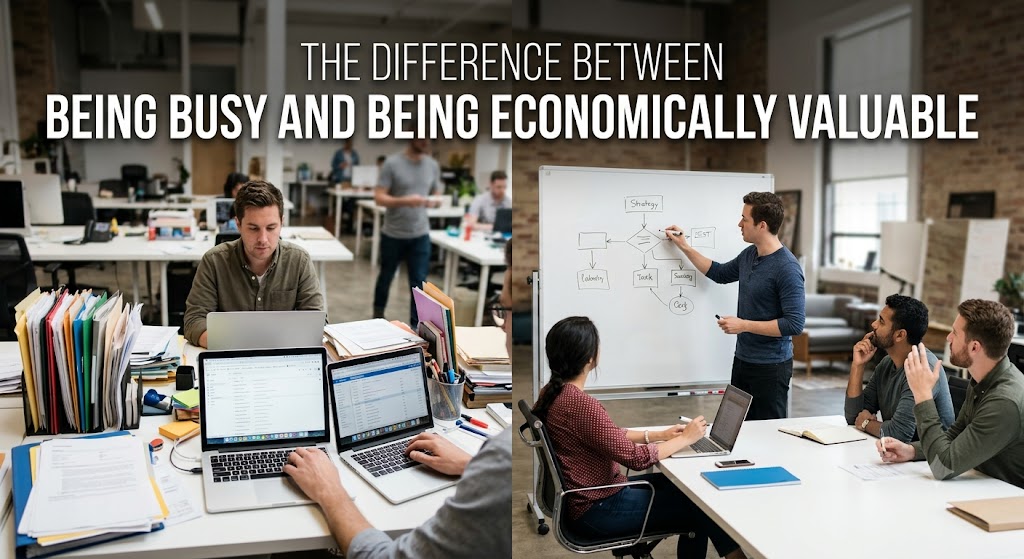
The Difference Between Being Busy and Being Economically Valuable
Many people wake up early, rush through traffic, answer countless phone calls, attend meetings, respond to emails, complete assignments, and return home exhausted. They collapse into bed believing they have been productive simply because they have been busy all day. Yet when the month ends, their financial situation has barely changed. Their stress level has increased, but their wealth has not. Their schedule is full, but their bank account remains empty. This reality exposes one of the greatest misconceptions in modern society. Being busy is not the same as being economically valuable.
The difference between being busy and being economically valuable is one of the most important lessons anyone who desires financial freedom, career growth, or entrepreneurial success must understand. Countless people confuse activity with achievement, effort with results, and movement with progress. They assume that if they are constantly occupied, success will eventually arrive. Unfortunately, the economy does not reward people simply because they are busy. It rewards those who create value that other people are willing to pay for.
The Difference Between Being Busy and Being Economically Valuable is a topic that deserves serious attention because it explains why two people can work equally hard but experience completely different financial outcomes. One person may spend twelve hours each day completing low-impact tasks while another spends only four focused hours solving high-value problems and earns significantly more. The difference is not always intelligence, luck, or even education. The difference often lies in economic value.
The world has never rewarded busyness on its own. Throughout history, people have always paid for solutions rather than effort. Customers do not care how many sleepless nights a business owner experienced while creating a product. They care whether the product solves their problem. Employers rarely increase salaries because someone appears stressed. Promotions usually come to individuals whose work generates measurable value for the organisation. Investors fund businesses that solve real problems, not businesses whose founders simply work long hours.
This truth becomes even more obvious in today’s digital economy. Technology has eliminated many tasks that once kept people busy. Artificial intelligence writes reports, software automates accounting, machines handle manufacturing, and online platforms simplify customer service. Activities that once required entire departments can now be completed in minutes. As automation continues to expand, busyness becomes less valuable while problem-solving becomes more valuable.
Many people proudly announce that they are busy whenever someone asks how they are doing. Being busy has almost become a status symbol. Society often associates busyness with importance, ambition, and success. However, being busy without creating meaningful value is similar to running on a treadmill. You expend enormous energy, but you remain in the same place.
Imagine two individuals. The first person spends ten hours every day responding to emails, attending unnecessary meetings, organising files, and completing repetitive administrative work. The second person spends three hours identifying a major customer problem and developing a product that solves it efficiently. The first person appears busier. The second person creates significantly more economic value.
This distinction explains why certain professionals earn far more than others despite working fewer hours. A skilled surgeon may perform one life-changing operation in a day while another individual works continuously performing low-value tasks. The surgeon is not necessarily working harder. The surgeon is solving a problem that society considers highly valuable.
Economic value depends on impact rather than activity. The market measures what your work accomplishes, not merely how much effort you invest. This principle applies whether you are an employee, entrepreneur, freelancer, consultant, creator, or investor.
One of the biggest traps people fall into is confusing motion with progress. They create endless to-do lists, constantly multitask, and celebrate completing dozens of minor tasks while ignoring the few important activities that actually generate income, improve systems, or increase productivity. At the end of each week, they feel exhausted but cannot point to any meaningful advancement.
The modern workplace often encourages busyness. Meetings multiply. Reports increase. Notifications constantly interrupt concentration. Employees spend entire days switching between tasks without accomplishing anything significant. Businesses sometimes mistake visible activity for genuine productivity because activity is easier to observe than value creation.
Economic value operates differently. It focuses on outcomes instead of appearances. It asks simple but powerful questions. Did this activity solve a problem? Did it increase revenue? Did it reduce costs? Did it save time? Did it improve quality? Did it create new opportunities? If the answer is yes, economic value has likely been created.
Consider the business owner who spends weeks redesigning the company logo while neglecting customer acquisition. The logo project creates busyness but may contribute little to revenue. Meanwhile, another entrepreneur spends the same period understanding customer needs and improving the product. The second entrepreneur creates lasting economic value because customers are willing to pay for better solutions.
Many employees unknowingly spend years perfecting skills that are becoming obsolete. They become extremely busy performing tasks that technology eventually automates. Meanwhile, others invest time learning skills that complement technology rather than compete against it. They become more economically valuable because their knowledge remains relevant.
Being economically valuable requires understanding the marketplace. Every economy rewards people who solve expensive problems. The larger the problem and the fewer people capable of solving it, the greater the potential reward. This principle explains why specialised expertise often commands higher compensation than general labour.
The internet has transformed how economic value is created. Years ago, geographical location limited opportunities. Today, someone with valuable digital skills can serve clients across multiple countries without leaving home. A software developer in Nigeria can build applications for companies in Europe. A graphic designer can create branding for businesses in America. A writer can publish content read by millions worldwide. Their income depends less on how busy they appear and more on the value they provide.
This shift has also changed entrepreneurship. Successful online businesses often rely on systems that continue generating income even while the owner sleeps. Digital products, online courses, software subscriptions, affiliate websites, blogs, and membership communities demonstrate that economic value can become scalable. Once created, these assets continue serving customers repeatedly without requiring the creator to repeat every hour of labour.
Busyness usually stops when the individual stops working. Economic value can continue producing results long after the original effort has been completed. This difference separates active income from scalable income.
Another important distinction involves leverage. Busy people often exchange time directly for money. Their earnings stop whenever they stop working. Economically valuable individuals frequently use leverage. They create systems, products, teams, technology, or intellectual property that multiply the impact of their efforts. Instead of working harder every year, they work smarter by increasing the value produced from each hour invested.
Knowledge itself has become one of the world’s most valuable economic resources. However, knowledge alone does not create wealth. Applied knowledge creates wealth. Someone may spend years collecting information without implementing any of it. Another person learns one useful skill and immediately begins solving real problems for paying clients. The second individual becomes economically valuable much faster.
This principle also applies to education. Degrees and certificates can open doors, but employers ultimately seek people capable of delivering measurable results. A qualification demonstrates potential. Consistent value creation demonstrates competence. Organisations survive by producing value for customers, so they naturally reward employees who strengthen that mission.
The Difference Between Being Busy and Being Economically Valuable also influences personal financial growth. Individuals who constantly remain occupied often struggle to find time for learning, investing, networking, or building additional income streams. Their schedules become prisons. Every hour is committed to immediate obligations, leaving little room for strategic improvement.
Economically valuable individuals intentionally protect time for activities that increase their future earning potential. They study industry trends. They improve communication skills. They learn emerging technologies. They build professional relationships. They create digital assets. They invest in businesses or financial instruments. They understand that future wealth often comes from today’s strategic preparation rather than today’s frantic activity.
Many entrepreneurs fail because they spend excessive time working inside their business instead of working on their business. They personally handle every customer enquiry, every payment, every delivery, every complaint, and every decision. While they remain incredibly busy, the business struggles to grow because systems never develop.
Successful entrepreneurs gradually replace personal effort with processes. They document procedures, hire capable people, automate repetitive tasks, and focus their attention on innovation, strategy, partnerships, and customer satisfaction. Their personal workload may decrease while the business becomes more valuable.
This lesson extends beyond business into careers. Employees who continuously volunteer for routine tasks may appear hardworking, but routine responsibilities rarely distinguish them from everyone else. Those who identify overlooked opportunities, improve workflows, reduce inefficiencies, increase customer satisfaction, or generate new revenue become indispensable because they contribute measurable value.
One fascinating characteristic of economically valuable people is that they continuously ask better questions. Instead of asking how they can become busier, they ask how they can become more useful. Instead of asking how many hours they should work, they ask which activities create the greatest impact. Instead of asking how to stay occupied, they ask how to solve bigger problems.
Problem-solving lies at the heart of every thriving economy. Every successful business exists because it addresses a need. Hospitals solve health problems. Banks solve financial problems. Schools solve educational problems. Technology companies solve efficiency problems. Hotels solve accommodation problems. Logistics companies solve transportation problems. Entertainment companies solve boredom. Every profitable organisation earns revenue because someone considers its solution valuable.
Individuals operate under the same principle. Your career becomes stronger as your ability to solve meaningful problems increases. Your reputation grows when people trust your solutions. Your income rises when your solutions become more valuable.
One reason many people remain trapped in low-income situations is that they focus exclusively on effort while ignoring market demand. They become exceptionally skilled at tasks that few people need. Meanwhile, others develop average skills in areas experiencing enormous demand and achieve better financial outcomes.
Understanding demand helps individuals become economically valuable. Markets constantly communicate what society values through prices, salaries, customer purchases, and investment patterns. Paying attention to these signals allows people to position themselves where value creation is rewarded most generously.
Adaptability also plays a significant role. Economically valuable individuals rarely assume their current skills will remain sufficient forever. Industries evolve. Customer preferences change. Technology advances. Regulations shift. Those who continuously adapt maintain relevance while others gradually become less valuable despite remaining equally busy.
The ability to communicate effectively further increases economic value. Brilliant ideas often remain unrecognised because they are poorly explained. Strong communication enables individuals to persuade customers, inspire teams, negotiate agreements, resolve conflicts, teach others, and build trust. These abilities amplify the value of technical expertise.
Relationships contribute significantly to economic value as well. Opportunities frequently emerge through trusted networks rather than formal applications. People recommend individuals who consistently deliver value. Reputation becomes an economic asset because trust reduces uncertainty for employers, clients, and business partners.
Integrity should never be overlooked in discussions about economic value. Sustainable value creation depends upon reliability, honesty, and ethical behaviour. Shortcuts may generate temporary profits, but trust destroyed is difficult to rebuild. Businesses with strong reputations often outperform competitors because customers value confidence alongside quality.
Many people underestimate the power of specialisation. General knowledge provides flexibility, but specialised expertise often commands premium compensation. Becoming exceptionally skilled within a particular niche allows individuals to solve problems that relatively few others can address. Scarcity increases value.
However, specialisation should not become isolation. Combining expertise from multiple fields often creates unique opportunities. Someone who understands technology and healthcare may develop innovative medical software. A professional skilled in marketing and psychology may create highly effective advertising campaigns. Blending disciplines frequently produces extraordinary economic value.
Another difference between busyness and economic value involves measurement. Busy individuals often measure success by completed tasks. Economically valuable individuals measure success by meaningful outcomes. Completing fifty emails may feel productive, but acquiring one long-term customer could produce far greater financial impact.
Time management therefore becomes less important than priority management. Every person receives the same twenty-four hours each day. The difference lies in how those hours are allocated. High-value activities deserve greater attention than low-value distractions, even when the latter appear urgent.
The digital world constantly competes for attention through notifications, entertainment, and endless information. Remaining busy has never been easier. Remaining focused on economically valuable work has never been more difficult. Those who master attention gain a competitive advantage because concentrated effort produces superior results.
Creators provide another excellent example. Someone may publish hundreds of social media posts without building an audience because the content lacks meaningful value. Another creator publishes fewer pieces but consistently educates, inspires, entertains, or solves problems. The second creator becomes economically valuable because audiences appreciate genuine usefulness rather than endless activity.
Blogging perfectly illustrates this principle. Publishing articles every day does not guarantee success. Readers return to blogs that answer important questions, solve problems, provide practical guidance, or offer unique insights. Search engines increasingly reward helpful, authoritative content rather than sheer volume. Therefore, the creator who focuses on value often outperforms the creator who simply produces more content.
Businesses themselves must continually evaluate whether employees are busy or valuable. Organisations filled with activity but lacking innovation eventually struggle against more efficient competitors. Companies that encourage employees to think critically, solve problems creatively, and improve systems generate stronger long-term performance.
Leaders should reward outcomes rather than appearances. Employees who quietly solve major problems often contribute more than individuals who constantly appear overwhelmed. A culture that values impact over busyness encourages innovation, accountability, and continuous improvement.
Individuals seeking career advancement should regularly assess their economic value honestly. Ask yourself whether your current responsibilities directly influence revenue, customer satisfaction, operational efficiency, product quality, strategic growth, or organisational success. If not, consider acquiring additional skills that strengthen your contribution.
Continuous learning remains one of the most reliable methods of increasing economic value. Every new capability expands the range of problems you can solve. Every solved problem strengthens your reputation. Every strengthened reputation creates additional opportunities.
Reading books, taking online courses, attending workshops, earning certifications, participating in industry communities, and experimenting with new technologies all contribute to long-term value when combined with practical application. Learning becomes an investment rather than an expense.
Economic value also grows through creativity. Innovation often involves discovering better methods rather than inventing entirely new ideas. Improving an existing product, simplifying a complicated process, reducing costs, enhancing customer experience, or combining existing concepts in fresh ways all create value.
Many famous entrepreneurs became successful not because they worked longer hours than everyone else but because they recognised overlooked opportunities. They observed frustrations others ignored and developed solutions people willingly purchased. Opportunity frequently hides inside inconvenience.
Resilience matters because valuable work often requires persistence. Significant problems rarely disappear after one attempt. Economically valuable individuals continue refining solutions until they produce results. Their determination increases the likelihood of creating lasting impact.
The global economy increasingly rewards originality. Repetitive tasks become automated while uniquely human abilities such as creativity, emotional intelligence, leadership, critical thinking, and complex problem-solving become increasingly valuable. Investing in these qualities prepares individuals for future economic changes.
One practical exercise involves reviewing your daily schedule honestly. Identify activities that genuinely create value and separate them from activities that merely consume time. Eliminate unnecessary meetings. Reduce repetitive manual work through automation. Delegate low-value tasks whenever possible. Focus your best energy on activities with the highest economic impact.
Financial success rarely depends upon staying busy every minute. Instead, it depends upon consistently directing attention toward meaningful value creation. This mindset transforms careers, businesses, and personal finances because it aligns effort with results.
The Difference Between Being Busy and Being Economically Valuable ultimately challenges people to rethink how they define productivity. A full calendar is not necessarily evidence of progress. Exhaustion is not proof of effectiveness. Constant motion does not guarantee meaningful achievement.
True productivity means creating something that improves another person’s life, solves a costly problem, saves valuable time, increases efficiency, generates opportunity, or delivers genuine satisfaction. The marketplace rewards these contributions because they make life better for others.
As economies become more competitive and technology continues reshaping industries, the gap between busyness and economic value will only become wider. Those who cling to outdated routines may remain occupied yet financially stagnant. Those who intentionally increase their value will discover greater opportunities regardless of economic conditions.
Every individual must eventually decide whether to pursue endless activity or meaningful impact. One path produces fatigue without significant progress. The other creates influence, opportunity, financial growth, and lasting relevance. The choice determines not only how busy your days become but also how valuable your contribution is to the world and how richly that contribution is rewarded. The people who thrive in the years ahead will not necessarily be those who work the longest hours. They will be those who consistently solve the most meaningful problems, create the greatest value for others, and understand that true wealth follows usefulness far more reliably than busyness ever will.

EarnSmartOnline.com.ng is dedicated to helping readers make smarter financial decisions through practical guides on online income, personal finance, technology, digital business, and wealth creation. Our goal is to provide reliable, easy-to-understand, and actionable content that empowers individuals to earn smarter, build sustainable income streams and achieve long-term financial success.
Recommended: Start Earning Online
- Ultimate Affiliate Marketing Program — learn affiliate marketing with a done-for-you sales system ($15). Check it out
- The Newbie Affiliate Guide — the beginner-friendly starter guide (~$6.68). Check it out
- Easy Dollar Maker — earn in dollars uploading AI images and videos from your phone ($17). Check it out
Disclosure: These are affiliate links. If you buy through them, I may earn a commission at no extra cost to you.