
Saving money does not always require a dramatic lifestyle change. You do not necessarily need to stop enjoying life, avoid every outing, cancel everything you love, or live as though you are preparing for an economic disaster. In many cases, reducing daily expenses is simply about becoming more intentional with the small decisions you make repeatedly. A small amount of money spent unnecessarily today may look insignificant, but when the same spending happens every day, week after week and month after month, it can quietly become one of the biggest reasons your money disappears.
If you have ever wondered where your money went despite not making any major purchase, you are not alone. Many people struggle financially not because they are constantly buying expensive things, but because their everyday spending has become difficult to control. Transport costs, food, impulse purchases, subscriptions, convenience fees, unnecessary data purchases and spontaneous outings can gradually consume a significant portion of monthly income. The good news is that you can address many of these expenses without making yourself miserable.
The goal of learning how to reduce daily expenses without stress is not to make life unnecessarily difficult. It is to create better spending habits that allow your money to serve you more effectively. When you know where your money is going, you can make conscious decisions instead of constantly wondering why your account balance keeps falling. You can still enjoy yourself, support your family, pursue your goals and occasionally spend on things you genuinely value while reducing the waste that often goes unnoticed.
One of the most practical ways to reduce daily expenses without stress is to track where your money goes. This sounds simple, but many people underestimate how powerful it can be. You cannot effectively control spending that you do not understand. If you regularly spend money without recording it, you may remember the large purchases while completely forgetting the smaller ones.
For example, spending a modest amount on snacks, drinks, transport alternatives, online purchases or other conveniences may not feel significant at the moment. However, if those purchases happen repeatedly, they can become a substantial monthly expense. Tracking your spending makes these patterns visible.
You do not need complicated financial software to begin. You can use a notebook, spreadsheet or simple notes application on your phone. Record what you spend each day and briefly state what the money was used for. After a week or two, review the information honestly. You may discover that some expenses are necessary, some are useful and others are simply habits.
The purpose is not to judge yourself. It is to understand your behaviour. Once you see where your money is disappearing, you can decide what deserves to remain and what can be reduced.
Another effective approach is to prepare more of your own food. Food can become one of the easiest places for daily spending to increase, particularly when convenience becomes a routine. Buying prepared meals occasionally is perfectly reasonable, but doing it several times a day can quickly become expensive.
Cooking at home does not mean preparing elaborate meals every day. Simple meals can be enough. Preparing food in larger quantities can also reduce the temptation to purchase something whenever you become hungry. If you already know that there is food waiting at home, you are less likely to spend money simply because you did not plan ahead.
You can also prepare snacks and drinks at home instead of purchasing them repeatedly throughout the day. The important point is not to eliminate every enjoyable food experience. Instead, distinguish between spending on food because you genuinely want something special and spending because you failed to prepare for a predictable need.
Planning meals before shopping can make this even easier. When you know what you intend to eat, you are less likely to buy random items that eventually go unused. A simple shopping list can prevent unnecessary purchases and help you make better use of the food you already have.
The third practical way to reduce daily expenses without stress is to become more intentional about transportation. Transport can quietly consume a large part of a person’s income, especially when small trips happen frequently. Sometimes the problem is not the cost of one journey but the number of unnecessary journeys made throughout the week.
Before travelling somewhere, ask yourself whether the trip is genuinely necessary. If several errands can be completed during one outing, combine them instead of making separate trips. If a destination is close enough and walking is safe and practical, walking may also eliminate an unnecessary transport expense while providing other benefits.
When public transport is available and convenient, it may sometimes be cheaper than using more expensive alternatives. However, convenience matters too. The objective is not to make every journey difficult just to save a small amount of money. The objective is to identify repeated transport expenses that could reasonably be reduced.
Planning your movements can make a surprising difference. Instead of making multiple trips because you forgot something, create a simple plan before leaving home. If you have several things to accomplish, arrange them according to location so that you do not repeatedly travel across town.
The fourth strategy is to reduce impulse buying. Impulse spending is one of the biggest enemies of a healthy budget because it often happens without deliberate consideration. You see something interesting, attractive or convenient and immediately decide to buy it. The purchase may feel harmless, but repeated impulse purchases can significantly affect your finances.
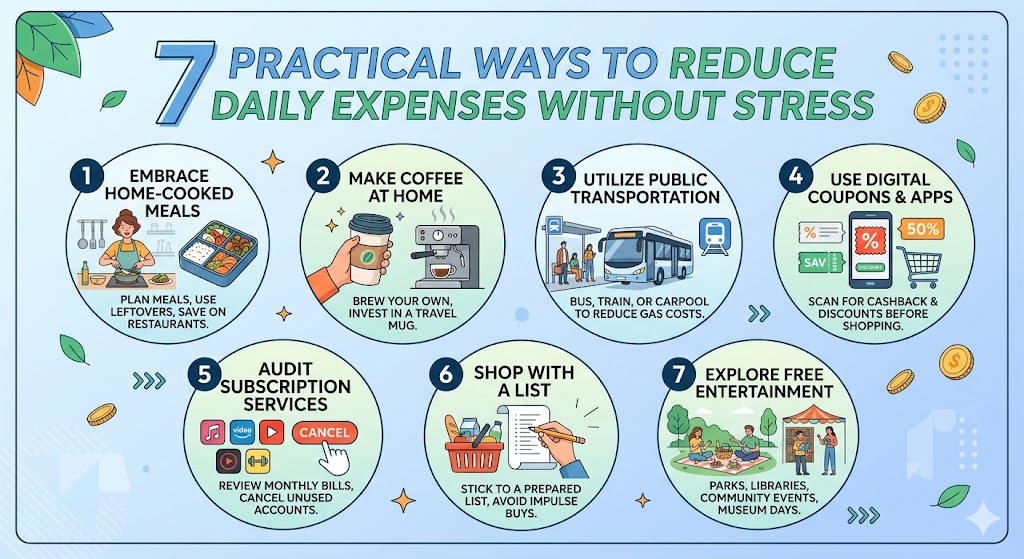
7 Practical Ways to Reduce Daily Expenses Without Stress
One useful habit is to introduce a waiting period before purchasing something that was not planned. For inexpensive items, waiting a few hours may be enough. For more expensive purchases, consider waiting a day or several days. During that time, ask yourself whether you actually need the item or whether you simply want it because it caught your attention.
This is particularly important when shopping online. Online platforms make spending incredibly easy because the distance between seeing an item and purchasing it can be only a few clicks. Saving payment information, responding to limited time offers and constantly browsing shopping platforms can make unnecessary spending feel normal.
You do not have to stop shopping altogether. Instead, make planned shopping the default. If you want something, write it down and consider whether it deserves a place in your budget. This simple change can help you separate genuine needs from temporary desires.
The fifth practical way to reduce daily expenses without stress is to review recurring payments and subscriptions. Many people focus heavily on daily purchases while ignoring money that leaves their accounts automatically. Subscriptions can be particularly dangerous because once they become automatic, you may stop noticing them.
Go through your bank statements and payment records. Identify recurring charges for entertainment, software, memberships, digital services, applications and other platforms. Ask yourself whether you still use each service enough to justify its cost.
You may discover subscriptions you forgot about or services you rarely use. Cancelling unnecessary subscriptions does not require sacrifice because you are not giving up something valuable. You are simply stopping payment for something that no longer provides enough value.
It is also worth reviewing services that you use regularly. Sometimes a cheaper plan may meet your needs just as well. If you are paying for features you never use, downgrading may be more sensible than cancelling completely.
The sixth strategy is to establish a realistic daily spending limit. A spending limit gives your money boundaries without forcing you to stop spending completely. The key word is realistic. If you create an extremely restrictive budget that does not match your actual life, you may follow it for a few days and then abandon it completely.
Start by looking at your income and necessary expenses. After accounting for important obligations, determine how much money can reasonably be used for flexible daily spending. This amount can cover things such as food outside your planned meals, small personal purchases and other discretionary expenses.
A daily spending limit does not mean you must spend exactly that amount every day. In fact, spending less on some days can create flexibility for occasions when you genuinely need to spend more.
For example, if you know that you have a social event later in the week, you can avoid unnecessary spending earlier in the week rather than feeling guilty about attending the event. This approach is more sustainable because it allows room for real life.
The seventh practical way to reduce daily expenses without stress is to replace expensive habits with cheaper alternatives rather than simply removing them. This is one of the most important principles of sustainable money management.
If you enjoy going out for expensive meals, you do not necessarily need to stop going out. You might reduce how frequently you go and prepare enjoyable meals at home on other days. If you frequently purchase drinks outside, you might carry a drink from home. If you regularly pay for convenience services, you might handle some tasks yourself when it is practical.
The goal is to preserve the experience while reducing the cost where possible.
This approach works because people often struggle with budgeting when they feel that financial discipline means punishment. Nobody wants to feel as though every enjoyable part of life has been taken away. When you find cheaper alternatives, saving becomes less about deprivation and more about making smarter choices.
Another important part of reducing daily expenses is learning to distinguish between cheap and valuable. The cheapest option is not always the best option. Sometimes spending a little more on a durable product can save money because you will not need to replace it repeatedly. Likewise, choosing poor quality simply because it is cheaper can become expensive over time.
Financial discipline therefore does not mean choosing the lowest price every time. It means considering the total value of the purchase. Ask how frequently you will use it, how long it will last and whether it solves a genuine problem.
It is also important to avoid comparing your financial life with other people’s lifestyles. Social media can create enormous pressure to spend. You constantly see people displaying restaurants, holidays, clothes, cars, gadgets and other purchases. What you see, however, rarely represents the complete financial picture.
Someone may look financially comfortable online while struggling with debt privately. Another person may genuinely have more disposable income than you. Comparing yourself with either person can encourage spending that does not align with your own circumstances.
Your financial decisions should be based on your income, responsibilities, priorities and goals. Reducing daily expenses becomes much easier when you stop spending to impress people who may not even be thinking about you.
You should also give yourself permission to enjoy your money. This may sound contradictory when discussing cutting expenses, but it is actually essential. A budget that contains no room for enjoyment can become difficult to maintain.
If you enjoy certain activities, include them deliberately in your financial plan. The difference is that planned enjoyment is different from uncontrolled spending. When you know that you have allocated money for entertainment, you can enjoy it without constantly feeling guilty.
Saving money should ultimately create freedom, not misery. The purpose of reducing unnecessary expenses is to create room for more important things. That could mean building an emergency fund, paying off debt, investing, starting a business, supporting your family, buying a home or simply having greater peace of mind.
Small savings can become meaningful when repeated consistently. Saving a modest amount today may not feel transformative, but doing it every day, week or month can produce a significant difference over time. The power is not necessarily in one dramatic financial decision. It is in the repeated decisions that become habits.
It is also useful to create specific financial goals. Saving money without knowing why can feel unrewarding. Give your savings a purpose. Instead of simply saying that you want to spend less, decide what the reduced spending is helping you accomplish.
You might say, “I want to reduce unnecessary expenses so I can save a certain amount within six months.” A clear objective gives your daily decisions greater meaning. When you are tempted to make an unnecessary purchase, you can compare that temporary pleasure with the larger goal you are trying to achieve.
Remember that reducing daily expenses without stress does not mean becoming perfect. There will be days when you spend more than planned. There will be unexpected expenses, social occasions, emergencies and moments when you simply make a poor financial decision. One bad day does not destroy your financial progress.
What matters is what you do next.
If you overspend today, do not decide that the entire month is ruined. Review what happened, make the necessary adjustment and continue. Financial progress is not built by perfection. It is built by consistency.
You can also involve your household in the process. If you live with family members or a partner, financial habits become easier when everyone understands the goal. Discuss unnecessary expenses without turning the conversation into accusations. Look for areas where everyone can contribute to reducing waste.
The same principle applies to children. Teaching children the difference between needs and wants can help establish healthy financial habits early. They do not need to understand every detail of household finances, but they can learn that money is limited and choices have consequences.
Ultimately, the most effective way to reduce daily expenses without stress is to stop thinking about saving money as simply saying no. Saving money is about saying yes to something more important. Every unnecessary expense you reduce creates an opportunity to use that money somewhere else.
You are not simply refusing to buy a snack. You may be saying yes to your savings goal. You are not simply cancelling a subscription. You may be saying yes to debt reduction. You are not simply reducing unnecessary transport. You may be saying yes to a future investment. You are not simply resisting an impulse purchase. You may be saying yes to financial independence.
The seven practical ways to reduce daily expenses without stress are therefore straightforward. Track your spending, plan your food, become intentional about transportation, control impulse purchases, review recurring payments, establish a realistic daily spending limit and replace expensive habits with affordable alternatives.
None of these strategies requires you to stop living. They simply require you to become more conscious of how you use your money.
The biggest financial changes often begin with ordinary decisions that nobody else notices. Choosing not to buy something you do not need. Preparing a meal instead of ordering one. Combining several errands into one trip. Cancelling a subscription you barely use. Waiting before making an impulse purchase. Setting a reasonable spending limit. Choosing a cheaper alternative without sacrificing something important.
These decisions may look small, but repeated small decisions eventually become financial habits. And financial habits eventually influence financial outcomes.
If you want to reduce daily expenses without stress, do not attempt to change everything overnight. Choose one area first. Track your spending for a week. Identify one unnecessary expense and reduce it. Then move to another. Give yourself time to adapt.
The goal is not to become someone who never spends money. The goal is to become someone who knows why they are spending it.
When you reach that point, saving becomes less stressful because you are no longer fighting your lifestyle. You are designing it. You are deciding what deserves your money, what does not and what kind of future you want your financial choices to create.
Reducing daily expenses is ultimately less about having less and more about wasting less. Once you understand that difference, financial discipline becomes much easier. You can still enjoy your life while becoming more responsible with your money. You can still buy things you love while refusing to spend mindlessly. You can still enjoy today while preparing for tomorrow.
That balance is what makes sustainable money management possible. You do not need extreme sacrifice. You need awareness, intention and consistency. Start with one small change today, repeat it tomorrow and allow those small decisions to become habits. Over time, you may be surprised by how much money you can keep simply by becoming more deliberate about where it goes.

EarnSmartOnline.com.ng is dedicated to helping readers make smarter financial decisions through practical guides on online income, personal finance, technology, digital business, and wealth creation. Our goal is to provide reliable, easy-to-understand, and actionable content that empowers individuals to earn smarter, build sustainable income streams and achieve long-term financial success.
Recommended: Start Earning Online
- Ultimate Affiliate Marketing Program — learn affiliate marketing with a done-for-you sales system ($15). Check it out
- The Newbie Affiliate Guide — the beginner-friendly starter guide (~$6.68). Check it out
- Easy Dollar Maker — earn in dollars uploading AI images and videos from your phone ($17). Check it out
Disclosure: These are affiliate links. If you buy through them, I may earn a commission at no extra cost to you.



