
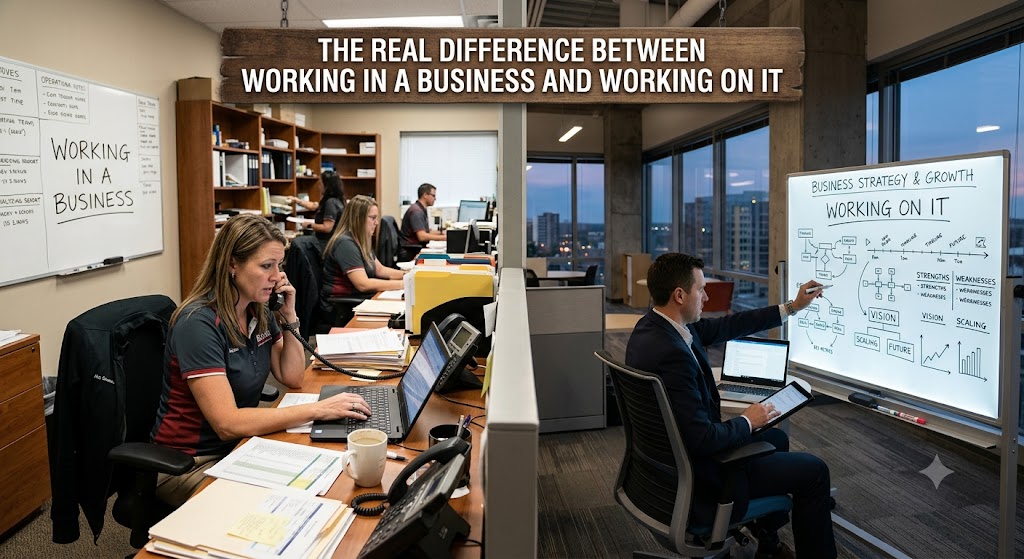
The Real Difference Between Working in a Business and Working on It
Many people dream of starting a business because they want freedom. They want to escape the daily routine of working for someone else, build wealth, create something meaningful, and have control over their time. Ironically, countless entrepreneurs eventually discover that they have created another job for themselves instead of building a business that can operate independently. They wake up before everyone else, close their shops or offices after everyone has gone home, answer every phone call, solve every customer complaint, approve every payment, supervise every employee, and make every important decision. If they are absent for just a few days, everything slows down or completely falls apart. This is the hidden difference between working in a business and working on it.
The real difference between working in a business and working on it is not about how hard someone works. It is about where their energy is invested. One approach keeps the business alive for today, while the other prepares the business to survive tomorrow. One focuses on completing daily tasks, while the other focuses on building systems that continue to produce results even when the owner is unavailable. Understanding this difference can completely change the future of any entrepreneur, regardless of the size of the business.
Working in a business means becoming deeply involved in the daily operations. It means personally attending to customers, processing orders, managing inventory, responding to emails, answering phone calls, creating invoices, handling deliveries, supervising workers every minute, and fixing problems as they arise. These tasks are important because every business needs someone to perform them. Without daily operations, there would be no products to sell and no services to offer. However, the problem begins when the owner becomes the only person capable of performing these activities successfully.
Many small business owners unknowingly become employees in their own companies. They may have registered a business, rented an office, hired staff, and even designed a beautiful logo, but they still perform almost every critical function themselves. Their employees constantly wait for instructions before making decisions. Customers insist on speaking directly with the owner. Suppliers refuse to finalize transactions without the owner’s approval. Even simple purchases require the owner’s signature. The business appears successful from the outside, but behind the scenes everything depends on one individual.
This dependency creates several hidden dangers. First, the owner becomes exhausted. Running from one responsibility to another every single day leaves very little time for strategic thinking. Instead of planning future expansion, they spend all their energy putting out today’s fires. They are constantly reacting instead of leading. Every unexpected problem demands immediate attention, leaving no room to think creatively about long-term opportunities.
Second, the business stops growing beyond the owner’s personal capacity. There are only twenty-four hours in a day. If every sale, decision, or approval depends on one person, the business can never expand beyond what that individual can physically handle. Eventually, growth becomes impossible because the owner’s time becomes the biggest limitation.
Third, the business becomes extremely vulnerable. If the owner becomes sick, travels unexpectedly, experiences a family emergency, or simply needs rest, operations slow down significantly. Customers become frustrated. Employees become confused. Opportunities are missed. Revenue begins to decline. This situation reveals that the business was never truly independent. It was merely an extension of one person’s daily effort.
Working on a business presents a completely different mindset. Instead of asking, “What task should I complete today?” the owner asks, “How can I build a system that completes this task consistently without depending entirely on me?” This question changes everything. Instead of becoming the centre of every activity, the entrepreneur gradually becomes the architect who designs the entire operation.
Working on a business involves creating clear procedures, documenting processes, training employees properly, developing leadership within the team, investing in technology, improving customer experience, analysing financial reports, studying competitors, exploring new markets, strengthening the company’s brand, refining products, and planning future growth. These activities may not generate immediate cash today, but they create the foundation for sustainable success tomorrow.
Imagine two restaurant owners. The first owner cooks every meal personally, greets every customer, purchases every ingredient, supervises every waiter, handles all accounting, and locks the restaurant every night. Customers love the food because of the owner’s personal involvement. However, if that owner takes one week off, the restaurant struggles immediately.
The second owner also understands cooking but spends more time developing recipes that chefs can consistently follow. They create training manuals, establish quality control procedures, hire competent managers, monitor financial performance, improve marketing strategies, negotiate supplier agreements, and continuously refine customer service standards. The restaurant becomes known for excellent service rather than depending solely on one individual’s presence. Even when the owner travels, customers continue receiving the same quality experience.
Both owners work hard. Both care deeply about their businesses. The difference lies in where they invest their effort. One keeps the business functioning today. The other ensures the business continues functioning tomorrow.
Many entrepreneurs resist delegating responsibilities because they believe nobody can perform tasks as well as they can. Sometimes they are correct. Employees may initially make mistakes. Customers may occasionally complain. Processes may require adjustments. However, perfection is rarely achieved immediately. Every experienced professional was once a beginner. Every skilled manager once needed training. Every successful organisation once invested time in developing people.
Refusing to delegate because others are imperfect creates a permanent trap. The owner remains overwhelmed while employees never gain enough experience to improve. Growth becomes impossible because every responsibility returns to the same individual. Ironically, businesses that successfully scale usually accept temporary imperfections while investing in long-term capability.
Working on a business also requires learning to think differently about time. Many entrepreneurs measure productivity by how busy they appear. They believe arriving early, leaving late, answering hundreds of phone calls, and constantly solving problems prove they are dedicated. While hard work is admirable, constant busyness does not necessarily indicate effective leadership.
Some of the most valuable business activities do not look busy at all. Spending several hours reviewing financial trends may produce greater long-term value than processing dozens of invoices personally. Developing a hiring strategy may generate more future profit than serving customers for one afternoon. Building an employee training programme may reduce operational mistakes for years to come. Meeting potential business partners may open opportunities that daily operational tasks could never create.
Unfortunately, these strategic activities are often postponed because urgent operational demands consume every available moment. Days become weeks. Weeks become months. Years pass before the owner realises they have remained trapped inside daily operations without building anything capable of surviving independently.
Systems represent one of the greatest differences between working in a business and working on it. A system is simply a repeatable method for completing a task consistently. Instead of depending on memory, personal habits, or constant supervision, systems provide clear instructions that anyone can follow.
For example, customer complaints should not depend entirely on the owner’s personal judgement. There should be documented procedures explaining how complaints are received, investigated, resolved, and followed up. Employee onboarding should not vary depending on who conducts the orientation. Every new employee should experience consistent training using established guidelines. Inventory management should not rely on guesswork. Proper systems should track stock levels, reorder points, supplier performance, and purchasing schedules.
Businesses with strong systems become more predictable, more efficient, and easier to improve. Problems become easier to identify because processes are documented. Training new employees becomes faster because instructions already exist. Quality becomes more consistent because everyone follows similar standards.
Another important difference involves decision-making. Owners working in their businesses often make every decision personally. They answer every question because nobody else feels authorised to act. Employees become dependent instead of confident. Managers hesitate before taking initiative. Simple issues wait unnecessarily for approval.
Owners working on their businesses deliberately develop decision-making capacity within their teams. They establish clear guidelines, define responsibilities, communicate expectations, and empower trusted individuals to solve problems independently. Rather than becoming the bottleneck, they become mentors who develop future leaders.
Financial management also reflects this distinction. Owners deeply trapped in daily operations often judge success by how busy the business appears. They celebrate increasing customer traffic without carefully analysing profitability. They focus heavily on sales while paying less attention to operating costs, cash flow, customer acquisition expenses, and long-term financial sustainability.
Owners working on their businesses regularly examine financial reports, identify trends, evaluate profit margins, monitor expenses, forecast future cash requirements, and make strategic adjustments before problems become crises. They understand that impressive revenue means very little if profitability continues declining.
Marketing offers another powerful example. Entrepreneurs working inside their businesses frequently depend on personal effort to generate sales. They personally answer inquiries, negotiate deals, maintain customer relationships, and promote products. Their personality becomes the primary marketing strategy.
Entrepreneurs working on their businesses build marketing systems that consistently attract customers regardless of their personal involvement. They improve websites, optimise search engine visibility, strengthen social media presence, create referral programmes, develop email marketing campaigns, encourage customer reviews, build partnerships, and invest in brand recognition. Instead of chasing every customer individually, they create mechanisms that continuously bring customers to the business.
Technology has made working on a business easier than ever before. Automation tools can schedule appointments, process payments, send reminders, manage inventory, organise customer databases, generate invoices, monitor marketing performance, and produce financial reports. Every repetitive task that becomes automated frees valuable time for strategic leadership.
However, technology alone cannot solve structural problems. A business filled with confusion cannot become organised simply by purchasing expensive software. Technology strengthens existing systems. If no systems exist, automation merely accelerates disorder. Therefore, building clear processes must always come before introducing advanced technology.
Many family businesses struggle because founders spend decades working inside the business without preparing successors. Every important relationship belongs personally to the founder. Every supplier trusts only one individual. Every customer requests the owner’s direct involvement. When retirement approaches, transferring leadership becomes extremely difficult because knowledge remains locked inside one person’s experience.
Businesses that survive across generations deliberately document knowledge, train future leaders, establish governance structures, and gradually transfer responsibilities long before succession becomes necessary. This preparation reflects working on the business rather than merely inside it.
Fear often prevents entrepreneurs from making this transition. Some fear losing control. Others fear employees making costly mistakes. Some worry customers will notice changes in service quality. Others simply enjoy feeling indispensable because constant dependence creates a sense of importance.
Yet true business leadership is not measured by how many problems only you can solve. It is measured by how effectively you build an organisation capable of solving problems without constantly depending on you. A business becomes stronger when knowledge is shared rather than protected.
There is also a psychological shift involved. Entrepreneurs working inside their businesses often identify themselves completely with their daily activities. They believe their value comes from doing everything personally. Consequently, stepping back feels uncomfortable because they confuse delegation with laziness.
In reality, stepping back strategically allows the owner to contribute greater value. Instead of spending three hours packaging products, they might spend those same hours identifying new markets capable of doubling annual revenue. Instead of personally delivering every order, they might negotiate partnerships that significantly reduce operational costs. Instead of answering every customer enquiry, they might create educational content that answers common questions automatically while attracting new customers online.
Growth requires replacing personal effort with organisational capability. This transition does not happen overnight. It occurs gradually through consistent improvements. Every documented procedure, every trained employee, every automated process, every leadership conversation, every performance review, every strategic planning session, and every system improvement moves the business one step closer to independence.
Many successful entrepreneurs intentionally schedule time specifically for working on their businesses. They block hours each week exclusively for reviewing performance, analysing data, improving processes, studying competitors, exploring innovation, mentoring managers, and planning future initiatives. During these periods, they deliberately avoid becoming distracted by routine operational activities unless genuine emergencies arise.
This discipline may initially feel uncomfortable because urgent tasks constantly compete for attention. However, protecting strategic thinking time eventually produces remarkable results. Better decisions accumulate over months and years, creating businesses that continue growing while owners regain greater personal freedom.
Business owners should regularly ask themselves several honest questions. If I disappear for one month, what happens? Which activities completely stop? Which employees feel confident making decisions without me? Which systems exist only inside my head? What recurring problems consume most of my time? Which tasks could be delegated, automated, or documented? What opportunities remain unexplored because I stay too busy handling daily operations?
These questions reveal whether someone primarily works in the business or on it. They expose hidden weaknesses before those weaknesses become expensive failures.
One common misconception is that only large corporations need systems and strategic planning. In reality, small businesses benefit even more because limited resources make efficiency absolutely essential. A small business owner cannot afford unnecessary confusion, repeated mistakes, or constant dependency on one individual. Building effective systems early prevents many future challenges.
Another misconception is that working on a business means doing less work. The truth is often the opposite. Strategic leadership requires deep thinking, careful analysis, difficult decisions, continuous learning, long-term patience, and emotional resilience. Unlike daily operational tasks that produce immediate visible results, strategic improvements sometimes take months before their benefits become obvious. This delayed gratification requires discipline.
Learning never stops for entrepreneurs committed to working on their businesses. They continually study industry trends, emerging technologies, changing customer expectations, leadership principles, financial management, marketing innovations, and operational excellence. They recognise that improving themselves ultimately improves the organisation they lead.
Surrounding themselves with capable people also becomes a priority. Instead of fearing talented employees, they actively recruit individuals whose strengths exceed their own in specific areas. They understand that strong teams outperform individual brilliance. Their confidence comes not from knowing everything personally but from building organisations filled with capable people working together effectively.
Customer satisfaction also improves when businesses become system-driven rather than personality-driven. Customers appreciate consistency. They want reliable quality regardless of who serves them. Businesses dependent entirely on one owner’s presence often deliver inconsistent experiences because exhaustion eventually affects performance. Well-designed systems create dependable quality that customers trust.
The financial value of the business increases dramatically when operations become independent of the founder. Investors and potential buyers rarely want businesses requiring the owner’s permanent presence. They prefer organisations with documented systems, capable management, loyal customers, stable financial performance, and sustainable operations. Therefore, working on a business not only improves daily life but also significantly increases long-term business value.
Many entrepreneurs mistakenly postpone strategic development until they become larger. They tell themselves they will create systems after hiring more employees or increasing sales. Unfortunately, bad habits established early become increasingly difficult to change later. Businesses usually grow into the structures they build from the beginning. If chaos becomes normal today, expansion often multiplies that chaos rather than eliminating it.
Building systems, developing people, documenting knowledge, improving processes, strengthening culture, and thinking strategically should begin immediately regardless of current business size. Even a solo entrepreneur can start documenting procedures, automating repetitive tasks, organising financial records, creating customer service standards, and planning for future delegation.
Ultimately, every entrepreneur chooses what kind of business they want to build. One path creates permanent dependence where the owner’s constant presence determines success or failure. The other path gradually builds an organisation capable of creating value beyond the founder’s daily involvement. Both paths require dedication, sacrifice, and persistence, but only one creates lasting freedom.
The real difference between working in a business and working on it is the difference between being the engine that keeps the business moving and being the engineer who designs a machine that continues running efficiently. One approach consumes the owner’s life through endless operational demands. The other transforms the owner’s effort into systems, people, and strategies that multiply results over time.
Every successful business eventually reaches a point where hard work alone is no longer enough. Sustainable growth demands intentional leadership, structured processes, empowered teams, continuous improvement, and long-term thinking. Owners who recognise this distinction early position themselves for greater profitability, greater stability, greater freedom, and greater impact. They understand that the ultimate goal is not simply to own a business but to build one that can thrive, adapt, and continue creating value long after today’s tasks have been completed. That is the real difference between working in a business and working on it, and it is one of the most important lessons every entrepreneur must learn if they hope to build something that truly lasts.

EarnSmartOnline.com.ng is dedicated to helping readers make smarter financial decisions through practical guides on online income, personal finance, technology, digital business, and wealth creation. Our goal is to provide reliable, easy-to-understand, and actionable content that empowers individuals to earn smarter, build sustainable income streams and achieve long-term financial success.
Recommended: Start Earning Online
- Ultimate Affiliate Marketing Program — learn affiliate marketing with a done-for-you sales system ($15). Check it out
- The Newbie Affiliate Guide — the beginner-friendly starter guide (~$6.68). Check it out
- Easy Dollar Maker — earn in dollars uploading AI images and videos from your phone ($17). Check it out
Disclosure: These are affiliate links. If you buy through them, I may earn a commission at no extra cost to you.



