
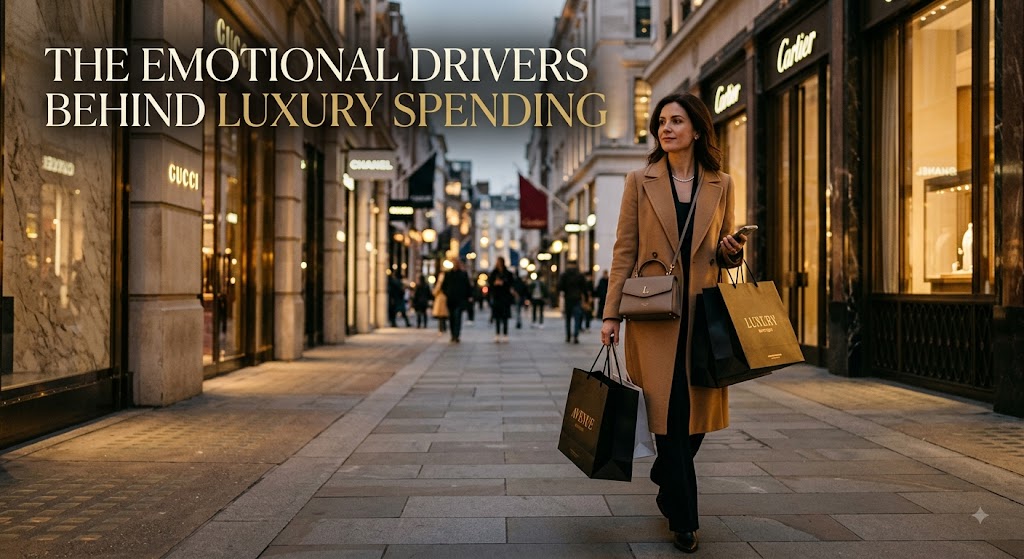
Luxury spending is often described as a matter of wealth, taste, status or personal preference. Someone buys an expensive watch, designer handbag, premium car, exclusive holiday or high end home, and the immediate assumption is usually that the person simply has enough money to afford it. But money alone does not fully explain why people spend enormous amounts on things they could live without. Behind many luxury purchases are powerful psychological and emotional forces that influence what people want, how they perceive themselves and how they want other people to perceive them. Understanding the emotional drivers behind luxury spending reveals that luxury consumption is rarely just about the product itself. It is often about identity, confidence, recognition, belonging, achievement, pleasure, security and the desire to feel different.
The emotional drivers behind luxury spending can be understood by looking beyond the price tag and examining what the purchase represents to the buyer. A luxury watch may tell time, but the person buying it may be purchasing a feeling of accomplishment. A luxury vehicle may provide transportation, but it may also represent independence, success or social recognition. A designer outfit may serve the practical purpose of covering the body, yet the buyer may also be purchasing confidence, admiration or a stronger sense of identity. This is why luxury brands have historically invested so heavily in storytelling. They are not simply selling physical products. They are selling emotions, experiences and meanings attached to those products.
One of the strongest emotional drivers behind luxury spending is the desire for status. Human beings are naturally influenced by social hierarchy. People often want to know where they stand in relation to others, and material possessions can become visible signals of achievement. Luxury products make this particularly powerful because their prices and brand identities often communicate exclusivity. Owning something expensive can create the feeling of having reached a particular level of success. In some environments, a luxury car, watch, home or fashion item becomes a social symbol that communicates financial capability without the owner having to say anything.
Status driven luxury spending can be especially powerful in societies where visible success is highly valued. People may feel pressure to demonstrate that their lives are progressing. A person who recently received a major promotion may purchase a premium vehicle because it feels like an appropriate reward for reaching a new level. Someone who has built a successful business may upgrade their wardrobe because their external appearance now feels connected to their professional identity. The purchase is therefore emotional as much as financial. It provides tangible evidence of an achievement that may otherwise be difficult to see.
Another important emotional driver behind luxury spending is self reward. Many people work for years under pressure, sacrificing leisure, comfort and personal desires in pursuit of financial goals. When they finally achieve something significant, luxury spending can become a form of celebration. The expensive holiday, jewellery, smartphone, watch or car becomes a physical reminder that their hard work produced something enjoyable.
This form of spending is not automatically irresponsible. In fact, thoughtful spending on meaningful rewards can contribute to a person’s sense of satisfaction. The problem begins when self reward becomes an excuse for continuous consumption. If every difficult week becomes a reason to buy something expensive, emotional spending can gradually turn into a financial habit. The individual may begin working harder not to build wealth but simply to maintain a lifestyle that constantly demands more income.
The emotional drivers behind luxury spending also include the search for confidence. People sometimes use appearance and possessions to influence how they feel about themselves. Wearing high quality clothing, carrying a prestigious handbag or driving a desirable vehicle can make someone feel more confident in social or professional environments. The product becomes psychologically connected to the person’s self image.
This relationship between luxury and confidence can be complicated. A luxury product can temporarily improve how someone feels about themselves, but confidence built entirely around external possessions can become fragile. If confidence depends on always having the newest or most expensive item, maintaining that confidence may require continuous spending. The person may feel successful only when surrounded by expensive symbols of success.
Luxury spending can also be driven by the desire for recognition. People want their efforts to be noticed. A person may purchase something expensive because they want friends, family, colleagues or society to acknowledge that they have achieved something. Recognition is a powerful human need, and luxury brands understand this extremely well.
The emotional reward can come not only from owning the item but from the reactions it generates. Compliments, attention, admiration and curiosity can reinforce the purchase. Someone who receives constant positive reactions after buying a luxury vehicle may associate the vehicle with social approval. The emotional reinforcement can make future luxury purchases more appealing.
Another major factor is belonging. Luxury spending may appear to be about standing above others, but sometimes it is actually about fitting into a particular social group. Certain professions, industries and social circles develop their own expectations around appearance and lifestyle. People entering those environments may purchase particular brands because those products help them feel accepted.
This creates an interesting contradiction. Luxury can communicate individuality while simultaneously functioning as a tool for conformity. Someone may believe they are expressing their unique taste through a luxury brand, while thousands of other people are using the same brand to communicate membership in the same social category. The product becomes a social language.
The desire for exclusivity is another powerful emotional driver behind luxury spending. People tend to value things more when access appears limited. Luxury brands frequently use scarcity, limited editions, private memberships and exclusive experiences to increase perceived desirability. When consumers believe that only a small number of people can access something, the emotional value can rise dramatically.
This psychological principle explains why two products with similar practical functions can have completely different prices. The expensive product may provide something beyond functionality. It may offer rarity, heritage, craftsmanship, exclusivity and the emotional satisfaction of owning something that most people cannot easily obtain.
Luxury spending can also be connected to the desire for control. In a world filled with uncertainty, expensive purchases can sometimes provide a sense of stability or control. Someone may purchase a premium home because it represents security. Another person may invest in high quality furniture because they want their environment to feel comfortable and controlled. Someone else may purchase premium technology because they value reliability and convenience.
There is nothing inherently irrational about paying more for quality when the additional value is genuine. The emotional component becomes problematic when the purchase provides the illusion of control without addressing the underlying anxiety. Buying more expensive things cannot permanently eliminate uncertainty. Yet emotional spending can sometimes create a temporary feeling of safety.
Nostalgia is another overlooked emotional driver behind luxury spending. People do not always buy expensive products because they want something new. Sometimes they purchase products because those products remind them of important moments in their lives. A particular watch may remind someone of a parent. A luxury car may represent a childhood dream. A designer fragrance may bring back memories of a significant relationship or period of personal growth.
The Emotional Drivers Behind Luxury Spending
In these situations, the consumer is not simply purchasing an object. They are purchasing a connection to a memory. This explains why sentimental value can make an expensive product feel worth far more than its practical usefulness.
Luxury spending can also emerge from insecurity. This is one of the more uncomfortable realities surrounding consumption. Sometimes people buy expensive things because they are afraid of being perceived as unsuccessful, poor, ordinary or irrelevant. The purchase becomes a form of emotional protection.
Social media has intensified this pressure. People are constantly exposed to carefully selected images of other people’s lifestyles. Luxury cars, expensive holidays, designer clothing, restaurants and impressive homes can create the impression that everyone else is succeeding at a higher level. The viewer sees the highlight reel and compares it with their ordinary life.
This comparison can create a powerful emotional gap. The individual may begin thinking, “I should have that too.” The purchase then becomes an attempt to close the psychological distance between their current identity and the lifestyle they believe they should have. Unfortunately, social media rarely shows the debt, financial stress, family sacrifices or business failures behind the visible lifestyle.
The emotional drivers behind luxury spending are also closely connected to aspiration. People often buy products associated with the person they want to become. A young entrepreneur might purchase professional clothing because they want to feel like an established executive. Someone beginning a fitness journey may buy premium equipment because it reinforces their identity as someone who takes health seriously. A person building a creative career may invest in expensive tools because they see themselves as a serious professional.
Aspirational spending can sometimes be constructive. When a purchase supports a genuine goal and is financially sustainable, it can reinforce commitment. However, the danger lies in confusing the appearance of success with the process required to achieve success. Buying the symbols of an identity does not automatically create the identity.
Another important emotional factor is pleasure. Luxury products often provide sensory experiences that ordinary products may not. A premium hotel may provide exceptional comfort. A high end restaurant may offer an unforgettable dining experience. A luxury vehicle may provide a refined driving experience. A quality piece of clothing may feel significantly better to wear.
Pleasure is a legitimate reason to spend money. The purpose of money is not simply to accumulate numbers in an account. Money can also create comfort, experiences and meaningful memories. The key question is whether the pleasure received from the purchase is proportional to the financial cost and whether the spending fits within the person’s broader financial priorities.
Luxury spending can also function as an escape. When people experience stress, loneliness, disappointment or emotional exhaustion, shopping can provide temporary relief. The anticipation of buying something can create excitement, while the purchase itself can create a short lived feeling of satisfaction. This is one reason emotional spending can become difficult to control.
The problem is that the emotional relief may disappear quickly. The stress that caused the purchase remains, while the money spent is gone. The consumer may then seek another purchase to recreate the same emotional experience. Over time, this can produce a cycle in which spending becomes a coping mechanism rather than a deliberate financial decision.
Marketing plays a major role in amplifying these emotional drivers. Luxury advertising rarely focuses exclusively on practical features. Instead, it associates products with desirable lifestyles and identities. Advertisements may show confidence, romance, freedom, success, sophistication, adventure or exclusivity. The consumer is encouraged to imagine how their life might feel if they owned the product.
This is why understanding the emotional drivers behind luxury spending is valuable for anyone interested in personal finance. A financially intelligent consumer does not necessarily have to reject luxury. Instead, they learn to distinguish between buying something because they genuinely value it and buying something because they are trying to solve an emotional problem with money.
One of the most useful questions to ask before a major luxury purchase is simple: “What am I really buying?” The answer might be comfort. It might be quality. It might be recognition. It might be confidence. It might be belonging. It might be a reward. It might even be approval. Understanding the real motivation can make the financial decision much clearer.
Another useful question is whether the desire would still exist without anyone else knowing about the purchase. Imagine buying the expensive watch, car, outfit or holiday without being able to post it online, tell friends about it or receive compliments. Would you still want it? If the answer is yes, the purchase may be strongly connected to personal enjoyment or genuine value. If the desire disappears when social recognition is removed, the emotional motivation may be primarily external.
This does not mean external motivation is automatically bad. Humans naturally care about reputation and social recognition. The important thing is to recognise the influence rather than allowing it to operate unconsciously.
There is also a major difference between luxury spending and luxury affordability. Someone can technically afford an expensive item while still making a poor financial decision. Having enough money in a bank account to purchase something does not necessarily mean the purchase fits into a person’s long term financial plan.
True financial confidence comes from being able to enjoy luxury without becoming financially dependent on the appearance of luxury. A person who can comfortably buy an expensive item without sacrificing emergency savings, investments, debt repayment or important financial goals is in a very different position from someone who borrows money simply to look successful.
This distinction is especially important because luxury consumption can create lifestyle inflation. As income increases, people often upgrade their homes, cars, clothing, holidays, restaurants and entertainment. What once felt luxurious gradually becomes normal. The individual then needs an even higher income to maintain the new standard.
This can create a strange financial trap. A person earns more money but does not necessarily become wealthier because their expenses rise alongside their income. The emotional satisfaction of reaching one level of luxury eventually fades, and another level becomes desirable. The finish line keeps moving.
Wealth, however, is not the same as the ability to display wealth. Someone can look extraordinarily wealthy while having little financial security behind the appearance. Another person can have substantial assets while living relatively modestly. The difference is often invisible because wealth and luxury consumption communicate very different things.
The emotional drivers behind luxury spending therefore deserve serious attention in personal finance discussions. Understanding them can help people make better decisions without turning financial discipline into a rejection of enjoyment. The goal is not to convince everyone to stop buying expensive things. The goal is to make sure the purchase is serving the person rather than the person becoming a servant of the purchase.
Luxury can be meaningful when it reflects genuine values. A beautifully designed home can create comfort. A memorable holiday can create lifelong memories. A high quality product can provide years of enjoyment. A special gift can communicate love. A premium experience can celebrate an important milestone. In these situations, spending can have emotional value that cannot be measured purely by functionality.
The danger begins when luxury becomes a substitute for identity, self worth or emotional stability. No handbag can permanently create confidence. No car can permanently create respect. No watch can permanently create achievement. No holiday can permanently eliminate dissatisfaction. External objects can enhance experiences, but they cannot permanently resolve internal problems.
Perhaps the most important lesson is that emotional awareness can make spending more intentional. Before making a major purchase, a person can pause and ask what emotion is driving the decision. Are they celebrating? Seeking approval? Escaping stress? Trying to impress someone? Rewarding themselves? Trying to fit in? Expressing personal taste? Buying quality? Chasing an image?
There is no single correct answer. Different people will have different motivations, and the same person can have different motivations at different times. What matters is recognising the emotional force behind the decision.
The healthiest approach to luxury spending is not extreme frugality or unrestricted consumption. It is conscious consumption. A financially mature person can enjoy beautiful things without believing that beautiful things determine their worth. They can appreciate premium experiences without needing to prove anything to anyone. They can spend generously when it aligns with their values and walk away when the purchase is mainly being driven by insecurity.
Ultimately, the emotional drivers behind luxury spending show us something much bigger about human behaviour. People do not only spend money to acquire objects. They spend money to communicate, celebrate, belong, remember, escape, aspire, reward themselves and construct identities. The products may sit in a wardrobe, driveway, garage or living room, but the real purchase often happens inside the mind.
Understanding this changes the way we think about money. Financial decisions are rarely purely mathematical. Income, prices, budgets and interest rates matter, but emotions often determine what people actually do. Someone may understand perfectly well that a purchase is unnecessary and still buy it because the emotional reward feels more important in that moment.
That is why financial intelligence requires more than knowing how to budget. It also requires knowing yourself. When you understand your emotional triggers, you become better equipped to decide when luxury is genuinely adding value to your life and when you are simply paying a high price for a temporary feeling.
Luxury spending does not have to be the enemy of financial success. The real enemy is unconscious spending. When people understand why they want what they want, they gain greater control over their money. They can enjoy luxury without being controlled by it, pursue wealth without feeling deprived and make purchases that reflect their real priorities rather than the expectations of society.
In the end, the most valuable form of luxury may not be the most expensive object in the room. It may be the freedom to make financial decisions without needing to impress anyone. It may be the peace that comes from knowing your lifestyle is sustainable. It may be the confidence to walk away from something expensive when it does not serve you. And it may be the ability to buy something beautiful, enjoy it completely and never confuse its price with your personal worth.
The emotional drivers behind luxury spending remind us that every financial decision carries a story. Sometimes that story is about success. Sometimes it is about insecurity. Sometimes it is about pleasure, identity, recognition or belonging. The more honestly we understand those stories, the better we become at managing money. Luxury is ultimately not just about what people buy. It is about what they hope the purchase will make them feel.

EarnSmartOnline.com.ng is dedicated to helping readers make smarter financial decisions through practical guides on online income, personal finance, technology, digital business, and wealth creation. Our goal is to provide reliable, easy-to-understand, and actionable content that empowers individuals to earn smarter, build sustainable income streams and achieve long-term financial success.
Recommended: Start Earning Online
- Ultimate Affiliate Marketing Program — learn affiliate marketing with a done-for-you sales system ($15). Check it out
- The Newbie Affiliate Guide — the beginner-friendly starter guide (~$6.68). Check it out
- Easy Dollar Maker — earn in dollars uploading AI images and videos from your phone ($17). Check it out
Disclosure: These are affiliate links. If you buy through them, I may earn a commission at no extra cost to you.



