
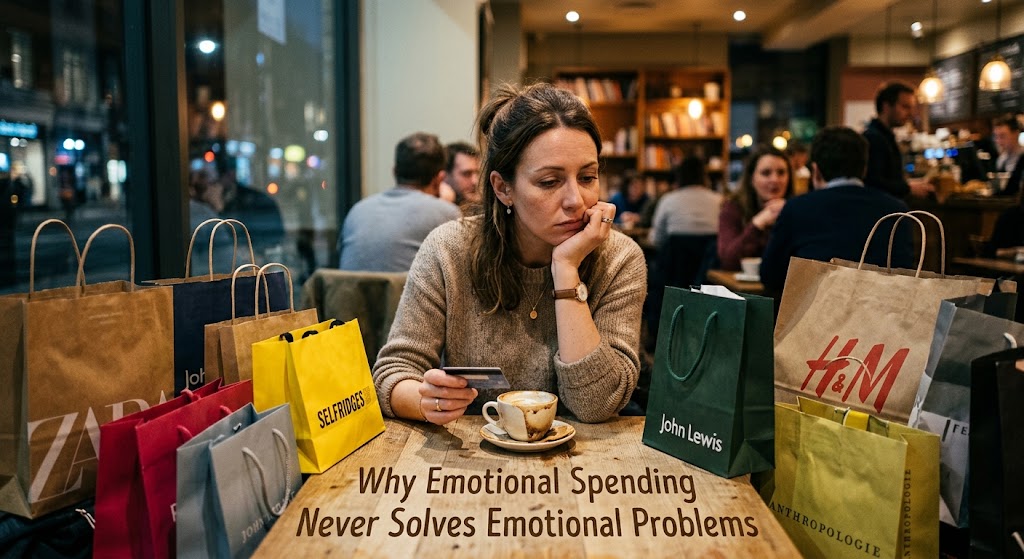
There is a strange comfort that comes from buying something when you are unhappy. You have had a terrible day, you feel rejected, lonely, stressed, disappointed or simply tired of everything, and suddenly the thought of buying something makes you feel a little better. Maybe it is a new pair of shoes, a phone accessory, a meal you did not plan to buy, expensive skincare, a new outfit, a weekend trip or something sitting in your online shopping cart. For a few minutes, the emotional heaviness seems to disappear. You click “buy now”, receive the confirmation message and experience a tiny burst of excitement. It feels like relief. It feels like you have done something for yourself. Why Emotional Spending Never Solves Emotional Problems.
But then the excitement fades.
The problem that caused the pain is still there.
The loneliness has not disappeared. The relationship is still broken. The financial pressure is still waiting for you. The insecurity has not been healed. The disappointment is still sitting somewhere inside you. The stress that pushed you towards spending has not magically disappeared. In many cases, you now have another problem to deal with because the money you spent was needed for something else.
This is why understanding why emotional spending never solves emotional problems is so important. Emotional spending can temporarily change how you feel, but it rarely changes why you feel that way. It provides a momentary distraction from emotional pain without addressing the source of the pain itself.
Emotional spending happens when emotions, rather than genuine needs or carefully considered decisions, become the primary reason behind a purchase. It is not necessarily about buying expensive things. Someone can emotionally spend a large amount of money on a luxury item, but another person can emotionally spend small amounts every day on food, subscriptions, online shopping, entertainment, betting, clothing or unnecessary conveniences. The amount is not always the most important part. The motivation behind the spending is what matters.
You might tell yourself, “I deserve this.”
Sometimes you genuinely do deserve something nice. There is nothing wrong with enjoying your money. Personal finance is not supposed to be a punishment where you never eat out, never travel, never buy clothes and never enjoy the results of your hard work. The problem begins when spending becomes your primary emotional coping mechanism.
When buying something becomes the way you deal with sadness, anger, loneliness, anxiety, boredom or disappointment, money starts carrying an emotional responsibility it was never designed to carry.
Money can pay a bill, but it cannot repair your self esteem.
Money can buy dinner, but it cannot guarantee emotional fulfilment.
Money can buy beautiful clothes, but it cannot make someone value you.
Money can create comfort, but it cannot permanently remove loneliness.
Money can provide entertainment, but it cannot resolve unresolved emotional pain.
This is the central reason why emotional spending never solves emotional problems. The purchase addresses the surface feeling for a moment while leaving the underlying issue untouched.
Imagine someone who feels lonely after a difficult breakup. They spend money on new clothes, expensive meals, entertainment and weekend activities. For a few hours, they feel distracted. They may even feel excited. But when they return home and the distractions disappear, the loneliness may return. If the response is to spend again, a cycle begins.
Pain creates spending.
Spending creates temporary relief.
The relief disappears.
The original pain returns.
More spending is used to create another temporary escape.
Eventually, the person may have both emotional pain and financial stress.
That is where the situation becomes dangerous.
Financial stress can intensify emotional stress. If someone repeatedly spends money they cannot comfortably afford, the consequences eventually arrive. The bank balance becomes smaller. Bills become harder to pay. Savings goals are delayed. Debt may increase. Then the person feels guilty about what they have done. That guilt creates more emotional discomfort, and the same person may once again seek comfort through spending.
The very behaviour that was originally used to escape emotional pain can become another source of emotional pain.
This is why emotional spending can be so deceptive. It does not initially feel destructive. In fact, it can feel therapeutic. You may feel that you are rewarding yourself, taking care of yourself or giving yourself something to look forward to. There is nothing inherently wrong with those things. But there is a major difference between intentional enjoyment and emotional escape.
Intentional spending says, “I have decided that this is valuable to me.”
Emotional spending often says, “I need this purchase to change how I feel.”
That difference can completely change your financial life.
The modern world makes emotional spending even easier. You do not necessarily have to leave your house. Your phone can put thousands of products in front of you within seconds. Social media constantly exposes you to people displaying holidays, cars, clothes, restaurants, gadgets, homes and lifestyles that appear perfect. Online stores make purchasing almost effortless. Buy now, pay later services can make expensive purchases feel deceptively affordable. Targeted advertising can identify what you are interested in and place it directly in front of you when you are most vulnerable to temptation.
You can be sitting alone at midnight feeling miserable and, within five minutes, have ordered something you never planned to buy.
The purchase may arrive several days later.
The emotional problem may still be waiting for you.
This does not mean every spontaneous purchase is emotional spending. Sometimes life simply happens. You see something you like and buy it. That is normal. The warning sign is when your emotional state repeatedly determines your spending behaviour.
Pay attention to the moments when you suddenly feel an intense need to buy something. Ask yourself what happened immediately before the urge appeared.
Did someone hurt your feelings?
Did you have an argument?
Did you receive disappointing news?
Did you compare yourself with someone online?
Did you feel rejected?
Did you become bored?
Did you feel like your life was not progressing?
Did you feel unsuccessful?
Did you experience a stressful day at work?
Did you feel lonely?
Sometimes the product is not what you actually want. What you want is the emotional experience you believe the product will give you.
A new outfit might represent confidence.
A luxury meal might represent comfort.
A new phone might represent success.
A holiday might represent escape.
An expensive purchase might represent achievement.
Shopping can therefore become symbolic. You are not simply buying an object. You are buying a temporary version of how you wish you felt.
And that is precisely why the satisfaction can disappear so quickly.
Once the emotional excitement fades, the object is left behind. The deeper need remains.
If you feel inadequate, buying something expensive does not automatically make you feel adequate. If you feel unwanted, buying something beautiful does not automatically make you feel loved. If you feel directionless, buying something new does not automatically give your life direction.
Why Emotional Spending Never Solves Emotional Problems
The solution is not to stop enjoying your money. The solution is to stop asking your money to solve problems that require emotional, relational, psychological or behavioural solutions.
Sometimes what you need after a difficult day is not a shopping cart. You need rest.
Sometimes you do not need another meal delivered to your door. You need someone to talk to.
Sometimes you do not need a new outfit to feel attractive. You need to stop measuring your worth against other people.
Sometimes you do not need another expensive gadget. You need to confront the dissatisfaction that is making everything you already own feel insufficient.
Sometimes you do not need a weekend of reckless spending. You need to admit that you are exhausted.
This requires emotional awareness.
Before making an emotionally charged purchase, pause. Do not immediately tell yourself that you cannot buy it. Instead, ask yourself why you want it right now.
A simple question can be surprisingly powerful: “What am I actually feeling?”
You may discover that the answer has nothing to do with the product.
You may be angry.
You may be lonely.
You may be bored.
You may feel unsuccessful.
You may be seeking validation.
You may be trying to reward yourself because you feel life has been unfair.
Once you identify the emotion, you can decide whether spending is actually an appropriate response.
If you are lonely, call someone.
If you are exhausted, rest.
If you are angry, give yourself time before making decisions.
If you are overwhelmed, simplify your responsibilities.
If you are grieving, allow yourself to grieve.
If you are struggling with your self worth, work on the beliefs you have about yourself instead of trying to purchase a new identity.
If you are dealing with serious emotional distress, consider speaking with a qualified mental health professional or another trusted source of support.
The goal is not perfection. You will probably make emotional purchases from time to time. Most people do. The important thing is becoming more conscious of the pattern.
You can also create practical barriers between your emotions and your money. Removing saved payment details from shopping websites can create an extra moment of reflection. Waiting 24 hours before making nonessential purchases can prevent emotional decisions. Creating a specific entertainment or personal spending allowance can allow you to enjoy your money without destroying your larger financial plans.
Another useful strategy is to separate your emotional needs from your financial goals. If you know that you enjoy buying things, create room for enjoyment in your budget. A financial plan that allows absolutely no pleasure may eventually feel so restrictive that you abandon it. The goal is not to become afraid of spending. The goal is to spend deliberately.
There is also an important lesson about self care here.
Consumer culture has increasingly connected self care with purchasing. Take yourself shopping. Buy this. Upgrade that. Treat yourself. You deserve it. While occasional purchases can certainly be enjoyable, self care should not require a transaction every time.
Sometimes self care is going for a walk.
Sometimes it is sleeping early.
Sometimes it is saying no.
Sometimes it is having an honest conversation.
Sometimes it is taking a break.
Sometimes it is cooking a meal at home.
Sometimes it is deleting an account that constantly makes you compare yourself with other people.
Sometimes it is finally dealing with a problem you have been avoiding.
Real self care is not always glamorous. Sometimes it is uncomfortable because it requires you to confront what is hurting you rather than covering it with something shiny.
This is especially important for people trying to build financial stability. Every emotionally driven purchase may appear small when viewed individually. The problem becomes obvious when you look at the pattern over months or years.
Imagine spending £20 or ₦20,000 every time you feel stressed. Perhaps you tell yourself it is nothing serious because the individual purchase is manageable. But if the behaviour happens repeatedly, the cumulative cost can become significant. The money could have been used to build an emergency fund, reduce debt, invest, support a meaningful goal or simply create breathing room in your financial life.
The issue is therefore not merely that emotional spending costs money. It is that emotional spending can quietly redirect money away from the future you say you want.
You may say you want financial freedom while repeatedly using money to purchase temporary emotional relief.
You may say you want to save for a home while spending whenever you feel inadequate.
You may say you want to escape debt while using shopping as a reward whenever life becomes difficult.
This creates a conflict between your immediate emotional needs and your long term financial goals.
The answer is not to ignore your emotions. It is to learn how to experience emotions without automatically turning them into financial decisions.
That is a powerful financial skill.
Not every feeling needs an action.
You can feel sad without shopping.
You can feel angry without spending.
You can feel bored without ordering something.
You can feel jealous without upgrading your lifestyle.
You can feel unsuccessful without trying to prove yourself through possessions.
You can feel lonely without buying something simply because it gives you a temporary dopamine rush.
Learning this changes your relationship with money.
Money stops becoming an emotional emergency button and starts becoming a tool.
That distinction can transform your finances.
One of the hardest truths about emotional spending is that the purchase often gives you exactly what you need for a few minutes, which is why you repeat it. The brain learns that spending can produce a quick emotional reward. But quick relief is not the same thing as genuine healing.
A painkiller can reduce the sensation of pain without fixing the cause of the pain. Emotional spending can work similarly. It can reduce emotional discomfort temporarily without resolving the underlying problem.
Eventually, the effect wears off.
Then you need another dose.
The healthier alternative is to become curious about the pain instead of immediately trying to silence it.
Ask yourself what the emotion is trying to tell you.
If you constantly spend when you feel unsuccessful, perhaps you need to reconsider how you define success.
If you constantly spend when you feel lonely, perhaps you need deeper relationships.
If you spend when you feel stressed, perhaps your lifestyle needs boundaries.
If you spend when you feel unattractive, perhaps your self image needs attention.
If you spend when you feel bored, perhaps your life needs meaningful activities rather than more consumption.
The purchase may be the visible behaviour, but the real opportunity is hidden underneath it.
You do not have to hate shopping to overcome emotional spending. You do not have to become extremely frugal. You do not have to deny yourself every pleasure. You simply need to become honest about what is happening between your emotions and your wallet.
Before you buy something you do not need, especially when you are emotionally overwhelmed, pause and ask yourself one final question: “If I felt completely calm and satisfied right now, would I still want this?”
If the answer is yes, perhaps the purchase is genuinely valuable to you.
If the answer is no, you may have just discovered that you were not shopping for the product. You were shopping for a feeling.
And feelings cannot be permanently purchased.
This is ultimately why emotional spending never solves emotional problems. Money can create experiences, provide comfort and improve your quality of life, but it cannot permanently heal wounds that require understanding, acceptance, connection, boundaries, personal growth or professional support.
The next time you feel the urge to spend because you are hurting, do not immediately judge yourself. Pause. Notice the emotion. Give yourself some time. Ask what you actually need. Then make your financial decision from a place of clarity rather than pain.
You may discover that the thing you were about to buy was never the thing you really needed.
Sometimes the most financially powerful purchase is the one you decide not to make.
And sometimes the greatest financial breakthrough begins when you realise that your wallet was never the real problem. Your emotions were asking for attention, and you were answering with money.

EarnSmartOnline.com.ng is dedicated to helping readers make smarter financial decisions through practical guides on online income, personal finance, technology, digital business, and wealth creation. Our goal is to provide reliable, easy-to-understand, and actionable content that empowers individuals to earn smarter, build sustainable income streams and achieve long-term financial success.
Recommended: Start Earning Online
- Ultimate Affiliate Marketing Program — learn affiliate marketing with a done-for-you sales system ($15). Check it out
- The Newbie Affiliate Guide — the beginner-friendly starter guide (~$6.68). Check it out
- Easy Dollar Maker — earn in dollars uploading AI images and videos from your phone ($17). Check it out
Disclosure: These are affiliate links. If you buy through them, I may earn a commission at no extra cost to you.



