
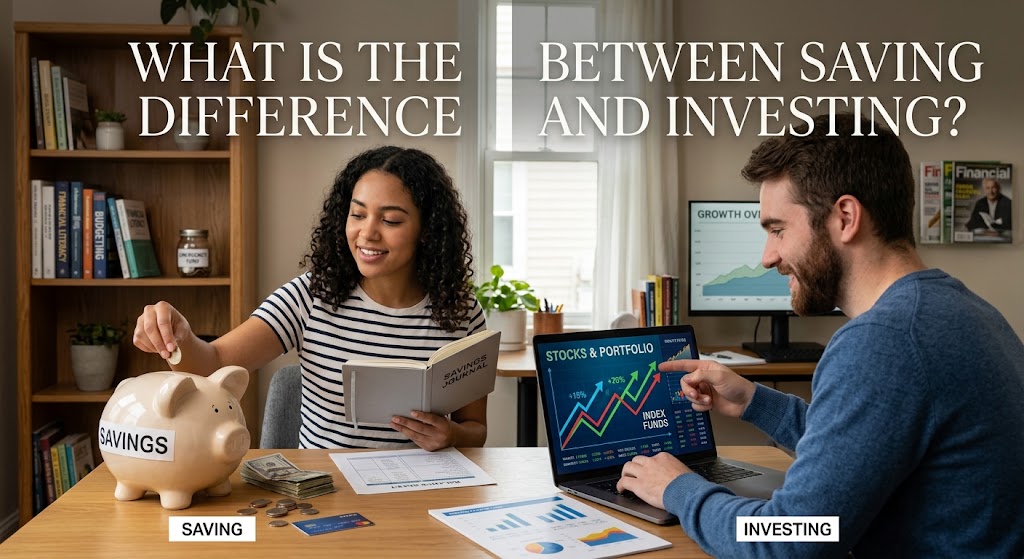
What is the difference between saving and investing?
What is the difference between saving and investing? This is one of the most important questions anyone trying to improve their financial life should ask. Saving and investing are often used interchangeably, but they serve different purposes, involve different levels of risk and play different roles in building financial security. Understanding the difference between saving and investing can help you make better decisions about where your money should go and when you should use it.
At the simplest level, saving involves putting money aside for future use, usually in a relatively safe and accessible place. Investing involves putting money into assets or opportunities with the expectation that the money will grow in value or generate income over time. Both are important, but they are designed to accomplish different financial goals.
When you save money, your main objective is generally to protect the money and keep it available when you need it. When you invest money, your primary objective is usually to grow your wealth over a longer period. The difference may sound straightforward, but understanding when to save, when to invest and when to do both is where personal finance becomes much more practical.
Imagine that you receive your salary at the end of the month. After paying your essential expenses, you have some money left. You might decide to put part of it into a savings account because you want to build an emergency fund. You might also invest another portion because you want to build wealth over several years. Although both actions involve putting money aside, the purpose of each decision is different.
Saving is generally more suitable for short term financial needs. If you expect to need the money soon, you usually do not want to expose it to unnecessary investment risk. An emergency fund is a good example. If your car breaks down, you lose an income source or you suddenly have an important bill to pay, you need money that can be accessed quickly.
The same principle applies to money you are saving for expenses that are approaching. If you are planning to pay school fees, move into a new home, replace an essential appliance or make another significant purchase within a relatively short period, keeping the money somewhere safe and accessible may make more sense than investing it in a volatile asset.
Investing is generally more appropriate for money you do not expect to need immediately. Investments can include shares, bonds, mutual funds, exchange traded funds, property and other assets, depending on the investor’s objectives, location and risk tolerance. The purpose is to give your money an opportunity to grow over time.
One of the biggest differences between saving and investing is risk. Savings products are generally designed to preserve your principal, although the exact level of protection depends on the financial institution, account type and country. Investments, on the other hand, can rise and fall in value.
For example, if you invest money in shares, the value of those shares can increase when the underlying companies perform well. However, their value can also fall because of economic conditions, company performance, market sentiment or other factors. You may make a profit, but you can also experience losses.
This is why investing should not be treated as a guaranteed way of making money. Every investment carries some form of risk, and the potential for higher returns usually comes with greater uncertainty. Saving generally prioritises stability and accessibility, while investing generally prioritises long term growth.
Another important difference between saving and investing is time. Saving can be useful for short term goals, while investing is generally more effective when you have a longer time horizon.
Suppose you need money in three months. Investing that money in an asset that could lose substantial value during those three months may expose you to unnecessary risk. If the market falls just when you need the money, you could be forced to sell at a loss.
Now imagine that you are setting aside money for a goal that is several decades away. In that situation, you may have more time to tolerate market fluctuations and potentially benefit from long term growth. This is one reason investing is commonly associated with long term financial goals such as retirement and wealth creation.
The power of compound growth is another reason investing can be valuable over long periods. When an investment generates returns and those returns are reinvested, future returns can potentially be earned on both the original money and previous gains. Over many years, this compounding effect can become significant.
Saving can also earn interest, depending on the account, but savings rates may not always keep pace with inflation. Inflation means that prices generally increase over time, reducing the purchasing power of money. If your savings earn a return below the rate of inflation for a prolonged period, your money may grow in numerical terms while losing purchasing power in real terms.
This does not mean saving is bad. Far from it. Saving is one of the foundations of a healthy financial plan. The mistake is assuming that every naira, pound or dollar you own should either be sitting in a savings account or invested. Different portions of your money can have different jobs.
One useful way to think about personal finance is to give every amount of money a purpose. Money needed for immediate expenses should remain accessible. Money intended for emergencies should be protected and readily available. Money intended for long term growth can potentially be invested according to your goals and risk tolerance.
This approach helps explain why the question “What is the difference between saving and investing?” matters so much. The issue is not about choosing one forever. It is about understanding which tool is appropriate for each financial objective.
An emergency fund is usually one of the first things people should consider building before taking significant investment risks. The exact amount depends on your circumstances, income stability, essential expenses and responsibilities. Someone with highly predictable income may have different needs from someone whose income changes significantly from month to month.
The important point is that an emergency fund can protect your investments from being disturbed at the wrong time. Without emergency savings, an unexpected financial problem might force you to sell an investment when its value has fallen.
Consider someone who invests almost all their spare money but has no emergency savings. If they suddenly face a major expense, they may have to sell investments immediately. If markets happen to be down, they could turn a temporary market decline into a permanent financial loss.
Someone with an adequate emergency fund may have more flexibility to leave long term investments alone while dealing with the emergency from their savings.
Another difference between saving and investing is accessibility. Savings are generally easier to access, depending on the account. Investments can be less convenient to liquidate, particularly when the asset is property or another investment that cannot easily be converted into cash.
Even investments that can be sold quickly may not provide the exact amount you expect at the moment you need the money. Market prices change. Selling an investment is therefore not always the same as withdrawing a fixed balance from a savings account.
Taxes and fees can also differ between saving and investing. Savings accounts may have certain fees or tax considerations depending on the jurisdiction. Investments can involve transaction costs, management fees, platform charges, taxes on income or capital gains and other expenses. These costs can reduce your overall return.
This is why people should look beyond the headline return. An investment that appears to generate an attractive return may become less attractive after fees, taxes and inflation are considered.
The difference between saving and investing also becomes important when considering financial goals. If your goal is to buy something within the next few months, saving may be appropriate. If your goal is to build wealth over twenty or thirty years, investing may have a more important role.
However, there is no universal formula that says everyone must save a particular percentage and invest another particular percentage. Your financial situation matters. Income, debt, age, dependants, emergency needs, financial goals and risk tolerance can all influence the right balance.
Debt is another factor that should not be ignored. If you have expensive high interest debt, paying it down can sometimes provide a more certain financial benefit than taking investment risk. The right decision depends on the interest rate, investment opportunity, tax considerations and your broader financial circumstances.
For example, someone carrying very expensive consumer debt while investing aggressively may need to reconsider the order of their priorities. Building an emergency fund, managing expensive debt and then investing for long term goals can sometimes provide a more stable foundation.
However, this does not mean you must wait until you are completely debt free before investing. Some people can save, repay debt and invest simultaneously. What matters is understanding the cost and purpose of each financial decision.
Saving also plays an important psychological role. Knowing that you have money available for emergencies can reduce financial stress and give you greater confidence when unexpected expenses appear.
Investing, meanwhile, can encourage long term thinking. Watching investments fluctuate can teach patience and help people understand that wealth building is not necessarily about getting rich quickly. It is often about consistently allocating money towards productive assets and allowing time to work in your favour.
One of the biggest mistakes beginners make is treating investing like gambling. They see someone make money from a particular asset and immediately want to copy the opportunity. They may invest money they cannot afford to lose because they are focused on short term gains.
A better approach is to understand the purpose of the money before deciding what to do with it.
If losing the money would create an immediate financial crisis, that money probably needs a different strategy from money that you will not need for many years.
Another common mistake is keeping all money in cash indefinitely because investing feels frightening. Fear is understandable, especially when markets are volatile. However, avoiding investment entirely can create another type of risk because inflation can gradually reduce the purchasing power of money.
The goal is therefore not to eliminate every financial risk. It is to understand the different risks and manage them according to your circumstances.
A balanced financial strategy can involve both saving and investing. You might maintain an emergency fund in accessible savings while investing money intended for long term goals. You might also keep separate savings for short term purchases so that you do not have to rely on investments whenever an expense appears.
Think of saving as building financial stability and investing as pursuing long term financial growth. Stability gives you a foundation. Growth helps you potentially increase your wealth.
The two can work together.
Suppose you receive a monthly income of ₦500,000. After essential expenses, you have ₦100,000 available for financial goals. You could decide that some of that money goes towards building or maintaining emergency savings while another portion is directed towards long term investments, depending on your circumstances. The precise amounts are less important than the principle of giving the money different jobs.
As your emergency fund becomes adequate, you may eventually be able to direct more of your surplus towards long term investing. If your circumstances change, you can adjust the balance again.
This flexibility is important because personal finance is not a one time decision. Your income can change. Your responsibilities can change. Your goals can change. Interest rates can change. Markets can change. Your financial strategy should be capable of changing with them.
So, what is the difference between saving and investing? Saving is primarily about setting money aside for safety, accessibility and relatively short term financial needs. Investing is primarily about putting money into assets or opportunities that have the potential to grow in value or generate income over the long term, while accepting a greater possibility of loss.
Saving generally offers greater stability and easier access, while investing generally offers greater growth potential with greater risk. Saving can help you prepare for emergencies and upcoming expenses, while investing can help you pursue long term goals such as retirement and wealth creation.
Neither is automatically better than the other. They solve different problems.
The real financial mistake is not choosing saving over investing or investing over saving. The real mistake is failing to understand what your money is supposed to accomplish.
If you invest money that you urgently need, you may expose yourself to unnecessary risk. If you keep all your long term wealth in cash without considering inflation and growth, you may limit the potential of your money. The answer is to match the financial tool to the financial goal.
Understanding what is the difference between saving and investing can therefore change the way you think about money. Instead of asking where you should put your money simply because someone else recommends a particular account or investment, you can start by asking a more important question: “What job does this money need to perform?”
If the answer is protection and accessibility, saving may be appropriate. If the answer is long term growth and you can tolerate investment risk, investing may be worth considering.
Ultimately, saving and investing are not competing financial philosophies. They are two different tools that can work together. Saving can help protect your present, while investing can help you prepare for your future.
The smartest financial strategy is not necessarily the one that promises the highest return. It is the one that understands your goals, protects you from avoidable financial problems and gives your money the best opportunity to serve you over time.
Once you understand the difference between saving and investing, you can stop treating every financial decision as an either or choice. You can save for what is near, invest for what is far away and build a financial system where every part of your money has a clear purpose.

EarnSmartOnline.com.ng is dedicated to helping readers make smarter financial decisions through practical guides on online income, personal finance, technology, digital business, and wealth creation. Our goal is to provide reliable, easy-to-understand, and actionable content that empowers individuals to earn smarter, build sustainable income streams and achieve long-term financial success.
Recommended: Start Earning Online
- Ultimate Affiliate Marketing Program — learn affiliate marketing with a done-for-you sales system ($15). Check it out
- The Newbie Affiliate Guide — the beginner-friendly starter guide (~$6.68). Check it out
- Easy Dollar Maker — earn in dollars uploading AI images and videos from your phone ($17). Check it out
Disclosure: These are affiliate links. If you buy through them, I may earn a commission at no extra cost to you.



