
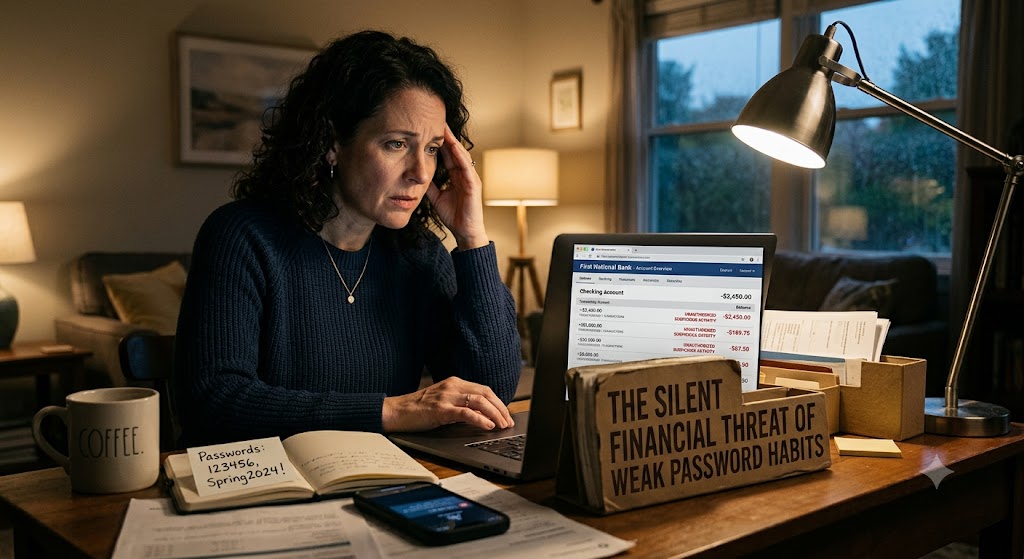
The Silent Financial Threat of Weak Password Habits
Most people think financial security begins with earning more money, creating a budget, paying off debt, saving consistently, and investing wisely. While these habits are essential, there is another financial risk that quietly destroys wealth every single day without attracting much attention. It is not inflation. It is not unemployment. It is not poor investment decisions. It is something much simpler and far more overlooked. Weak password habits have become one of the biggest silent financial threats in the digital age, and millions of people continue to underestimate the damage they can cause.
Today, our financial lives exist largely online. We use internet banking, mobile payment applications, online shopping platforms, investment portals, cryptocurrency wallets, digital savings accounts, email services, cloud storage, tax portals, business dashboards, and social media accounts that are often connected to payment methods. Every one of these accounts is protected by a password. Unfortunately, many people still treat passwords as an inconvenience rather than the first line of defense protecting everything they have worked hard to build.
The problem with weak password habits is that they rarely cause immediate problems. A person can use the same password for ten years without experiencing any obvious consequences. They may believe they are safe because nothing bad has happened. This false sense of security is exactly what cybercriminals rely on. Weak password habits are dangerous because they create vulnerabilities that remain invisible until the day an attacker discovers them. By then, the financial damage may already be severe.
Many people use passwords that are incredibly easy to guess. Birthdays, names of children, favorite football clubs, simple number sequences like 123456, passwords such as “password,” or combinations like “John123” continue to appear among the world’s most commonly used passwords. Criminals know this. Modern hacking software can test millions of common password combinations within seconds. What once required technical expertise has become increasingly automated.
Another dangerous habit is password reuse. Someone creates one memorable password and uses it for email, online banking, shopping websites, streaming services, social media, work accounts, and investment platforms. It feels convenient because remembering dozens of unique passwords seems impossible. Unfortunately, this convenience creates a domino effect. If just one website suffers a data breach and your password becomes exposed, attackers immediately attempt that same password on hundreds of other popular services. This technique, known as credential stuffing, has become one of the most successful methods criminals use to take over online accounts.
Email accounts deserve particular attention because they often function as the master key to nearly every digital service. Most password reset links are sent directly to email addresses. If a criminal gains access to your email account, they may not need to know your banking password at all. They simply request a password reset, intercept the reset email, and create a new password. Within minutes they may control your bank account, investment platform, online shopping accounts, digital wallets, and cloud storage.
The financial consequences extend far beyond stolen money. Criminals who gain access to financial accounts may apply for loans using stolen identities, make unauthorized purchases, withdraw savings, sell investment assets, access confidential business information, or even lock legitimate owners out of their own accounts. Recovering from identity theft often requires months of paperwork, legal documentation, account verification, and emotional stress. Some victims never recover every dollar they lose.
Weak password habits also threaten small businesses. Entrepreneurs often believe cybercriminals only target large corporations. The reality is quite different. Small businesses frequently become attractive targets because they typically have weaker security systems. A compromised administrator password can expose customer information, payroll records, supplier contracts, financial statements, and confidential business strategies. The resulting financial losses may include legal expenses, customer compensation, regulatory fines, reputational damage, lost sales, and operational downtime.
One overlooked aspect of password security is the relationship between convenience and risk. Humans naturally prefer convenience. We create passwords that are easy to remember because our brains dislike complexity. Unfortunately, what is easy for us to remember is often easy for criminals to predict. Cybersecurity continually reminds us that convenience and security often move in opposite directions. The safest password may not be the easiest to memorize, but modern tools have made this challenge much easier to manage.
Password managers have emerged as one of the most effective solutions. Instead of memorizing dozens of complicated passwords, users only need to remember one strong master password. The password manager generates unique, random, highly complex passwords for every account and stores them securely. If one website experiences a breach, every other account remains protected because each password is completely different.
Some people hesitate to use password managers because they fear placing all their passwords in one location. While this concern is understandable, reputable password managers use strong encryption specifically designed to protect sensitive information. In many cases, using a trusted password manager is significantly safer than relying on human memory or writing passwords on paper.
Another common mistake involves making only small variations to the same password. Someone might use “Family2025!” for email, “Family2025!!” for banking, and “Family2025!!!” for shopping. From a security perspective, these passwords remain highly predictable. Once attackers identify one version, they often test similar variations automatically.
Password length plays an equally important role. Many people focus only on complexity by adding symbols or numbers while ignoring overall length. A long password or passphrase containing several unrelated words is generally far stronger than a short password filled with special characters. Longer passwords dramatically increase the number of possible combinations attackers must attempt, making brute-force attacks far less practical.
Two-factor authentication adds another critical layer of financial protection. Even if criminals somehow obtain a password, they still need a second verification factor such as a temporary authentication code, a security key, or biometric verification before accessing the account. This additional step has prevented countless financial crimes around the world. Every important financial account should have two-factor authentication enabled whenever possible.
Public Wi-Fi networks introduce another overlooked financial risk. Many people log into banking applications or payment platforms while connected to unsecured public networks in airports, hotels, restaurants, or shopping malls. Although encrypted websites provide significant protection, attackers sometimes create fake Wi-Fi networks that imitate legitimate ones, hoping unsuspecting users will connect and unknowingly expose sensitive information. Using trusted mobile data or secure virtual private networks for financial activities provides additional protection.
Phishing attacks continue to evolve at an alarming pace. Rather than guessing passwords directly, criminals increasingly trick victims into voluntarily revealing them. Fraudulent emails, text messages, social media messages, or fake websites may appear nearly identical to legitimate organizations. They create urgency by claiming an account has been suspended, unauthorized transactions have occurred, or immediate verification is required. Panicked users click fraudulent links and unknowingly enter their passwords into fake login pages controlled by criminals.
Artificial intelligence has made phishing even more convincing. Poor grammar and obvious spelling mistakes once helped identify fraudulent messages. Today, AI-generated phishing campaigns produce highly professional emails that closely resemble genuine communications from banks, online retailers, delivery companies, government agencies, and technology firms. As these scams become more sophisticated, password awareness becomes even more important.
Families should also recognize that password security is a shared responsibility. Parents often teach children how to save money but rarely teach them how to protect digital accounts. Young people increasingly use online banking, gaming platforms, digital wallets, and social media from an early age. Teaching strong password habits alongside financial literacy prepares them for a world where digital identity and financial security are deeply connected.
Older adults face different challenges. Many seniors struggle to remember complex passwords and may become more vulnerable to phishing scams or social engineering attacks. Criminals frequently target elderly individuals because they may possess retirement savings while having less experience recognizing modern cyber threats. Patient education and simple security tools can significantly reduce these risks.
Businesses should establish password policies rather than leaving security decisions entirely to employees. Requirements for unique passwords, minimum lengths, password managers, regular security awareness training, and multi-factor authentication create multiple barriers that discourage attackers. A single compromised employee password can sometimes expose an entire organization’s financial infrastructure.
The financial cost of cybercrime continues to grow globally each year. Individuals often assume only wealthy people become targets. In reality, criminals frequently prefer attacking ordinary users because they may have weaker security and are less likely to detect suspicious activity immediately. Small thefts multiplied across thousands of victims generate enormous profits for cybercriminal organizations.
Many people delay improving password security because they assume they will do it later. Unfortunately, cyberattacks rarely provide advance notice. Security is most valuable before an incident occurs, not afterward. Strengthening password habits today may prevent financial losses that could otherwise require years to recover from.
Regular account monitoring should become part of every personal financial routine. Checking bank statements, credit card transactions, investment activity, and login notifications helps detect suspicious behavior early. The sooner unauthorized activity is identified, the greater the likelihood of limiting financial damage.
Another overlooked habit involves storing passwords in unsecured documents or sending them through messaging applications without encryption. Screenshots containing passwords, notes stored on unsecured devices, or shared login credentials within organizations create unnecessary vulnerabilities. Sensitive information should always be handled with appropriate security measures.
Password security also influences business reputation. Customers expect organizations to protect personal information responsibly. Data breaches caused by poor password management can permanently damage public trust. Rebuilding credibility after a major security incident often costs far more than implementing proper security practices from the beginning.
Some people mistakenly believe antivirus software alone protects them from password theft. While antivirus programs remain valuable, they cannot compensate for weak passwords or prevent users from voluntarily entering credentials into fraudulent websites. Cybersecurity requires multiple protective layers working together rather than relying on any single solution.
Financial planning traditionally emphasizes budgeting, investing, insurance, and retirement preparation. Digital security now deserves a place alongside these traditional financial disciplines. Protecting existing wealth is just as important as creating new wealth. A person who spends decades building financial stability can lose substantial assets surprisingly quickly if criminals gain access to poorly protected digital accounts.
Good password habits reflect a broader mindset of responsibility and preparation. Just as homeowners lock their doors before leaving the house, responsible digital citizens protect their online identities with strong, unique passwords and additional security measures. These habits require only a small investment of time but provide lasting protection against increasingly sophisticated threats.
The future will likely become even more digital. Online banking, digital currencies, biometric verification, artificial intelligence, connected devices, and cloud-based financial services will continue expanding. As digital convenience increases, so will the importance of securing access to these systems. Weak password habits that may seem insignificant today could become even more dangerous tomorrow.
Financial success is not determined solely by how much money you earn or how wisely you invest. It is also determined by how effectively you protect what you already own. Every strong password represents another barrier standing between your financial future and those who seek to exploit it. Every unique password reduces the risk of widespread account compromise. Every enabled authentication feature strengthens your digital defenses.
The silent financial threat of weak password habits is not dramatic until it becomes personal. It does not announce itself with warning signs or newspaper headlines directed at individual victims. Instead, it waits quietly for moments of carelessness, repeated passwords, ignored security updates, or successful phishing attempts. The financial losses that follow often appear sudden, but the underlying vulnerability has usually existed for years.
Protecting your financial future requires more than earning, saving, investing, and planning. It requires recognizing that cybersecurity has become an essential part of modern financial management. Strong password habits are no longer simply an IT recommendation. They are a financial necessity. By creating unique passwords, using a trusted password manager, enabling two-factor authentication, remaining alert to phishing attempts, monitoring accounts regularly, and treating digital security with the same seriousness as physical security, individuals can significantly reduce one of the most overlooked financial risks of our time.
Money can take years to accumulate but only moments to lose. In an increasingly connected world, one of the simplest and most effective ways to safeguard your wealth begins with something many people still underestimate: the strength of the passwords protecting your digital life.

EarnSmartOnline.com.ng is dedicated to helping readers make smarter financial decisions through practical guides on online income, personal finance, technology, digital business, and wealth creation. Our goal is to provide reliable, easy-to-understand, and actionable content that empowers individuals to earn smarter, build sustainable income streams and achieve long-term financial success.
Recommended: Start Earning Online
- Ultimate Affiliate Marketing Program — learn affiliate marketing with a done-for-you sales system ($15). Check it out
- The Newbie Affiliate Guide — the beginner-friendly starter guide (~$6.68). Check it out
- Easy Dollar Maker — earn in dollars uploading AI images and videos from your phone ($17). Check it out
Disclosure: These are affiliate links. If you buy through them, I may earn a commission at no extra cost to you.



