
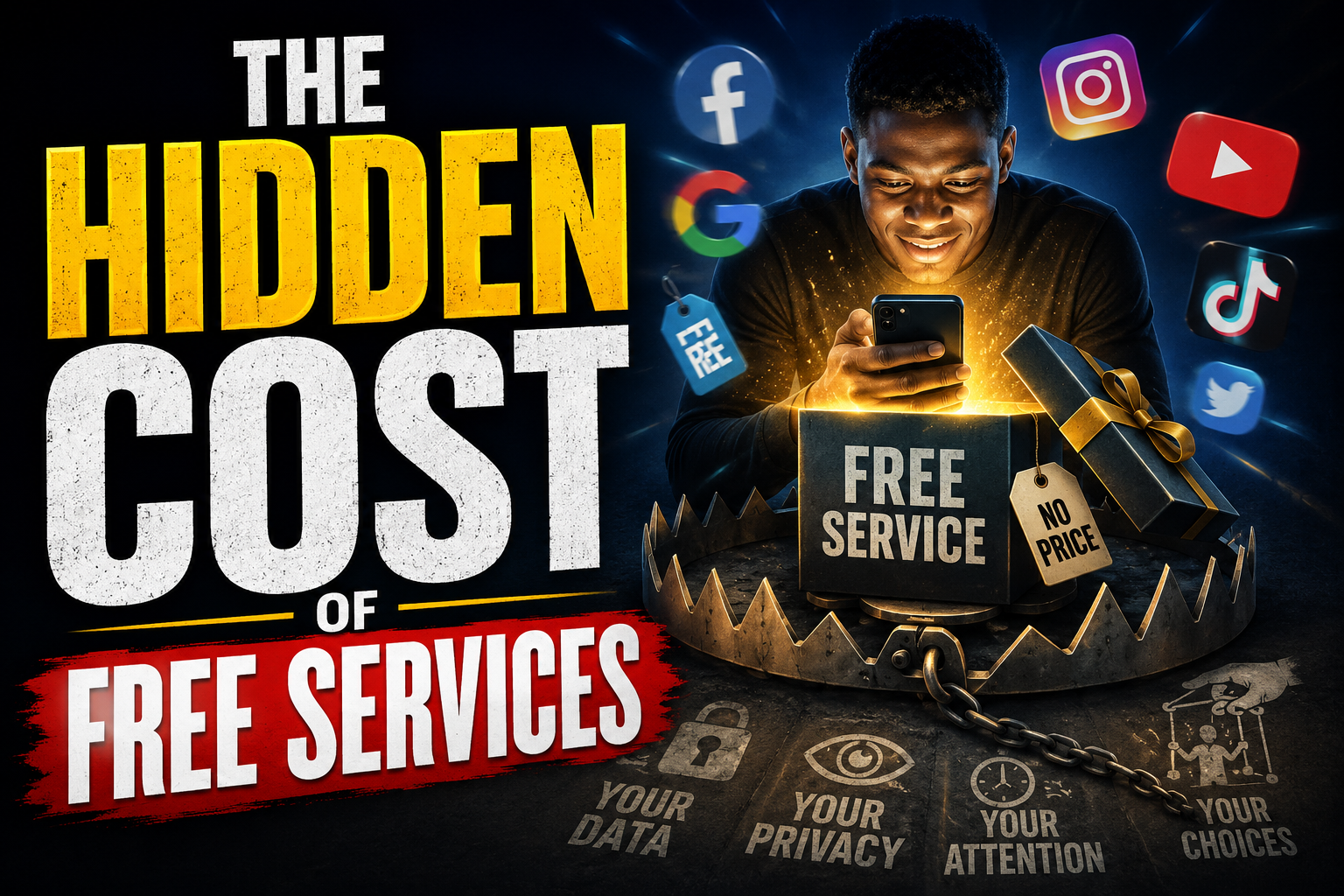
The Hidden Cost of Free Services
The internet has transformed the way people live, work, communicate, learn, shop, and entertain themselves. Today, billions of people enjoy access to search engines, social media platforms, email providers, cloud storage, messaging applications, navigation tools, online marketplaces, video streaming platforms, and countless mobile apps without paying a single naira or dollar upfront. At first glance, this seems like one of humanity’s greatest achievements. People can connect with loved ones across continents, build businesses from their bedrooms, gain access to educational resources, and consume endless entertainment without opening their wallets. It feels like a world where everything valuable has suddenly become free. Yet beneath this convenient reality lies an uncomfortable truth that many users rarely stop to consider. Nothing of real value is ever completely free. Every service has a cost, and if you are not paying with money, there is a good chance you are paying with something else.
The phrase “If you’re not paying for the product, you are probably the product” has become increasingly relevant in the digital age. While it may sound dramatic, it captures a fundamental economic principle. Businesses exist to generate revenue. They hire employees, rent offices, maintain servers, invest in research, market their products, and satisfy investors. All these activities require money. Therefore, when a company offers an apparently free service to millions or even billions of users, it must recover those costs through another method. Understanding how this works is essential for anyone who wants to make smarter financial and technological decisions.
One of the biggest hidden costs of free services is your personal data. Every click, search, location update, purchase history, browsing habit, device information, and interaction creates valuable information about who you are. Individually, these pieces of information may appear harmless. Together, they create a remarkably detailed profile of your interests, habits, fears, ambitions, relationships, preferences, and spending patterns. Companies collect this information because it allows them to understand users with incredible accuracy.
This information has become one of the world’s most valuable business assets. Advertisers are willing to spend enormous amounts of money to reach the right audience at precisely the right moment. Rather than showing the same advertisement to everyone, businesses can now target people based on age, location, hobbies, shopping history, income level, education, relationship status, and even recent online behaviour. The more accurately companies understand users, the more valuable their advertising platforms become. This explains why many digital services remain free while generating billions of dollars every year.
Many people believe they have nothing to hide, so they assume data collection is not a problem. However, privacy is not about hiding wrongdoing. Privacy is about maintaining control over your personal information. Most people lock the doors to their homes, not because they are criminals, but because privacy is a basic human need. The same principle applies online. Every piece of information you willingly or unknowingly surrender reduces your control over your digital identity.
Another hidden cost of free services is attention. In today’s economy, human attention has become one of the most valuable resources in existence. Every minute you spend scrolling through social media, watching recommended videos, reading endless feeds, or clicking suggested articles generates revenue for platforms. Their business depends on keeping you engaged for as long as possible. This means their algorithms are carefully designed to encourage continuous interaction.
Notifications arrive at strategic moments. Videos automatically play one after another. Infinite scrolling removes natural stopping points. Personalised recommendations encourage users to consume just one more piece of content. These design choices are not accidents. They are deliberate features developed after years of behavioural research and testing. The longer you stay, the more advertisements you see, and the more profitable the platform becomes.
The hidden cost of this attention economy is often invisible until people examine how much time disappears every day. Five minutes become thirty. Thirty minutes become three hours. Over weeks, months, and years, countless productive hours are exchanged for digital engagement that often provides very little lasting value. Lost attention eventually becomes lost opportunities, delayed goals, weaker relationships, lower productivity, and increased mental fatigue.
Free services also influence consumer behaviour in subtle ways. Recommendation engines decide which videos appear first, which products receive visibility, which news stories trend, and which creators become popular. Many users assume they are making completely independent choices, yet much of what they consume has already been filtered by algorithms optimised to maximise engagement rather than personal benefit.
This creates information bubbles where people repeatedly encounter ideas that reinforce existing beliefs. Over time, users may become less exposed to alternative perspectives, reducing critical thinking and increasing polarisation. Although the service remains financially free, the long-term cost may include reduced intellectual diversity and greater susceptibility to manipulation.
Another hidden expense involves digital dependence. Many individuals now rely almost entirely on free online platforms for communication, document storage, business operations, customer acquisition, entertainment, and even income generation. While these services provide enormous convenience, they also create dependency. If a platform changes its policies, suspends an account, introduces new restrictions, or experiences technical failures, users may suddenly lose access to years of work, valuable contacts, or important files.
Business owners who depend entirely on free social media platforms often discover this risk the hard way. One algorithm update can drastically reduce visibility. A mistaken account suspension can eliminate years of audience building overnight. A policy change can alter the effectiveness of marketing strategies that previously generated consistent income. The platform belongs to the company, not the user. As long as someone else owns the infrastructure, they control the rules.
This is one reason why many successful entrepreneurs encourage owning digital assets such as personal websites, email lists, and custom domain names. Unlike rented digital space on social media platforms, owned assets provide greater independence and long-term security. While creating and maintaining these assets requires investment, they often reduce vulnerability to sudden platform changes.
Free services may also introduce hidden financial costs through behavioural influence. Online shopping platforms recommend complementary products. Streaming services suggest premium subscriptions. Mobile games encourage microtransactions. Free software promotes paid upgrades. Cloud storage providers gradually reduce free limits while encouraging users to purchase additional space. These strategies are carefully designed to convert free users into paying customers over time.
This business model is not unethical by itself. Companies deserve to earn profits for providing valuable services. However, users should understand that free access frequently serves as the beginning of a carefully designed customer acquisition journey rather than the final destination. Recognising this process allows consumers to make intentional purchasing decisions instead of emotional ones.
Cybersecurity presents another hidden cost. Many free applications generate revenue through advertising networks, third-party partnerships, or extensive data sharing. Some applications request permissions that exceed their legitimate functionality. A simple flashlight application requesting access to contacts, location, camera, microphone, and storage should immediately raise concerns. Every unnecessary permission potentially increases privacy risks.
In some situations, poorly maintained free services may receive fewer security updates than premium alternatives. Cybercriminals constantly search for vulnerabilities in popular software. Companies with limited financial resources may struggle to maintain strong cybersecurity infrastructure. As a result, users may unknowingly expose themselves to identity theft, financial fraud, phishing attacks, malware infections, or data breaches.
Free email accounts, cloud storage services, and messaging platforms often contain highly sensitive personal information. A successful cyberattack can expose years of conversations, financial documents, photographs, passwords, and business information. The monetary cost of recovering from identity theft frequently exceeds any savings gained from using free services.
Psychological wellbeing also deserves consideration. Many free platforms measure success through engagement metrics rather than user satisfaction. Features that maximise user activity may unintentionally increase anxiety, comparison, loneliness, fear of missing out, or reduced attention spans. Constant exposure to carefully curated highlights from other people’s lives creates unrealistic standards that negatively affect self-esteem.
Children and teenagers are particularly vulnerable because their identities are still developing. Growing up in environments where social approval is quantified through likes, comments, shares, and follower counts can reshape self-worth around external validation rather than internal confidence. Although access to these platforms costs nothing financially, the emotional consequences may last for years.
Another hidden cost involves reduced ownership over digital content. Many users upload photographs, videos, documents, and creative work to free platforms without reading the terms of service. While creators generally retain copyright over their content, many platforms receive broad licences allowing them to store, distribute, modify, or display uploaded material within their ecosystems. Most users accept these agreements without fully understanding what they contain.
The convenience of free cloud services also encourages digital accumulation. Thousands of photographs, documents, emails, and files accumulate over time. Eventually, users become emotionally attached to these ecosystems. Switching providers becomes increasingly difficult because transferring years of digital history requires significant effort. Economists describe this phenomenon as switching costs. The service initially appears free, yet leaving eventually becomes expensive in terms of time, effort, and inconvenience.
There is also the economic cost of reduced competition. Large companies capable of offering free services often attract enormous user bases very quickly. Smaller competitors may struggle to survive because they cannot afford similar business models. Over time, markets may become dominated by a handful of technology giants with significant influence over communication, commerce, advertising, and information distribution. Reduced competition can eventually lead to fewer consumer choices, slower innovation, and greater market concentration.
Businesses themselves are not immune to the hidden costs of free services. Many organisations rely on free productivity software, communication tools, analytics platforms, and customer relationship management systems during their early growth stages. While this approach reduces initial expenses, limitations eventually appear. Storage restrictions, branding limitations, advertising, feature caps, customer support delays, and integration challenges may reduce operational efficiency. Businesses often discover that upgrading becomes unavoidable once growth reaches a certain point.
The hidden cost of free services also extends to education. Free online courses, tutorials, videos, and articles have democratised learning on an unprecedented scale. However, free information alone rarely guarantees mastery. Without structured guidance, accountability, practical application, mentorship, or consistent discipline, many learners accumulate information without developing valuable skills. The greatest cost is not financial but the illusion of progress. Watching educational content feels productive, yet genuine competence requires sustained practice.
There is also a significant time cost. Time remains the one resource that cannot be replaced. Every advertisement watched, every unnecessary notification opened, every recommendation followed, and every distraction accepted consumes moments that could have been invested elsewhere. Over decades, these seemingly insignificant interruptions accumulate into months or even years of lost productive time.
Despite these hidden costs, free services are not inherently bad. In fact, they have created extraordinary opportunities for individuals, businesses, students, entrepreneurs, researchers, and entire communities. Free search engines have expanded access to knowledge. Free communication platforms have connected families across continents. Free development tools have enabled innovation. Free educational resources have transformed millions of lives. The objective is not to reject free services but to understand their true economics.
Smart users approach free services with awareness rather than blind acceptance. They read privacy settings, review application permissions, use strong passwords, enable multi-factor authentication, diversify digital assets, maintain backups, and remain cautious about excessive data sharing. They recognise that convenience should never completely replace ownership or security.
Business owners can reduce dependence on third-party platforms by investing in their own websites, building email subscriber lists, developing customer databases they control, and diversifying traffic sources. Individuals can become more intentional about their digital habits by limiting unnecessary screen time, disabling non-essential notifications, reviewing subscriptions regularly, and choosing services that align with their long-term interests.
Ultimately, every economic exchange involves value flowing in both directions. When a service appears free, it simply means payment occurs through a different currency. That currency may be personal information, attention, behavioural data, advertising exposure, platform dependence, emotional engagement, future purchases, or lost opportunities. Understanding these hidden exchanges empowers consumers to make informed decisions instead of unconscious ones.
The digital economy has made extraordinary convenience available to billions of people, but convenience should never replace awareness. Every click has value. Every minute of attention has value. Every piece of personal data has value. The companies providing free services understand this exceptionally well. The question every user should ask is whether they understand it equally well. The smartest consumers are not those who avoid free services altogether. They are the ones who recognise the true price behind the word “free” and choose carefully which costs are worth paying.

EarnSmartOnline.com.ng is dedicated to helping readers make smarter financial decisions through practical guides on online income, personal finance, technology, digital business, and wealth creation. Our goal is to provide reliable, easy-to-understand, and actionable content that empowers individuals to earn smarter, build sustainable income streams and achieve long-term financial success.
Recommended: Start Earning Online
- Ultimate Affiliate Marketing Program — learn affiliate marketing with a done-for-you sales system ($15). Check it out
- The Newbie Affiliate Guide — the beginner-friendly starter guide (~$6.68). Check it out
- Easy Dollar Maker — earn in dollars uploading AI images and videos from your phone ($17). Check it out
Disclosure: These are affiliate links. If you buy through them, I may earn a commission at no extra cost to you.



