
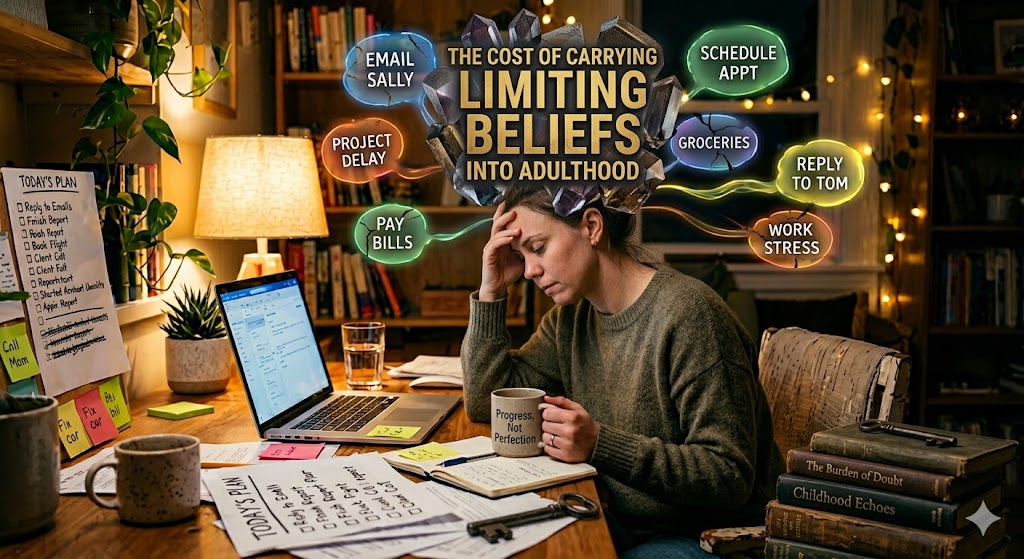
The Cost of Carrying Limiting Beliefs Into Adulthood
Every adult carries stories about themselves. Some of those stories are empowering and push them toward growth, achievement, and fulfillment. Others are invisible chains that quietly restrict what they believe is possible. These chains are known as limiting beliefs. They are deeply rooted assumptions about oneself, other people, or the world that create barriers to progress. While many limiting beliefs are formed during childhood, they often remain active well into adulthood, influencing decisions, relationships, careers, finances, and overall quality of life.
The cost of carrying limiting beliefs into adulthood is far greater than most people realize. Unlike obvious obstacles, limiting beliefs are hidden. They operate beneath the surface, shaping actions without announcing their presence. A person may believe they are making rational choices while unknowingly being guided by outdated assumptions that no longer serve them. Because these beliefs often feel like facts, they are rarely questioned.
Many limiting beliefs begin early in life. A child who repeatedly hears that they are not smart enough may grow into an adult who avoids challenging opportunities. A child who is constantly criticized may become an adult who fears failure. Someone who grows up in an environment where money is always scarce may develop the belief that wealth is only for certain people. These early experiences create mental frameworks that can persist for decades if left unexamined.
One of the most significant costs of limiting beliefs is lost opportunity. Opportunities often require confidence, risk, and the willingness to step into unfamiliar territory. When someone believes they are not capable, not deserving, or not qualified, they frequently reject opportunities before anyone else has the chance to reject them. They may avoid applying for better jobs, starting businesses, pursuing education, or entering meaningful relationships. In many cases, the opportunity itself is not the problem. The belief standing in the way becomes the real obstacle.
Limiting beliefs also have a profound impact on financial growth. Many adults struggle financially not because opportunities are absent but because their beliefs prevent them from recognizing or pursuing those opportunities. A person who believes wealthy people are dishonest may unconsciously resist wealth creation. Someone who believes they are destined to struggle may sabotage financial progress whenever success begins to appear. These beliefs create self-fulfilling patterns that reinforce themselves over time.
Relationships are another area where limiting beliefs can cause significant damage. Adults who carry beliefs such as “I am not lovable,” “People always leave,” or “I cannot trust anyone” often experience recurring relationship difficulties. These beliefs influence behavior in subtle ways. They may cause someone to withdraw emotionally, become overly defensive, seek constant reassurance, or avoid intimacy altogether. The result is often the very outcome they fear, which then appears to confirm the original belief.
Career growth is equally affected. Many talented individuals remain stuck in positions far below their potential because they carry limiting beliefs about their capabilities. They may believe leadership roles are not for them. They may assume they are not intelligent enough to compete at higher levels. They may fear criticism so much that they avoid visibility and responsibility. Over time, these beliefs create a ceiling that limits advancement regardless of actual ability.
Perhaps one of the greatest hidden costs of limiting beliefs is the erosion of self-confidence. Confidence is not simply a personality trait. It is largely built through action, experience, and evidence. When limiting beliefs prevent people from taking action, they miss opportunities to build confidence. The less they act, the less evidence they gather about their capabilities. This creates a cycle where lack of action reinforces self-doubt, and self-doubt reduces future action.
Mental health can also suffer under the weight of limiting beliefs. Constantly believing that one is inadequate, incapable, or unworthy creates chronic stress and emotional exhaustion. Individuals may experience anxiety when facing new situations because they assume failure is inevitable. They may experience frustration because they sense their potential but feel unable to reach it. Over time, these internal conflicts can reduce overall life satisfaction.
Another overlooked consequence is the effect on decision-making. Every decision is filtered through belief systems. When beliefs are limiting, decision quality often suffers. Adults carrying limiting beliefs tend to focus more on potential risks than potential rewards. They may underestimate their strengths and overestimate challenges. As a result, they frequently choose safety over growth, comfort over opportunity, and certainty over possibility.
Limiting beliefs also affect how people interpret events. Two individuals can experience the same setback and reach completely different conclusions. One may view failure as feedback and continue moving forward. The other may see it as proof that they were never capable in the first place. The difference often lies not in the event itself but in the beliefs used to interpret it.
The workplace provides countless examples of limiting beliefs in action. Employees may hesitate to share valuable ideas because they assume their opinions do not matter. Professionals may avoid networking because they believe they are not interesting enough. Entrepreneurs may delay launching businesses because they assume success belongs only to others. In each case, the limiting belief creates an invisible barrier that restricts growth long before external obstacles appear.
Another major cost is unrealized potential. Every individual possesses abilities that can only be discovered through action and experience. Limiting beliefs prevent exploration. They convince people to remain within familiar boundaries rather than testing what is possible. The tragedy is not merely that goals remain unachieved. It is that entire capabilities remain undiscovered.
Limiting beliefs often become more expensive with age because they compound over time. A belief that prevents one opportunity today may prevent hundreds over the course of a lifetime. A single assumption can influence years of decisions, relationships, and behaviors. The cumulative effect can be enormous. Looking back decades later, many people realize the greatest obstacles they faced were not external circumstances but internal assumptions.
Social influence also plays a role in maintaining limiting beliefs. Adults often surround themselves with people who reinforce their existing worldview. If everyone within a person’s environment shares the same limiting assumptions, those beliefs appear normal and unquestionable. Growth frequently begins when individuals encounter new perspectives that challenge long-held assumptions.
Fortunately, limiting beliefs are not permanent. They are learned, and what is learned can be unlearned. The first step is awareness. Many people spend years fighting symptoms without recognizing the underlying belief causing them. Once a belief is identified, it can be examined objectively. Questions such as “Is this belief actually true?” or “What evidence supports this assumption?” can reveal weaknesses in beliefs that once seemed unquestionable.
Replacing limiting beliefs requires intentional effort. New beliefs gain strength through repeated action and evidence. Someone who believes they are incapable can begin by taking small actions that challenge that belief. Each successful experience becomes evidence that weakens the old assumption and strengthens a new one. Over time, identity begins to shift.
Personal growth often begins where limiting beliefs end. The moment someone stops accepting old assumptions as permanent truths, new possibilities emerge. Opportunities that once seemed impossible become achievable. Challenges become learning experiences rather than threats. Failure becomes feedback rather than proof of inadequacy.
The most successful individuals are not necessarily those with the fewest obstacles. Often, they are those who refuse to let limiting beliefs define what is possible. They recognize that circumstances matter, but beliefs determine how those circumstances are interpreted and addressed. By challenging limiting beliefs, they expand their capacity to act, learn, adapt, and grow.
The cost of carrying limiting beliefs into adulthood is measured not only in missed opportunities, reduced income, strained relationships, and unrealized potential. It is measured in the life that could have been lived but was never fully explored. Every limiting belief narrows possibilities. Every empowering belief expands them. The difference between the two can shape the entire course of a person’s life.
Adulthood offers a unique opportunity to reassess the stories inherited from childhood. Not every belief deserves lifelong loyalty. Some beliefs protected us in the past but limit us in the present. Growth begins when individuals have the courage to question what they have always assumed to be true. By doing so, they free themselves from invisible barriers and create space for greater success, fulfillment, and personal freedom. The beliefs carried into adulthood will either become foundations for growth or walls that restrict it. The choice of which beliefs to keep ultimately determines the direction of one’s future.

EarnSmartOnline.com.ng is dedicated to helping readers make smarter financial decisions through practical guides on online income, personal finance, technology, digital business, and wealth creation. Our goal is to provide reliable, easy-to-understand, and actionable content that empowers individuals to earn smarter, build sustainable income streams and achieve long-term financial success.
Recommended: Start Earning Online
- Ultimate Affiliate Marketing Program — learn affiliate marketing with a done-for-you sales system ($15). Check it out
- The Newbie Affiliate Guide — the beginner-friendly starter guide (~$6.68). Check it out
- Easy Dollar Maker — earn in dollars uploading AI images and videos from your phone ($17). Check it out
Disclosure: These are affiliate links. If you buy through them, I may earn a commission at no extra cost to you.



