
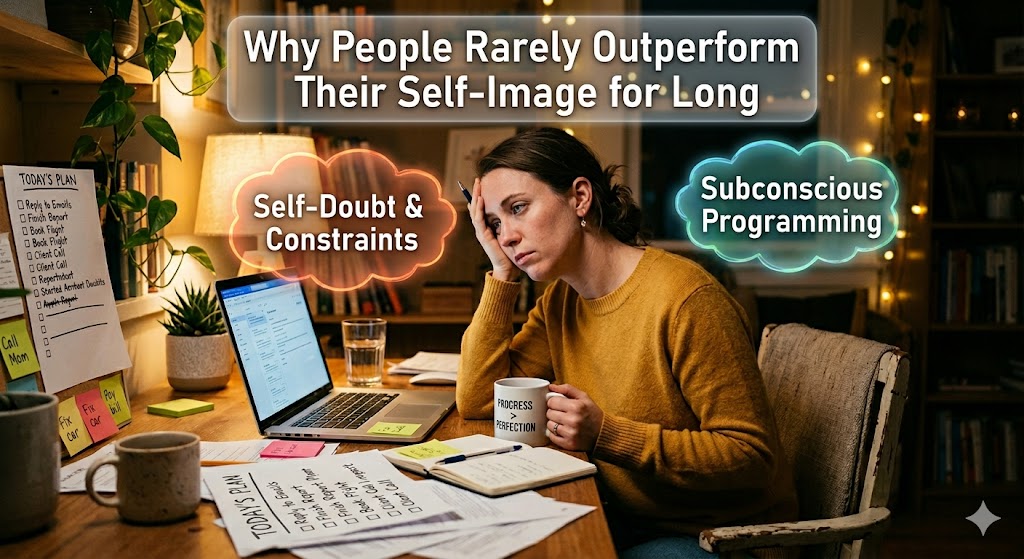
Why People Rarely Outperform Their Self-Image for Long
Many people believe success is primarily determined by talent, intelligence, education, luck, or hard work. While all of these factors play important roles, there is another force operating beneath the surface that often determines how far a person can go and how long they can stay there. That force is self image.
Self image is the mental picture people hold about themselves. It is the collection of beliefs, assumptions, expectations, and perceptions that shape how they see their own abilities, worth, and potential. Whether accurate or inaccurate, self image acts like an invisible ceiling that influences behavior, decisions, relationships, and outcomes.
This is why people rarely outperform their self image for long. A person may temporarily achieve results that exceed their internal beliefs, but unless their self image changes, they often find ways to return to a level that feels familiar and comfortable. This process happens so subtly that many people never realize it is taking place.
Imagine someone who secretly believes they are not smart enough to succeed. They may work hard and eventually receive a promotion at work. At first, everything seems positive. However, because their internal image still tells them they are not capable, they begin to doubt themselves. They overthink decisions, hesitate to take initiative, avoid opportunities, and fear being exposed as inadequate. Over time, their behavior starts to match their self image rather than their actual achievements.
The human mind constantly seeks consistency between beliefs and actions. When reality conflicts with self perception, discomfort arises. Most people resolve this discomfort not by changing their beliefs but by changing their behavior. As a result, they unconsciously sabotage opportunities that challenge their existing identity.
This phenomenon can be seen in almost every area of life. Some people earn more money than ever before yet quickly return to old financial habits. Others lose weight only to regain it months later. Some start successful businesses but eventually make decisions that undermine their progress. The issue is not always a lack of skill or knowledge. Often, the deeper problem is that their self image has not evolved to match their new circumstances.
Many people underestimate the power of identity. They focus on changing outcomes while ignoring the beliefs that produce those outcomes. They set goals, create plans, and pursue external success without addressing the internal narrative that drives their behavior. As a result, they experience temporary victories but struggle to maintain them.
The relationship between self image and performance is powerful because behavior tends to follow identity. People naturally act in ways that confirm what they believe about themselves. Someone who sees themselves as disciplined will find it easier to maintain good habits. Someone who sees themselves as careless will often struggle with consistency, even when they know exactly what to do.
This explains why two individuals with similar skills and opportunities can experience dramatically different results. Their external circumstances may be nearly identical, but their internal beliefs create different behaviors. One person approaches challenges with confidence and persistence, while the other approaches them with doubt and hesitation. Over time, these small differences accumulate into significant outcomes.
Self image also affects the opportunities people are willing to pursue. Individuals rarely seek goals they believe are beyond their reach. If someone views themselves as average, they may avoid ambitious opportunities because they feel unqualified. If they see themselves as capable and resourceful, they are more likely to take calculated risks and pursue growth.
What makes self image particularly powerful is that it often operates below conscious awareness. People may not realize how strongly their beliefs influence their choices. They simply experience the effects. They wonder why they keep repeating the same patterns, making the same mistakes, or returning to the same level of success despite their efforts to change.
Childhood experiences often play a major role in shaping self image. Messages received from parents, teachers, friends, and society can become deeply embedded beliefs. A child repeatedly told they are not good enough may carry that belief into adulthood. Even after achieving success, the old programming can remain active, influencing decisions and behaviors.
Past failures can also shape self image. Many people allow temporary setbacks to become permanent identities. Instead of viewing failure as an event, they begin to see it as evidence of who they are. This shift can have profound consequences because identity-based beliefs are much harder to change than isolated opinions.
The media and social environment also contribute to self image formation. Constant comparison with others can distort perceptions of personal worth and capability. People may focus on what they lack rather than what they possess. Over time, this can create limiting beliefs that reduce confidence and ambition.
One of the most interesting aspects of self image is that it influences perception itself. People tend to notice information that confirms their existing beliefs while ignoring evidence that contradicts them. Someone who believes they are unlucky will remember instances of bad luck and overlook examples of success. This selective attention strengthens the self image and makes change more difficult.
The good news is that self image is not fixed. Although deeply rooted, it can be changed through intentional effort and consistent action. The first step is awareness. People must identify the beliefs they hold about themselves and examine whether those beliefs are accurate or outdated.
Many limiting beliefs survive simply because they are never questioned. A person may believe they are incapable of leadership because of an experience that occurred years ago. Yet circumstances change, skills improve, and people grow. Holding onto outdated self perceptions prevents progress.
Another important step is gathering evidence that supports a new identity. Confidence grows when people repeatedly demonstrate competence through action. Small wins matter because they provide proof that existing beliefs may be incorrect. Each successful action becomes evidence that reinforces a more empowering self image.
Language also plays a significant role. The words people use to describe themselves influence their identity. Statements such as “I am bad with money” or “I am not a confident person” reinforce limiting beliefs. Replacing these statements with more constructive perspectives can gradually reshape self perception.
Surrounding oneself with positive influences is equally important. The people we spend time with often affect how we see ourselves. Supportive environments encourage growth and reinforce empowering beliefs. Negative environments frequently strengthen limiting identities.
Consistency is essential because self image changes slowly. Just as limiting beliefs were formed through repeated experiences, empowering beliefs require repetition and reinforcement. Lasting transformation occurs when new behaviors are practiced consistently enough to become part of one’s identity.
This process explains why sustainable success is often an inside-out journey. External achievements alone cannot create lasting change if internal beliefs remain unchanged. People who maintain extraordinary results usually develop an identity that supports those results. They do not simply achieve success. They become the type of person who naturally produces success.
The most successful individuals understand this principle, whether consciously or unconsciously. They invest not only in skills and knowledge but also in their mindset and self perception. They recognize that lasting performance depends on internal alignment. Their beliefs support their actions, and their actions reinforce their beliefs.
Ultimately, why people rarely outperform their self image for long comes down to the powerful connection between identity and behavior. People tend to live in ways that confirm what they believe about themselves. Temporary success can exceed those beliefs, but long-term success usually requires transforming them.
When self image remains small, achievements often shrink to match it. When self image expands, possibilities expand as well. This is why personal growth begins not with changing circumstances but with changing perception. The moment people begin to see themselves differently, they start making different decisions, taking different actions, and creating different results.
The greatest limitation in life is often not a lack of opportunity, talent, or resources. It is the invisible picture people carry in their minds about who they are and what they are capable of becoming. Change that picture, and over time, the results begin to change as well. That is why lasting success is rarely about outperforming your self image. It is about continuously upgrading it.

EarnSmartOnline.com.ng is dedicated to helping readers make smarter financial decisions through practical guides on online income, personal finance, technology, digital business, and wealth creation. Our goal is to provide reliable, easy-to-understand, and actionable content that empowers individuals to earn smarter, build sustainable income streams and achieve long-term financial success.
Recommended: Start Earning Online
- Ultimate Affiliate Marketing Program — learn affiliate marketing with a done-for-you sales system ($15). Check it out
- The Newbie Affiliate Guide — the beginner-friendly starter guide (~$6.68). Check it out
- Easy Dollar Maker — earn in dollars uploading AI images and videos from your phone ($17). Check it out
Disclosure: These are affiliate links. If you buy through them, I may earn a commission at no extra cost to you.



