
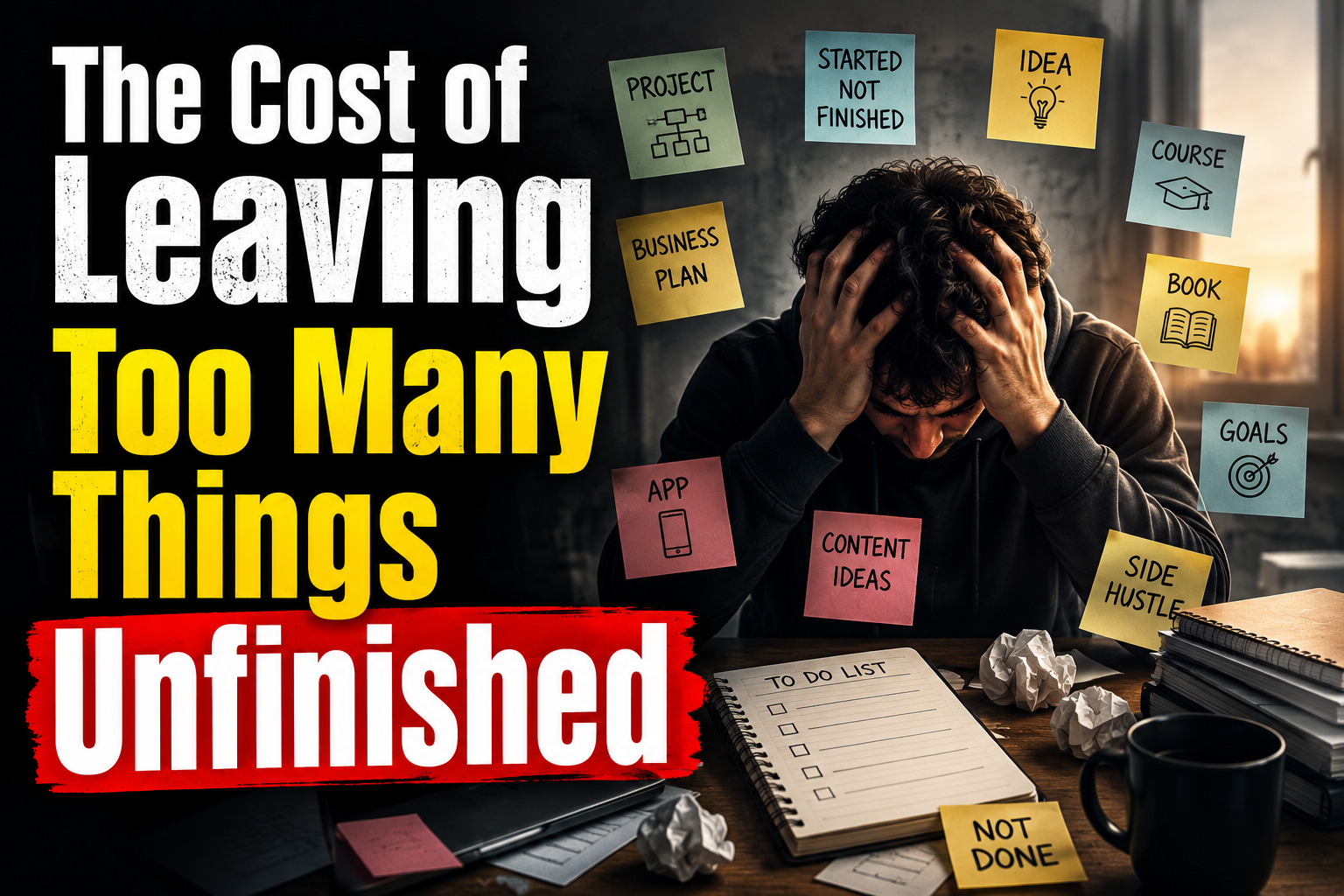
The Cost of Leaving Too Many Things Unfinished
Most people don’t realize it, but unfinished tasks are not just “incomplete work,” they are silent mental weights that accumulate over time. Every abandoned project, every unresolved goal, every ignored responsibility sits somewhere in the background of the mind like a tab left open in a browser. At first, it feels harmless. You tell yourself you will come back to it later. But later becomes weeks, weeks become months, and months slowly turn into a pattern of unfinished living. The real cost is not always visible on the surface, but it shows up in focus, discipline, confidence, and ultimately in the quality of life a person is able to build.
When a person constantly starts things they do not finish, they begin to lose trust in themselves. Self trust is one of the most important currencies in personal development. It is built quietly through consistency and completion. Every time you finish something you said you would do, you reinforce the belief that you are reliable in your own eyes. But every time you abandon something without closure, you weaken that internal trust. Over time, this creates a subtle identity shift. The person no longer sees themselves as someone who completes things, but as someone who starts and stops. That identity then becomes a filter through which all future decisions are made.
This pattern also affects mental clarity. The human brain is not designed to hold multiple unresolved tasks without cost. Psychologically, unfinished work creates what can be described as cognitive residue. Even when you are not actively thinking about it, part of your attention is still tied to it. This reduces mental bandwidth for new ideas and meaningful execution. That is why people who have many incomplete projects often feel mentally tired even when they are not doing much. It is not physical exhaustion, it is psychological clutter.
There is also a deeper emotional cost that builds quietly. Unfinished things often carry a sense of guilt, even if it is not fully conscious. A person may not actively think about the project they abandoned, but when they see reminders of it, or when they reflect on their progress in life, there is a subtle feeling of stagnation. This emotional weight accumulates and can slowly turn into frustration or even self doubt. It becomes harder to feel proud of progress because the mind keeps pointing to what has not been completed rather than what has been achieved.
Another major cost is the distortion of productivity perception. When someone starts many things without finishing them, they often feel busy but not effective. Activity replaces achievement. They confuse motion with progress. This creates a cycle where the person keeps starting new tasks in search of motivation or excitement, but rarely experiences the satisfaction that comes from completion. Without completion, there is no closure. Without closure, there is no real sense of advancement. This is how people end up feeling stuck even though they are constantly doing something.
Financially, this habit can be extremely damaging. In business or career growth, unfinished work translates into wasted resources. Time, money, energy, and opportunity all get invested into ideas that never reach maturity. A person may start learning multiple skills but master none. They may begin multiple business ideas but develop none to profitability. In the long run, the cost of scattered effort is far greater than the cost of focused execution. Wealth and success are usually built through completion cycles, not initiation cycles.
There is also a hidden impact on discipline. Discipline is not about starting strong, it is about finishing regardless of emotional fluctuations. When someone repeatedly abandons tasks, they train their mind to escape difficulty. The moment discomfort appears, they shift to something new. Over time, this weakens resilience. The mind begins to associate difficulty with avoidance instead of persistence. This is dangerous because most meaningful achievements exist on the other side of difficulty, not before it.
Unfinished work also creates a subtle identity fragmentation. A person may have multiple versions of themselves tied to different abandoned efforts. One version wanted to write a book, another wanted to build a business, another wanted to learn a skill, and none of them fully materialized. Instead of becoming one strong identity built through mastery and completion, the person becomes scattered across unrealized possibilities. This fragmentation weakens direction. It becomes harder to define who they are and what they stand for because too many paths were started but not followed through.
Another overlooked consequence is reduced credibility. Even if no one openly calls it out, people tend to notice patterns. Someone who consistently starts things but does not finish them eventually loses perceived reliability. In professional environments, this affects opportunities, trust, and responsibility. People prefer to work with those who finish what they start, even if they are slower or less flashy. Completion builds reputation in a way that intention never can.
There is also a motivational illusion that comes with starting new things repeatedly. The beginning of anything feels exciting. It carries emotional energy, novelty, and optimism. Many people mistake this initial energy for progress. They chase the feeling of starting instead of the discipline of finishing. But motivation naturally declines after the beginning phase. Without commitment to completion, every new start becomes another cycle of temporary excitement followed by abandonment. This creates a dependency on novelty rather than mastery.
The deeper issue is that unfinished tasks accumulate like invisible debt. Just like financial debt, they create pressure that compounds over time. The more you accumulate, the harder it becomes to regain control. Eventually, even simple tasks feel overwhelming because the mind is already burdened with unresolved commitments. This is how procrastination becomes chronic. It is not laziness, it is overload caused by too many open loops.
To understand the importance of finishing, one must also understand the power of closure. Completion gives the mind resolution. It creates a sense of order and achievement. It allows the brain to release attention from that task and fully allocate energy to new goals. Each finished task strengthens confidence and reinforces the identity of someone who follows through. This is how momentum is built, not through starting more things, but through finishing what has already been started.
There is a powerful shift that happens when a person decides to complete more than they begin. Focus sharpens. Energy becomes more directed. Decisions become easier. Instead of constantly searching for new opportunities, they begin to extract value from existing commitments. This shift transforms productivity from scattered effort into structured progress. Over time, the results compound in ways that starting new things never could.
The truth is that success is not built on how many things you start, but on how many things you finish. Completion is what turns effort into results. It is what turns ideas into outcomes and intentions into reality. Without it, everything remains potential. With it, potential becomes achievement.
In the end, the cost of leaving too many things unfinished is not just wasted time. It is a weakened identity, reduced clarity, diminished discipline, and a life that feels constantly in progress but rarely complete. The opposite of this is not perfection, but completion. A life where fewer things are started, but more things are finished, creates not only better results, but a stronger sense of self.
Finishing is what gives meaning to starting. Without it, everything remains unfinished potential.

EarnSmartOnline.com.ng is dedicated to helping readers make smarter financial decisions through practical guides on online income, personal finance, technology, digital business, and wealth creation. Our goal is to provide reliable, easy-to-understand, and actionable content that empowers individuals to earn smarter, build sustainable income streams and achieve long-term financial success.
Recommended: Start Earning Online
- Ultimate Affiliate Marketing Program — learn affiliate marketing with a done-for-you sales system ($15). Check it out
- The Newbie Affiliate Guide — the beginner-friendly starter guide (~$6.68). Check it out
- Easy Dollar Maker — earn in dollars uploading AI images and videos from your phone ($17). Check it out
Disclosure: These are affiliate links. If you buy through them, I may earn a commission at no extra cost to you.



