
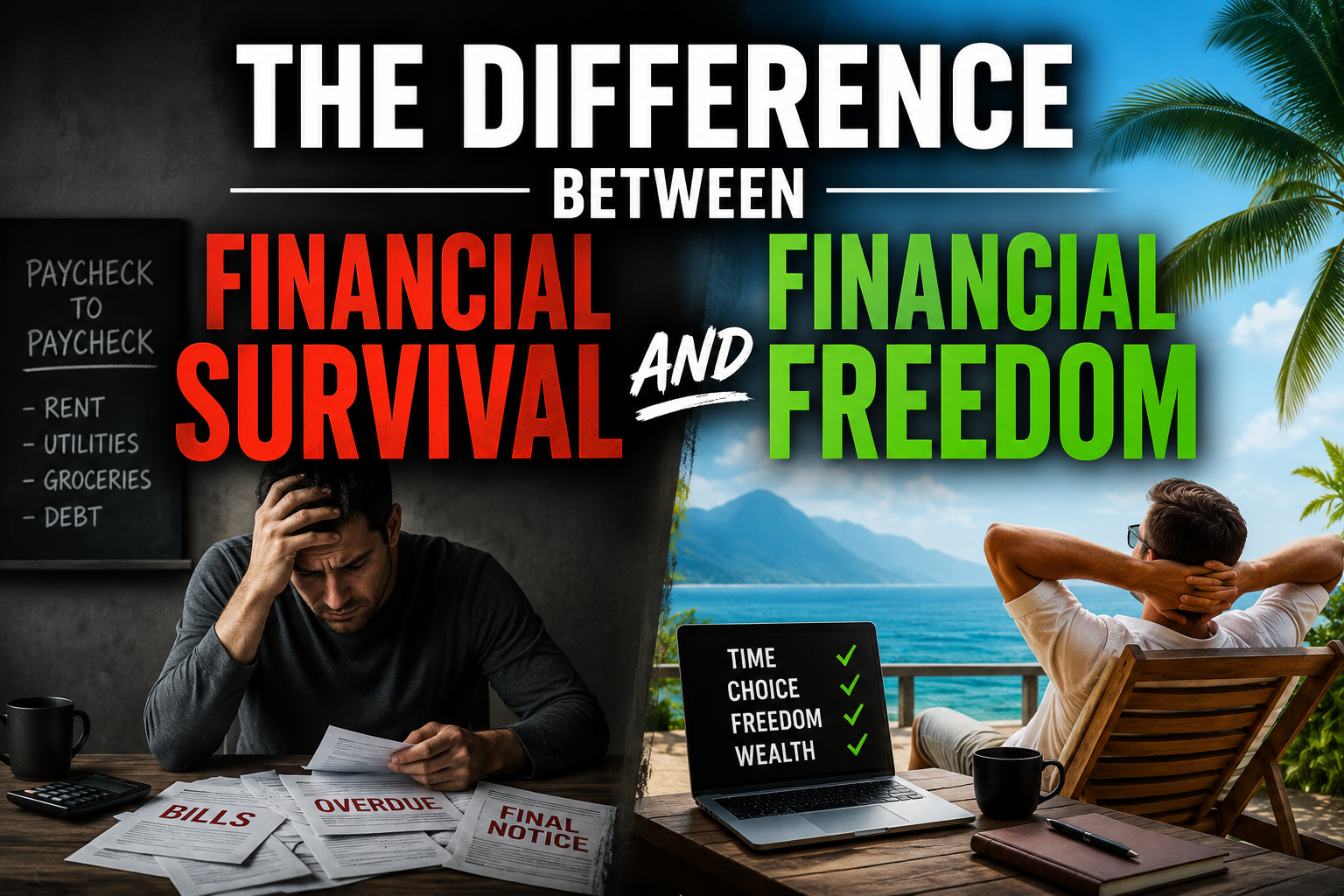
The Difference Between Financial Survival and Financial Freedom
Financial survival and financial freedom are two very different realities that often get confused, especially in a world where many people are simply trying to get by. At first glance, both may look like someone is managing money, earning income, and meeting basic needs. But underneath the surface, the difference is as wide as standing in shallow water versus being able to swim freely in the open ocean. One is about staying afloat under pressure, while the other is about control, choice, and long-term stability. Understanding this difference is one of the most important steps in changing your financial life permanently.
Financial survival is the state where a person’s income is just enough, or barely enough, to cover essential expenses. These essentials usually include food, rent, transport, utilities, and sometimes debt repayments. In this stage, money comes in and almost immediately goes out. There is little to no room for saving, investing, or planning for the future. Every financial decision is driven by urgency rather than strategy. If income stops even for a short period, life becomes unstable very quickly. This is why financial survival often comes with stress, anxiety, and a constant sense of pressure.
People living in financial survival mode are not necessarily irresponsible. In many cases, they are hardworking individuals who are simply trapped in a cycle where expenses rise as fast as income. The problem is not always how much they earn, but how their money is structured and how dependent they are on a single stream of income. In survival mode, there is no financial cushion. A medical emergency, job loss, or unexpected bill can completely disrupt life plans. This creates a mindset of fear, where decisions are made to avoid immediate pain rather than to build long-term wealth.
Financial freedom, on the other hand, is a completely different experience. It is the state where income not only covers basic needs but also supports savings, investments, and lifestyle choices without constant stress. A financially free person is not dependent on a single source of income. They have systems in place where money continues to flow even when they are not actively working at every moment. This does not always mean being extremely rich, but it does mean having control over time and financial decisions.
One of the clearest differences between financial survival and financial freedom is choice. In survival mode, choices are limited. A person takes jobs they do not like simply because they need income. They delay important goals because immediate needs come first. They cannot afford to take risks or explore opportunities that may improve their future. In financial freedom, choices expand. People can decide how they want to work, what they want to do, and how they want to live without being controlled by immediate financial pressure.
Another major difference lies in time. Financial survival traps people in a cycle where they constantly trade time for money just to stay afloat. If they stop working, money stops coming in. This creates a direct dependence on active effort. Financial freedom begins when money starts working independently through investments, assets, or systems that generate income without constant presence. This is where passive income, business ownership, and smart financial planning become important. It is not about escaping work entirely but about no longer being trapped by it.
The mindset in both situations is also very different. Financial survival creates a short-term mindset. People think in terms of days, weeks, or at best months. The focus is on immediate needs and solving urgent problems. Financial freedom builds a long-term mindset. Decisions are made based on where life will be in five, ten, or even twenty years. This difference in thinking changes everything, from spending habits to career choices and investment decisions.
One important truth is that financial survival can feel normal for many people because it is common. When everyone around you is also living paycheck to paycheck, it may seem like that is just how life works. But normalization does not mean it is the only option. Many people remain in survival mode not because they lack opportunities, but because they have never been taught how to move beyond it. Financial education plays a major role in breaking this cycle.
Poor financial habits often keep people stuck in survival mode. Spending without planning, relying heavily on debt, failing to save consistently, and ignoring investment opportunities all contribute to long-term financial instability. Even small decisions, repeated over time, can either trap someone in survival or gradually move them toward freedom. For example, consistently saving a small percentage of income may seem insignificant at first, but over time it builds a foundation that creates financial breathing space.
Financial freedom is built on systems rather than effort alone. This is a key distinction that many people misunderstand. Working harder may improve income temporarily, but without structure, that income can still disappear quickly. Systems such as budgeting, investing, multiple income streams, and financial planning create stability. They ensure that money is not only earned but also preserved and multiplied. This is what separates temporary success from lasting financial independence.
Another important difference is emotional control. Financial survival often leads to emotional decision-making. Fear, pressure, and stress influence how money is used. People may borrow impulsively, spend to relieve stress, or avoid looking at their financial situation altogether because it feels overwhelming. Financial freedom introduces emotional stability. Decisions become more rational because there is less pressure. Money becomes a tool rather than a source of constant worry.
Debt also plays very different roles in both states. In financial survival, debt is often a burden that keeps people trapped. High-interest loans, unpaid bills, and credit obligations consume a large portion of income, leaving little room for growth. In financial freedom, debt is either minimal or strategically used as leverage for growth, such as investing in income-generating assets. The difference is not just in having or not having debt, but in how debt is managed and whether it contributes to or reduces financial stability.
It is also important to understand that financial freedom is not a destination that suddenly appears. It is a gradual process built through consistent decisions. Many people assume it requires a sudden increase in income or a lucky opportunity, but in reality, it often starts with small but disciplined changes. Learning to track expenses, reduce unnecessary spending, invest early, and develop additional income streams are all steps that slowly shift a person from survival to freedom.
One of the most overlooked differences is peace of mind. Financial survival rarely allows mental peace because there is always something urgent demanding attention. Bills, rent, and daily expenses constantly create pressure. Financial freedom brings a sense of stability that allows the mind to focus on growth, relationships, creativity, and long-term goals. This mental shift is often more valuable than money itself because it changes how a person experiences life.
Another key distinction is resilience. People in financial survival are highly vulnerable to shocks. A small disruption can cause major setbacks. In financial freedom, there is resilience built through savings, investments, and diversified income. This means that unexpected events do not create panic but are managed with stability. This resilience is what allows financially free individuals to maintain consistency even in uncertain times.
Ultimately, the difference between financial survival and financial freedom comes down to control. Survival is about reacting to life as it happens, while freedom is about designing life intentionally. One is reactive and restrictive, the other is proactive and expansive. The transition between the two does not happen overnight, but it begins with awareness. Once a person clearly understands where they are, they can begin making decisions that gradually shift their financial reality.
Financial freedom is not reserved for a select few. It is the result of consistent discipline, financial literacy, and intentional planning. While financial survival may be the starting point for many, it does not have to be the permanent state. With the right mindset and actions, it is possible to move from just surviving to truly living with financial confidence and stability.

EarnSmartOnline.com.ng is dedicated to helping readers make smarter financial decisions through practical guides on online income, personal finance, technology, digital business, and wealth creation. Our goal is to provide reliable, easy-to-understand, and actionable content that empowers individuals to earn smarter, build sustainable income streams and achieve long-term financial success.
Recommended: Start Earning Online
- Ultimate Affiliate Marketing Program — learn affiliate marketing with a done-for-you sales system ($15). Check it out
- The Newbie Affiliate Guide — the beginner-friendly starter guide (~$6.68). Check it out
- Easy Dollar Maker — earn in dollars uploading AI images and videos from your phone ($17). Check it out
Disclosure: These are affiliate links. If you buy through them, I may earn a commission at no extra cost to you.



