
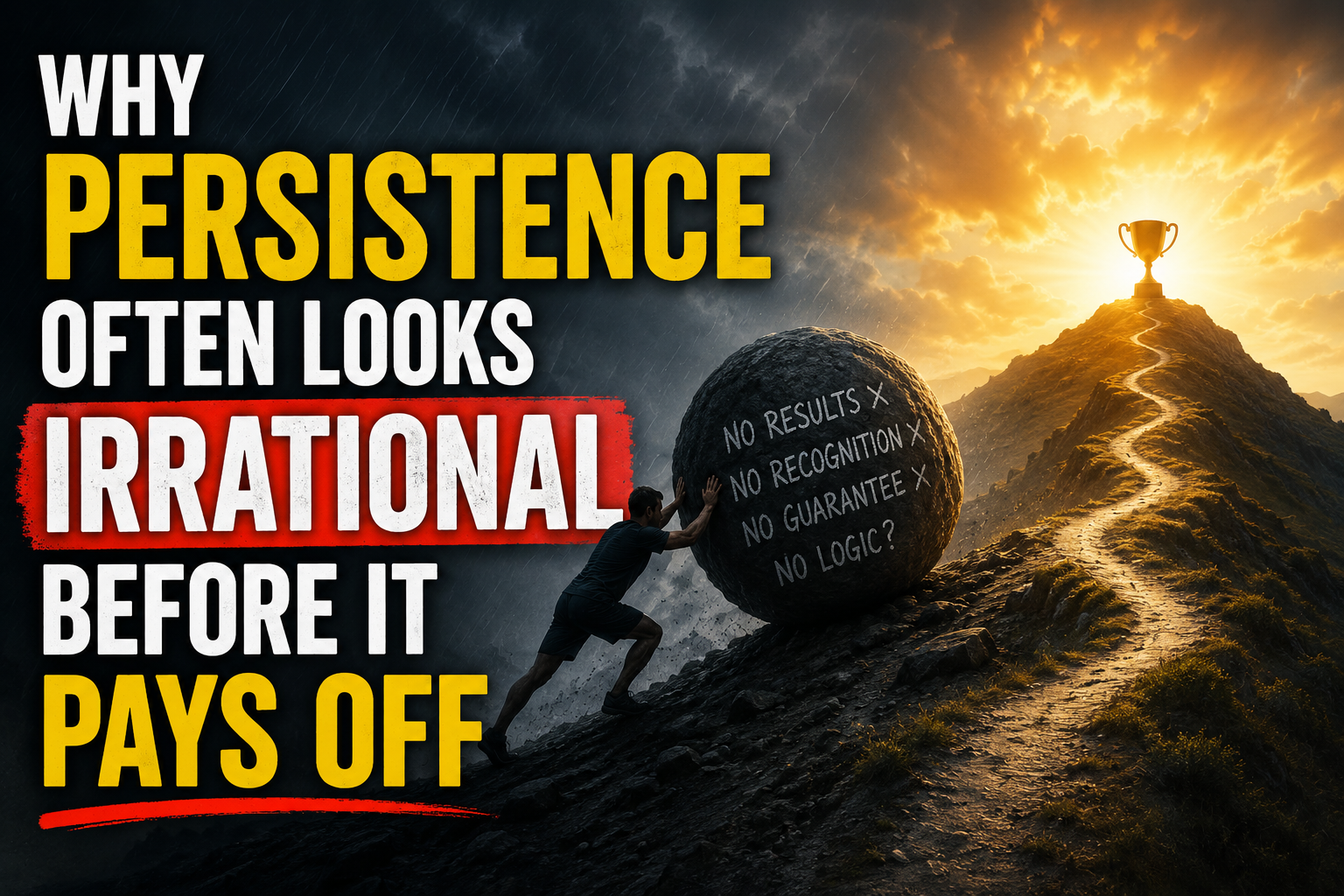
Why Persistence Often Looks Irrational Before It Pays Off
In a world that celebrates instant success, persistence often appears irrational. People admire the successful entrepreneur, athlete, artist, or innovator after they have achieved remarkable results, but very few admire them during the long and difficult journey that led to those achievements. Before success becomes visible, persistence frequently looks like stubbornness, wasted effort, or even poor judgment. This is because human beings naturally evaluate actions based on immediate outcomes rather than long term potential.
The reality is that many of life’s greatest achievements are the result of persistence that seemed unreasonable at the time. History is filled with examples of individuals who continued working toward a goal long after others believed they should quit. Their determination often attracted criticism, skepticism, and ridicule before it eventually produced results. What appears irrational today may later be recognized as vision, discipline, and courage.
One reason persistence often looks irrational is that progress is rarely visible in its early stages. People tend to expect effort and reward to follow a straight line. They assume that if someone works hard for a month, the results should be visible within that month. If someone studies for a year, they expect obvious improvement within that year. If a business owner invests time and money into a venture, they expect immediate profits. Unfortunately, real life rarely works this way.
Many worthwhile pursuits follow a delayed growth pattern. The effort accumulates beneath the surface long before visible results appear. Just as a seed spends time developing roots underground before emerging above the soil, success often requires an invisible period of preparation. During this phase, persistence can look pointless because observers only see the absence of results. They do not see the foundation being built.
Human psychology also contributes to this misunderstanding. People naturally seek immediate gratification. We prefer rewards that arrive quickly rather than rewards that require patience. This tendency makes persistence difficult to appreciate because persistent individuals willingly endure discomfort today in exchange for uncertain rewards tomorrow. To those who prioritize short term outcomes, such behavior can seem irrational.
Consider someone learning a complex skill. For months or even years, they may appear to be making little progress. Friends and family may question why they continue investing time into something that produces no immediate benefit. Yet every hour of practice strengthens their abilities. Every mistake teaches a lesson. Every challenge builds competence. Eventually, a breakthrough occurs, and outsiders suddenly notice the success. What they fail to recognize is that the breakthrough was not sudden at all. It was the result of countless invisible efforts accumulated over time.
Persistence often appears irrational because society tends to focus on results rather than processes. People celebrate winners but rarely pay attention to the years of dedication that preceded victory. When someone succeeds, observers often rewrite the story and claim the outcome was inevitable. They forget that before success arrived, many people doubted the same person they now admire.
This phenomenon can be observed in business. Many successful companies spent years operating without significant profits. During those early years, outsiders questioned their strategies and criticized their persistence. Investors doubted them. Competitors dismissed them. Yet those companies continued refining their products, understanding their customers, and improving their operations. When success finally arrived, their persistence was reinterpreted as wisdom. The same actions that once appeared irrational suddenly seemed brilliant.
The challenge is that persistence requires faith in a future that does not yet exist. It demands belief in possibilities that cannot currently be proven. This makes persistent individuals vulnerable to criticism because most people judge based on present circumstances rather than future potential. When results are absent, persistence can easily be mistaken for denial.
Another reason persistence appears irrational is that the costs are often visible while the benefits remain hidden. People see the sacrifices being made. They see the long hours, missed opportunities, financial investments, and emotional struggles. What they do not see is the gradual development of expertise, resilience, relationships, and knowledge. These hidden assets accumulate quietly until they eventually produce tangible rewards.
Many people abandon their goals because they become discouraged by the gap between effort and reward. They assume that because results have not yet appeared, their efforts are ineffective. However, progress often operates like compound interest. Small improvements accumulate slowly at first and then accelerate over time. The early stages can feel frustrating because the growth is almost invisible. Yet those who continue often experience results that appear dramatic to outside observers.
Persistence also develops qualities that extend beyond the original goal. A person who persists through difficulties becomes more resilient, disciplined, patient, and resourceful. These characteristics have value regardless of the specific outcome being pursued. Even when a particular effort does not succeed as planned, the individual often emerges stronger and better prepared for future opportunities.
There is an important distinction between persistence and blind stubbornness. Persistence involves adapting, learning, and improving while remaining committed to a meaningful objective. Blind stubbornness involves repeating ineffective actions without reflection or adjustment. True persistence is not about refusing to change course. It is about refusing to abandon a worthwhile goal simply because progress is slower than expected.
Successful individuals understand that setbacks are not necessarily signs of failure. They view obstacles as part of the process rather than evidence that the process is flawed. This mindset allows them to continue when others give up. They recognize that difficulties are often the price of meaningful achievement.
The world often misunderstands persistence because people only see outcomes after they become obvious. They do not witness the countless moments when a persistent individual chose to continue despite uncertainty. They do not see the internal battles, the self doubt, the disappointments, and the sacrifices. By the time success becomes visible, the difficult part of the journey has already passed.
Persistence is especially important in a rapidly changing world where many people expect immediate results. Technology has conditioned us to expect instant access, instant communication, and instant gratification. As a result, patience has become increasingly rare. Yet many of the most valuable accomplishments still require time. Relationships require time. Expertise requires time. Businesses require time. Character requires time. Meaningful growth cannot be rushed.
The irony is that what appears irrational in the short term often becomes obvious in hindsight. Once success arrives, people wonder why they ever doubted the individual who persisted. They forget that the same persistence they now admire was once criticized. They overlook the uncertainty that existed before the outcome became known.
This pattern repeats throughout life. Inventors are called unrealistic until their inventions work. Entrepreneurs are called reckless until their businesses succeed. Writers are ignored until their books become popular. Athletes are doubted until they win championships. In each case, persistence bridges the gap between vision and reality.
The ability to persist when others doubt you is one of the most powerful advantages a person can develop. Most people quit when progress becomes difficult or invisible. They abandon goals just before meaningful results begin to emerge. As a result, persistence becomes a rare quality. Those who possess it often achieve outcomes that seem extraordinary, not because they are extraordinarily talented, but because they remained committed longer than others.
Ultimately, persistence often looks irrational before it pays off because people judge based on what they can currently see. They evaluate visible results rather than invisible progress. They focus on immediate outcomes rather than long term potential. Yet many of the greatest achievements in history were built by individuals who continued moving forward despite uncertainty, criticism, and slow progress.
The next time persistence appears irrational, it may be worth remembering that success often spends a long time hidden before it becomes visible. The roots grow before the tree appears. The foundation is laid before the building rises. The effort accumulates before the reward arrives. What looks unreasonable today may simply be the early stage of a future success story. Persistence is not always glamorous, and it is rarely easy, but it remains one of the most reliable paths to accomplishing meaningful goals. Those who understand this truth are often willing to endure temporary doubt, knowing that patience and consistency have a way of turning apparent irrationality into undeniable achievement.

EarnSmartOnline.com.ng is dedicated to helping readers make smarter financial decisions through practical guides on online income, personal finance, technology, digital business, and wealth creation. Our goal is to provide reliable, easy-to-understand, and actionable content that empowers individuals to earn smarter, build sustainable income streams and achieve long-term financial success.
Recommended: Start Earning Online
- Ultimate Affiliate Marketing Program — learn affiliate marketing with a done-for-you sales system ($15). Check it out
- The Newbie Affiliate Guide — the beginner-friendly starter guide (~$6.68). Check it out
- Easy Dollar Maker — earn in dollars uploading AI images and videos from your phone ($17). Check it out
Disclosure: These are affiliate links. If you buy through them, I may earn a commission at no extra cost to you.



