
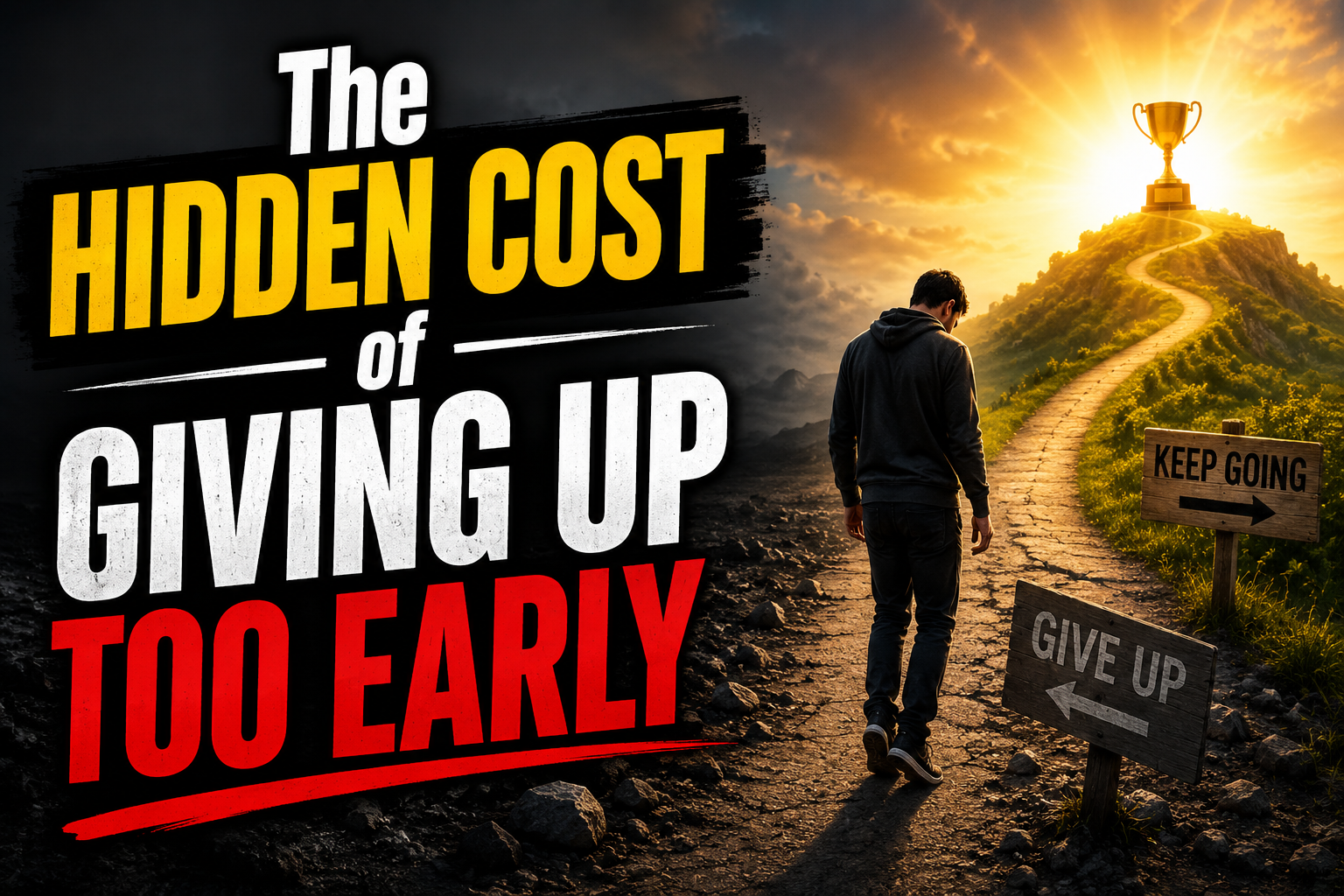
The Hidden Cost of Giving Up Too Early
One of the most expensive mistakes people make in life is giving up too early. It is a silent habit that rarely receives the attention it deserves because the consequences are often invisible. Unlike a bad investment that immediately drains a bank account or a failed business that publicly collapses, giving up too early leaves behind something much harder to measure. It leaves behind unrealized potential, missed opportunities, abandoned dreams, and futures that never had the chance to exist.
Many people assume that quitting simply means stopping an activity. In reality, quitting too early is often the act of walking away from results that were much closer than they appeared. Success has a peculiar habit of hiding behind periods of difficulty, uncertainty, frustration, and slow progress. The problem is that most people judge their future based on what they can see today. When results are delayed, motivation begins to fade. Doubt enters the picture. The mind starts creating reasons why the effort may not be worth it. Eventually, many people convince themselves to stop, not because success was impossible, but because success was taking longer than expected.
The hidden cost begins with lost opportunities. Every worthwhile goal requires time to develop. Businesses take time to gain customers. Skills take time to master. Investments take time to grow. Relationships take time to strengthen. Personal transformation takes time to become visible. When someone gives up too early, they interrupt a process that may have been quietly moving in the right direction. Unfortunately, because the future cannot be seen, they never realize how close they were to achieving the breakthrough they desired.
Many of the greatest accomplishments in life are preceded by periods that appear unproductive. Consider a seed planted in the ground. For weeks, there may be no visible evidence that anything is happening. Yet beneath the surface, roots are forming, foundations are strengthening, and growth is taking place. If someone judged the seed based only on what was visible above the soil, they might conclude that nothing is happening. Human effort often works the same way. Progress is frequently invisible before it becomes obvious.
One reason people give up too early is the unrealistic expectation of immediate results. Modern society celebrates overnight success stories while ignoring the years of preparation behind them. People see the finished product but rarely witness the struggles, failures, and persistence that made the achievement possible. This distorted view creates unrealistic expectations. When reality proves slower than expected, disappointment follows. What many people interpret as failure is often simply the normal pace of meaningful progress.
The hidden cost of quitting early also includes the loss of accumulated effort. Every hour spent learning, practicing, building, and improving contributes to future outcomes. Even when progress appears slow, those efforts are often compounding beneath the surface. Walking away prematurely means abandoning the value of all previous work. It is like stopping a journey after traveling ninety percent of the distance because the destination is not yet visible.
Another overlooked consequence is the damage done to self confidence. Each time people quit too early, they reinforce a dangerous belief that challenges should be avoided whenever they become uncomfortable. Over time, this habit weakens resilience and reduces confidence in one’s ability to overcome obstacles. The next challenge feels larger. The next goal appears more intimidating. Eventually, a pattern develops where quitting becomes the default response whenever progress slows down.
Persistence, on the other hand, creates a completely different psychological effect. Every obstacle overcome becomes evidence that difficulties can be managed. Every challenge survived builds confidence. Every setback navigated successfully strengthens resilience. Success is not always about reaching the destination. Sometimes the greatest reward is the person you become during the journey.
Many people underestimate how often success arrives just after the point where most others quit. Competition naturally decreases as challenges increase. The early stages of any pursuit are crowded because enthusiasm is high and commitment is low. As obstacles emerge, people begin to leave. The individuals who remain are often not the most talented but the most persistent. Endurance becomes a competitive advantage because so few people are willing to continue when progress feels slow.
The hidden cost of giving up too early is especially evident in skill development. Every expert was once a beginner. Every master was once inexperienced. The difference between average and exceptional performance is often measured by the willingness to continue practicing after the excitement disappears. Many people stop before reaching competence. They never experience the rewards that come from sustained improvement because they abandon the process too soon.
Relationships provide another example. Strong friendships, successful partnerships, and healthy families are not built overnight. They require patience, communication, understanding, and perseverance. When people walk away at the first sign of difficulty, they may miss opportunities for deeper connection and greater fulfillment. While some situations genuinely require separation, many challenges can be overcome through commitment and effort.
Entrepreneurship offers perhaps the clearest illustration of the hidden cost of quitting too early. New businesses often experience periods of uncertainty, low sales, and slow growth. Many entrepreneurs abandon their ventures during these difficult phases. Yet numerous successful companies spent years struggling before finding their footing. The difference between success and failure was not always intelligence, funding, or talent. Often, it was simply the willingness to continue longer than others.
The financial consequences can also be significant. Investments require time to benefit from compound growth. Wealth creation rarely happens instantly. Many people become impatient and abandon sound financial strategies because results are not immediate. In doing so, they sacrifice future gains for temporary emotional relief. The true cost may not become visible until years later when they realize what could have been achieved through patience and consistency.
Giving up too early also limits personal discovery. Many strengths remain hidden until they are tested by adversity. Courage is not developed during easy times. Discipline is not built during comfort. Resilience does not emerge without challenges. When people quit at the first sign of difficulty, they never discover what they are truly capable of becoming. Some of the most remarkable qualities in human beings are revealed only after they persist through discomfort.
There is also the emotional burden of regret. Failure can be painful, but regret often lasts much longer. Many people can accept failure when they know they gave their best effort. What becomes difficult to accept is wondering what might have happened if they had continued. The unanswered questions linger. The possibilities remain unresolved. The opportunity to know the outcome disappears forever.
This does not mean persistence should be blind or irrational. Sometimes changing direction is wise. Sometimes strategies need adjustment. Sometimes circumstances genuinely require a new approach. The key difference is between strategic adaptation and premature surrender. Adaptation seeks a better path toward the goal. Giving up too early abandons the goal entirely because the journey became uncomfortable.
The most successful people often share a common trait. They understand that progress is rarely linear. There are periods of growth, plateaus, setbacks, and uncertainty. They do not interpret temporary difficulties as permanent failure. Instead, they recognize that meaningful achievements require time. They understand that persistence is not about never struggling. It is about continuing despite the struggle.
Life rewards those who can remain committed when immediate rewards are absent. The ability to stay focused during slow progress is one of the most valuable skills a person can develop. It separates dreamers from achievers, starters from finishers, and potential from accomplishment.
The hidden cost of giving up too early is ultimately the cost of unrealized possibilities. It is the business that could have succeeded, the skill that could have been mastered, the relationship that could have flourished, the wealth that could have compounded, and the future that could have been created. Most people never see these costs because they exist in an alternative reality that never materialized.
The next time progress feels slow, remember that visible results are often the final stage of a process that has been developing beneath the surface for a long time. Success is rarely determined by who starts the fastest. More often, it is determined by who remains committed long enough to see the process through. Sometimes the greatest mistake is not failing. It is leaving the field before the rewards of persistence have the chance to appear.

EarnSmartOnline.com.ng is dedicated to helping readers make smarter financial decisions through practical guides on online income, personal finance, technology, digital business, and wealth creation. Our goal is to provide reliable, easy-to-understand, and actionable content that empowers individuals to earn smarter, build sustainable income streams and achieve long-term financial success.
Recommended: Start Earning Online
- Ultimate Affiliate Marketing Program — learn affiliate marketing with a done-for-you sales system ($15). Check it out
- The Newbie Affiliate Guide — the beginner-friendly starter guide (~$6.68). Check it out
- Easy Dollar Maker — earn in dollars uploading AI images and videos from your phone ($17). Check it out
Disclosure: These are affiliate links. If you buy through them, I may earn a commission at no extra cost to you.



