
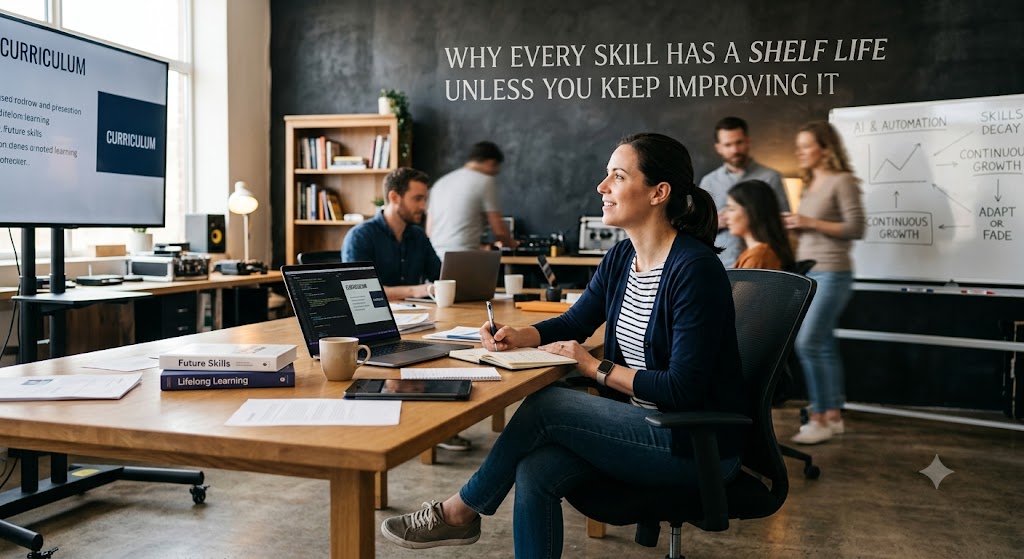
Why Every Skill Has a Shelf Life Unless You Keep Improving It
Every skill has a shelf life unless you keep improving it. That statement may sound uncomfortable at first, especially if you have spent years mastering a craft, earning qualifications, or building a successful career around a particular ability. Many people believe that once they become good at something, they can relax and enjoy the rewards indefinitely. Unfortunately, that is rarely how the modern world works. Skills that were once considered rare and highly valuable can become common, outdated, or even completely irrelevant within a surprisingly short period. The only reliable way to remain valuable in an ever-changing world is to embrace continuous improvement. Learning is no longer something that ends after school or university. It has become a lifelong responsibility for anyone who wants to remain competitive, relevant, and financially secure.
The pace of change today is unlike anything previous generations experienced. Technology evolves faster than ever before. Industries transform almost overnight. Consumer behaviour changes rapidly. New tools replace old methods. Artificial intelligence automates tasks that once required years of human experience. Businesses constantly search for faster, cheaper, and more efficient ways to operate. In this environment, standing still is often the same as moving backwards. The people who continue growing are the ones who remain in demand, while those who refuse to adapt often struggle to keep up.
History provides countless examples of talented individuals whose skills eventually became obsolete because they stopped learning. There was a time when video rental stores dominated entertainment. Employees who specialised in managing physical movie rentals believed they had secure careers until online streaming changed everything. Photographers who refused to embrace digital cameras found themselves replaced by those who adapted to new technology. Travel agents who ignored online booking systems lost customers to websites that offered greater convenience. Even experienced journalists had to learn digital publishing, social media strategies, and search engine optimisation as traditional newspapers declined.
The same principle applies to every profession. Doctors continuously study new treatments because medicine evolves every year. Lawyers must understand new legislation and legal precedents. Engineers learn about modern construction techniques and emerging technologies. Teachers update their teaching methods to meet the needs of changing generations. Software developers constantly learn new programming languages and frameworks because yesterday’s popular language may no longer dominate tomorrow’s projects. Even artists, musicians, and writers improve their techniques to match changing tastes and creative trends.
One of the biggest mistakes people make is assuming that experience alone guarantees long-term success. Experience is valuable, but only when combined with continuous learning. Imagine someone who has been driving for thirty years but refuses to learn about electric vehicles, autonomous driving technology, or modern safety systems. Their years of experience become less valuable if they ignore important developments in the industry. Experience without growth eventually becomes outdated knowledge repeated over and over again.
Many professionals unknowingly reach a comfort zone where they stop challenging themselves. They become confident because they know enough to perform their current job well. They no longer read industry news, attend training sessions, watch educational videos, or experiment with new ideas. At first, nothing seems wrong because their existing knowledge still works. However, while they remain comfortable, competitors continue learning. Slowly but surely, the gap widens until the once-experienced professional finds themselves struggling to compete with people who have fewer years of experience but more current knowledge.
The shelf life of a skill depends largely on the speed at which its industry changes. Some skills remain relevant for decades but still require refinement. Communication, leadership, problem-solving, emotional intelligence, and critical thinking remain valuable across generations. However, even these timeless skills benefit from continuous improvement because the contexts in which they are applied continue evolving. Public speaking today may involve virtual presentations, webinars, live streaming, and global audiences instead of traditional conference rooms. Leadership now includes managing remote teams, understanding digital collaboration tools, and leading people across different cultures.
Technical skills generally have much shorter shelf lives. Software that dominates today’s market may disappear within a few years. Programming languages rise and fall in popularity. Graphic design tools receive frequent updates. Marketing strategies that once produced excellent results become ineffective as search engines and social media platforms change their algorithms. Financial professionals adapt to new regulations and investment technologies. Healthcare workers learn new equipment and treatment protocols. Manufacturing employees work alongside increasingly advanced robotics and automation systems.
The rise of artificial intelligence has made continuous learning even more important. AI is changing how businesses operate across virtually every industry. Many repetitive tasks are becoming automated, forcing workers to develop skills that machines cannot easily replicate. Creativity, strategic thinking, relationship building, ethical judgement, emotional intelligence, innovation, and complex decision-making are becoming increasingly valuable. At the same time, professionals who understand how to work alongside AI rather than compete against it gain a significant advantage.
Rather than fearing technological change, successful individuals learn to use it as a tool. Writers use AI to brainstorm ideas while refining their own unique voices. Designers use intelligent software to speed up repetitive tasks while focusing on creativity. Programmers rely on AI assistants to improve productivity without abandoning the need for strong coding knowledge. Business owners automate routine operations so they can spend more time on strategy and customer relationships. The winners are rarely those who reject new technology. They are usually the ones who learn how to combine traditional expertise with modern innovation.
Education no longer ends with a diploma or degree. Universities provide foundations, but the real education continues throughout a person’s career. Employers increasingly value people who demonstrate curiosity, adaptability, and a willingness to learn. A certificate earned ten years ago may still be impressive, but employers often care more about whether candidates have kept their knowledge current. Someone who regularly completes professional development courses, earns updated certifications, and demonstrates ongoing learning often stands out from equally experienced applicants who have remained stagnant.
The internet has removed many barriers to learning. Decades ago, acquiring new knowledge often required expensive books, formal classes, or travelling long distances. Today, millions of educational resources are available online. Online courses, podcasts, digital libraries, webinars, discussion forums, educational videos, industry newsletters, and virtual conferences allow people to learn almost anything from anywhere. The challenge is no longer access to information. The challenge is maintaining the discipline to keep learning consistently.
Improvement does not always require dramatic changes. Small daily progress often produces remarkable long-term results. Reading twenty pages of a professional book each day may seem insignificant, but over a year it represents thousands of pages of new knowledge. Watching one educational video each evening can introduce hundreds of new concepts annually. Practising a skill for thirty minutes daily compounds into hundreds of hours of experience over time. Tiny improvements accumulate quietly until they create substantial differences between people who remain consistent and those who neglect personal development.
Athletes understand this principle exceptionally well. Elite footballers, runners, swimmers, and tennis players never assume they have mastered their sport completely. Even after winning championships, they continue training, analysing performances, improving weaknesses, and refining techniques. The moment they stop improving, younger and hungrier competitors begin catching up. Success at the highest level requires constant evolution because every competitor is also working hard to improve.
Business follows exactly the same pattern. Companies that stop innovating rarely remain market leaders forever. Successful organisations continually improve products, customer service, operational efficiency, and employee skills. They invest heavily in research, development, and training because they understand that today’s success does not guarantee tomorrow’s survival. Businesses that become complacent often discover too late that competitors have introduced better solutions, more efficient processes, or superior customer experiences.
Individuals should adopt the same mindset. Your career is your personal business. Your skills are your products. Your knowledge is your inventory. Your reputation depends on the quality of what you offer. If you neglect improvement, your professional value gradually declines while others increase theirs. Continuous learning is therefore not merely self-improvement; it is essential business maintenance for your own career.
Another reason skills have shelf lives is that customer expectations constantly evolve. Consumers expect faster service, better experiences, higher quality, and greater convenience than previous generations. Professionals who fail to meet these rising expectations risk losing clients regardless of their previous achievements. Restaurants introduce digital ordering systems because customers expect convenience. Retail businesses improve online shopping experiences because buying habits have changed. Content creators adapt to new social media trends because audience preferences evolve rapidly.
The entertainment industry illustrates this perfectly. Musicians cannot rely solely on vocal ability anymore. They often need branding knowledge, social media engagement, content creation skills, audience analytics, live streaming experience, and digital marketing expertise. Actors increasingly build personal brands online. Authors learn self-publishing platforms alongside traditional publishing methods. Creative talent remains important, but complementary skills significantly increase opportunities.
Entrepreneurship demands even greater adaptability. Business owners wear multiple hats. They manage finances, marketing, customer service, operations, negotiation, leadership, and strategic planning. As markets change, entrepreneurs must update these skills continuously. A marketing strategy that doubled sales five years ago may perform poorly today. Payment technologies evolve. Consumer behaviour shifts. Competition increases. Regulations change. Entrepreneurs who learn quickly often outperform competitors with larger budgets but outdated thinking.
Fear often prevents people from improving their skills. Some worry they are too old to learn something new. Others fear appearing inexperienced when exploring unfamiliar subjects. Many simply become overwhelmed by the speed of change. However, learning itself becomes easier with consistent practice. The more frequently people challenge themselves intellectually, the more comfortable they become adapting to change. Confidence grows not from already knowing everything but from trusting one’s ability to learn whatever becomes necessary.
Age rarely determines learning ability as much as attitude does. Across countless industries, experienced professionals successfully reinvent themselves by embracing continuous education. Some learn coding after forty. Others build online businesses after retirement. Many switch careers entirely by developing new competencies. Their previous experience becomes an advantage because they combine mature judgement with newly acquired knowledge.
Curiosity remains one of the most valuable personal qualities in the modern world. Curious people naturally ask questions, explore possibilities, test ideas, and seek understanding. They read widely, observe carefully, and remain open to different perspectives. This mindset keeps their skills fresh because curiosity constantly drives improvement. Complacency, on the other hand, gradually weakens professional value because it discourages exploration and experimentation.
Feedback also plays an essential role in extending the life of any skill. Improvement requires recognising weaknesses rather than pretending they do not exist. Constructive criticism helps identify blind spots that personal observation may miss. Athletes review match footage. Speakers watch recordings of presentations. Writers edit drafts repeatedly. Entrepreneurs analyse customer complaints. Professionals who welcome feedback usually improve faster than those who avoid criticism.
Networking contributes significantly to continuous development as well. Surrounding yourself with ambitious, knowledgeable people naturally exposes you to fresh ideas and better practices. Conversations with experienced professionals often reveal industry trends before they become widely known. Professional communities encourage learning because members share resources, discuss challenges, and exchange solutions. Isolation, by contrast, increases the risk of becoming outdated because new ideas rarely reach those who remain disconnected from their industries.
Reading remains one of the simplest yet most powerful methods for maintaining relevant skills. Books provide deep understanding that quick social media posts rarely offer. Industry publications reveal emerging trends before they become mainstream. Research papers introduce scientific advances. Biographies teach lessons from accomplished individuals. Consistent reading broadens perspective while strengthening professional expertise.
Practical application matters just as much as theoretical knowledge. Reading about leadership does not automatically create a great leader. Watching coding tutorials does not instantly produce programming expertise. Improvement happens through deliberate practice. Skills strengthen when knowledge becomes action. Every lesson should eventually be tested through real-world experience. Mistakes become valuable teachers because they reveal areas requiring further development.
Many people underestimate how quickly industries can transform. Entire job categories have disappeared within a generation while completely new professions have emerged. Social media managers, cloud architects, cybersecurity analysts, prompt engineers, digital content strategists, and data scientists were either uncommon or nonexistent not long ago. Meanwhile, numerous traditional roles have declined dramatically because technology replaced or transformed them. Predicting exactly which jobs will dominate the future remains difficult, but developing the habit of continuous learning prepares individuals to adapt regardless of what changes occur.
Financial security increasingly depends on adaptability rather than permanence. Previous generations often spent entire careers working for one employer. Today’s workforce experiences frequent career changes, industry shifts, and evolving employment models. Freelancing, remote work, digital entrepreneurship, and portfolio careers have become common. In this environment, transferable skills and learning agility provide greater security than relying solely on one specialised ability.
Employers consistently seek individuals who solve problems rather than simply perform routines. Routine tasks are often the first to become automated. Complex problem-solving, innovation, collaboration, and creative thinking remain difficult to replace. Therefore, professionals should continually strengthen these higher-level abilities alongside technical expertise. This balanced approach increases long-term employability regardless of technological disruption.
Personal branding also benefits from continuous improvement. People naturally associate expertise with those who consistently demonstrate current knowledge. Professionals who regularly share insights, publish articles, teach others, speak at events, or contribute to industry discussions establish reputations as lifelong learners. This credibility attracts opportunities because clients and employers trust individuals who clearly remain informed about current developments.
Teaching others is another powerful way to keep skills alive. Explaining concepts forces deeper understanding while revealing knowledge gaps. Mentoring junior colleagues strengthens communication abilities and reinforces core principles. Educational content creation encourages continuous research because audiences expect accurate and up-to-date information. Those who teach often learn twice because preparation requires thorough mastery.
Resilience becomes stronger through continuous improvement as well. Unexpected disruptions become less threatening when individuals possess diverse, updated skills. Losing a job becomes less devastating because adaptable professionals can transition into new roles more easily. Economic downturns become more manageable because continuous learners recognise emerging opportunities sooner. Adaptability creates confidence because people trust their ability to navigate uncertainty.
It is important to remember that improvement does not mean abandoning previous knowledge. Instead, it means building upon existing foundations. Every new skill becomes more powerful when combined with previous experience. An accountant who learns data analysis becomes more valuable. A teacher who masters educational technology reaches more students effectively. A photographer who understands digital marketing attracts more clients. Skills multiply in value when combined intelligently.
The most successful people rarely assume they have finished learning. They remain students regardless of their achievements. They read after becoming executives. They practise after becoming experts. They ask questions despite decades of experience. This humility protects them from stagnation because they recognise that knowledge continually evolves.
There is also a psychological benefit to continuous improvement. Learning stimulates the mind, increases confidence, and creates a sense of progress. Acquiring new abilities keeps work interesting while reducing boredom. People who challenge themselves intellectually often experience greater motivation because growth itself becomes rewarding. Instead of fearing change, they become excited by opportunities to expand their capabilities.
Many people wait until they lose relevance before deciding to improve. Unfortunately, recovery often proves more difficult than prevention. Learning continuously while your existing skills remain valuable creates smoother transitions because you build upon strength rather than reacting to crisis. Prevention almost always requires less effort than rebuilding after becoming obsolete.
Young professionals should understand that graduating marks the beginning rather than the conclusion of education. Experienced professionals should recognise that decades of success do not eliminate the need for adaptation. Entrepreneurs should expect markets to evolve continuously. Creatives should embrace changing audience preferences. Employees should prepare for technological transformation. Leaders should cultivate cultures where learning never stops.
The future will belong to people who combine expertise with adaptability. They will not necessarily be the smartest individuals in every room, nor will they always possess the most impressive qualifications. Instead, they will be the people who consistently ask, “What do I need to learn next?” That simple question keeps skills fresh, careers resilient, businesses competitive, and opportunities abundant.
Every sunrise introduces new ideas, technologies, competitors, and possibilities. Every day offers an opportunity either to sharpen existing abilities or slowly allow them to fade. Skills resemble living organisms more than permanent possessions. They grow when exercised, weaken when neglected, and eventually disappear when ignored for too long. Your greatest competitive advantage is not what you learned years ago but your willingness to continue learning today.
The world will continue changing whether we prepare for it or not. Industries will evolve. Technology will advance. Customer expectations will rise. New careers will emerge while familiar ones transform. Amid all this uncertainty, one truth remains remarkably consistent. The people who thrive are not those who cling stubbornly to yesterday’s knowledge but those who continually refresh, refine, and expand their abilities. Every skill has a shelf life unless you keep improving it, and the decision to extend that shelf life rests entirely in your own hands.

EarnSmartOnline.com.ng is dedicated to helping readers make smarter financial decisions through practical guides on online income, personal finance, technology, digital business, and wealth creation. Our goal is to provide reliable, easy-to-understand, and actionable content that empowers individuals to earn smarter, build sustainable income streams and achieve long-term financial success.
Recommended: Start Earning Online
- Ultimate Affiliate Marketing Program — learn affiliate marketing with a done-for-you sales system ($15). Check it out
- The Newbie Affiliate Guide — the beginner-friendly starter guide (~$6.68). Check it out
- Easy Dollar Maker — earn in dollars uploading AI images and videos from your phone ($17). Check it out
Disclosure: These are affiliate links. If you buy through them, I may earn a commission at no extra cost to you.



