
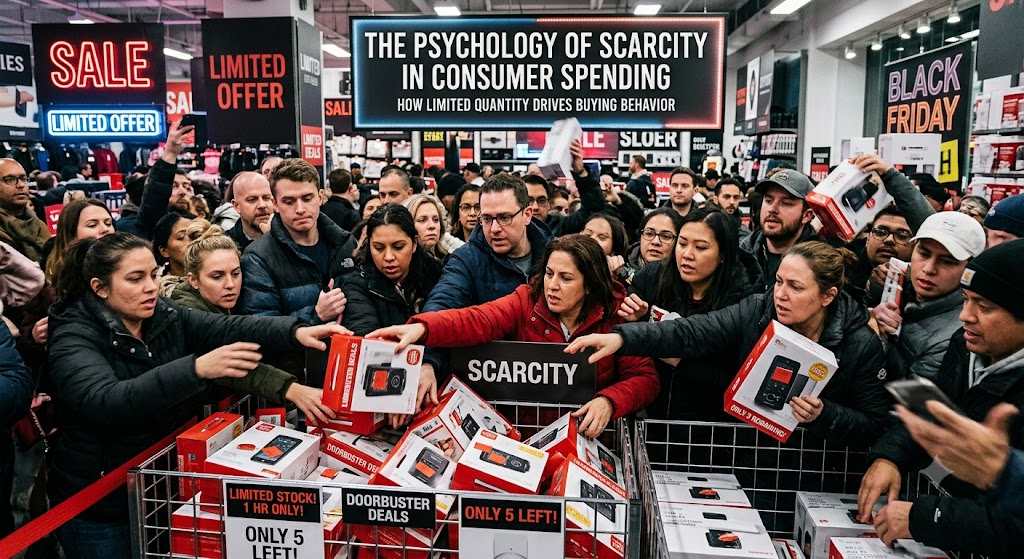
Scarcity has a powerful influence on the way people think, behave, and spend money. When something appears to be limited, people often want it more, even when they had little interest in it before discovering that it might soon disappear. A product can suddenly become more attractive because there are only a few units left. A discount can become difficult to resist because it expires at midnight. A message saying that thousands of people are viewing an item can create anxiety that someone else might buy it first. These reactions are not always driven by genuine need. In many cases, they are driven by the psychology of scarcity. The Psychology of Scarcity in Consumer Spending
The psychology of scarcity in consumer spending explains how perceived shortages, limited availability, time restrictions, and fear of missing out can influence purchasing decisions. Scarcity can make consumers act faster, spend more than planned, and sometimes purchase things they do not actually need. Understanding this psychological principle is important because it helps explain why otherwise financially disciplined people sometimes make impulsive spending decisions.
Scarcity itself is not a new concept. Human beings have always had to make decisions under conditions where resources were limited. Food, shelter, water, safety, and other essential resources have historically determined survival. When something appears difficult to obtain, the brain can treat it as more valuable. This response may have been useful when resources genuinely were scarce, but modern consumer markets have learned how to trigger similar psychological reactions through marketing.
Walk into a shop and see a product sitting on a shelf with hundreds of identical units around it, and you may feel no urgency. Now imagine seeing the same product with a sign saying, “Only two left.” Your perception may immediately change. You may begin thinking about whether you should buy it before somebody else does. The product has not necessarily become better. Its physical qualities have not changed. What has changed is your perception of its availability.
This is one of the central ideas behind scarcity marketing. Consumers often assign greater value to things that appear rare, exclusive, or difficult to obtain. Limited edition products, exclusive memberships, flash sales, countdown offers, invitation only events, and temporary discounts all use scarcity in different ways. The underlying psychological message is simple: if you do not act now, you may lose the opportunity.
The fear of losing an opportunity can be stronger than the desire to gain something. This is particularly important when understanding consumer spending. A person may not originally intend to spend ₦50,000 on clothing, but seeing a message that a particular item is available for only a few more hours can change the decision. Suddenly, the person is not simply considering whether the clothing is worth ₦50,000. The person is also considering what it would feel like to miss the opportunity.
This is where fear of missing out, commonly known as FOMO, becomes powerful. FOMO is the uncomfortable feeling that other people are benefiting from an opportunity while you are being left behind. It can influence spending on fashion, technology, travel, entertainment, investments, restaurants, online courses, subscriptions, and even everyday household products.
Social media has intensified this phenomenon because consumers constantly see what other people are buying, experiencing, and enjoying. Someone sees friends travelling to a particular destination and suddenly feels pressure to book a trip. Someone watches influencers showing a new smartphone and begins wondering whether their current phone is outdated. Someone sees people celebrating a product launch online and begins feeling that owning the product is necessary to remain part of the conversation.
The Psychology of Scarcity in Consumer Spending
Scarcity becomes even more powerful when it is combined with social proof. If a consumer sees “Only three rooms remaining” alongside “1,200 people booked this hotel this week,” the message becomes psychologically stronger. The first statement creates urgency while the second creates social pressure. The consumer may begin thinking that so many other people cannot all be wrong.
However, popularity does not automatically mean suitability. A product can be popular and still be unnecessary for a particular consumer. A hotel can be nearly fully booked and still be too expensive for someone’s budget. A course can have thousands of students and still not solve the buyer’s specific problem. The Psychology of Scarcity in Consumer Spending
The danger of scarcity psychology is that it can move a person from deliberate decision making into emotional decision making. Instead of asking, “Do I need this?” the consumer begins asking, “What if I lose the chance to get this?” Those questions sound similar, but they lead to very different financial outcomes.
Consider the psychology behind a limited time discount. Suppose a product normally costs ₦100,000 but is advertised at ₦70,000 for the next two hours. A consumer might think, “I am saving ₦30,000.” But that is not necessarily what is happening. If the consumer never needed the product, spending ₦70,000 is not a saving. It is an expense.
This is one of the most important lessons in personal finance. A discount does not automatically create wealth. Spending less than the original price is still spending money. Consumers can become financially trapped by constantly buying discounted things they do not need because each individual purchase appears to be a bargain.
The scarcity effect can also distort perceptions of value. When something becomes difficult to obtain, consumers may assume that it must be more valuable. This is not always true. Rarity and usefulness are different concepts. A product can be rare but useless to you. Another product can be widely available but extremely valuable.
Luxury brands have understood this principle for decades. Limited production, exclusive releases, invitation only access, waiting lists, and restricted availability can increase the perceived desirability of products. Consumers are sometimes paying not only for the physical item but also for the feeling of exclusivity attached to owning something that others cannot easily obtain.
This demonstrates another important aspect of consumer psychology. People do not always buy products purely because of their practical benefits. They also buy identity, status, belonging, excitement, security, and emotional experiences. Scarcity can strengthen all of these motivations.
For some consumers, buying something rare communicates status. For others, it creates a sense of achievement. For another person, purchasing before everybody else creates the feeling of being ahead of the crowd. Scarcity therefore operates differently depending on the emotional needs of the individual.
The psychology of scarcity in consumer spending becomes particularly dangerous when consumers are financially stressed. A person with limited income may already have very little room for unnecessary spending, yet scarcity marketing can make impulsive purchases feel urgent. When money is tight, every avoidable purchase becomes more significant because there are fewer resources available to absorb the financial mistake.
People who are already experiencing financial scarcity can also become more vulnerable to short term thinking. When individuals constantly worry about money, they may focus heavily on immediate opportunities and immediate threats. A “buy now” message can therefore have greater psychological impact than a long term financial consideration.
This creates an interesting paradox. Scarcity can affect both people who have plenty of money and people who have very little. Wealthier consumers may respond to scarcity because they can afford the product and enjoy exclusivity. Lower income consumers may respond because they fear losing a rare opportunity or missing a discount. The financial consequences, however, can be very different.
Scarcity is also common in online shopping. E commerce platforms can display countdown timers, stock warnings, limited quantity messages, and notifications about recent purchases. These features are designed to reduce the amount of time consumers have to think before buying.
When consumers have plenty of time to evaluate a purchase, they can compare prices, read reviews, consider alternatives, and examine their budget. When urgency is introduced, those deliberate processes can become weaker. The consumer may act first and evaluate later.
This is why one of the simplest personal finance strategies is to create a pause between desire and purchase. The pause does not have to be complicated. It could be ten minutes for a small purchase, twenty four hours for a moderate purchase, or several days for an expensive purchase. The purpose is to separate genuine need from emotional urgency.
A useful question is, “Would I still want this if it were available tomorrow at the same price?” If the answer is no, scarcity may be influencing the decision more than the product itself.
Another useful question is, “If nobody knew I owned this, would I still buy it?” This can help reveal whether the purchase is primarily about personal usefulness or social status.
Consumers can also ask, “Was this purchase already in my financial plan?” If the answer is no, the urgency deserves closer examination. Planned spending and emotional spending are not always the same thing.
Scarcity also influences how consumers respond to sales events. Large shopping events can create an atmosphere where spending becomes socially normalised. Everyone appears to be buying something, deals appear everywhere, and consumers begin feeling that not participating means missing out.
The result can be a strange financial contradiction. People may enter a sale intending to save money and leave having spent significantly more than they planned. The psychological environment changes the objective from “buy what I need at a good price” to “take advantage of as many opportunities as possible.”
This is why a shopping budget should be established before entering a major sale. The budget creates a boundary before emotions become involved. Once a person is surrounded by scarcity messages, changing the budget becomes much easier. The Psychology of Scarcity in Consumer Spending
Scarcity can also influence subscription spending. A company might offer a promotional price for a limited period, causing consumers to subscribe quickly. The immediate price may appear attractive, but consumers sometimes forget to evaluate the long term cost. A discounted first month can eventually become an expensive annual commitment.
The same principle applies to online courses, memberships, software, entertainment services, fitness programmes, and other recurring expenses. The consumer should evaluate the total expected cost rather than focusing exclusively on the initial discount.
Another important psychological factor is regret. Consumers often fear regretting the decision not to buy something. Marketing can exploit this emotion by presenting the purchase as an opportunity that may never return.
But regret can work in both directions. People can regret not buying something, but they can also regret buying something they did not need. In personal finance, the second form of regret can be particularly expensive.
Imagine someone purchasing an expensive gadget because it was described as a limited time offer. After the excitement disappears, the gadget sits unused. The consumer now has two problems. The money is gone, and the product has little practical value. The original fear of missing out has been replaced by buyer’s remorse.
This is why emotional discipline is an essential part of financial literacy. Financial success is not simply about knowing how to earn money. It also involves understanding the psychological forces that influence how money leaves your hands.
Many people spend considerable effort trying to increase their income while paying little attention to the psychology behind their spending. But earning more money does not automatically solve poor spending behaviour. If lifestyle inflation, impulse buying, FOMO, and scarcity driven decisions increase alongside income, financial problems can continue even when earnings improve.
Understanding scarcity can therefore become a form of financial self defence. Once consumers recognise the pattern, marketing messages become easier to interpret. “Only three left” becomes a psychological trigger rather than an unquestionable reason to purchase. “Offer ends tonight” becomes a deadline to evaluate rather than an instruction to spend. “Thousands bought this” becomes social proof rather than evidence that the product is necessary.
This does not mean every scarcity message is manipulative. Sometimes products really are limited. Genuine shortages exist, prices really do change, and legitimate opportunities can disappear. The goal is not to reject every limited offer. The goal is to make sure urgency does not replace judgement.
A smart consumer can take advantage of genuine opportunities without allowing urgency to control financial decisions. The difference is intentionality. If the purchase fits the budget, solves a real problem, and provides sufficient value, buying during a limited opportunity can make sense. If the purchase exists primarily because the consumer is afraid of missing out, caution is usually wiser.
Scarcity also teaches a broader lesson about human behaviour. People tend to value what they believe they might lose. This is why scarcity can influence not only shopping but also relationships, attention, status, opportunities, and social behaviour. When availability decreases, perceived value can increase.
Businesses understand this because consumer psychology directly affects sales. Creating urgency can reduce hesitation and increase conversion. But consumers need to understand the same psychology from the opposite side of the transaction. The seller is trying to persuade you to act. Your responsibility is to decide whether acting is actually in your interest.
This is particularly important for young consumers growing up in an environment where advertising is everywhere. Traditional advertising used to appear mainly on television, radio, newspapers, billboards, and magazines. Today, marketing can enter someone’s life through social media feeds, search engines, emails, mobile applications, influencers, notifications, videos, and personalised recommendations.
Consumers are therefore exposed to persuasive messages almost continuously. Many of those messages are designed around urgency, exclusivity, convenience, and emotional appeal. Developing awareness of these techniques is becoming an increasingly important part of financial education.
Parents and educators can also help young people understand the psychology behind spending. Instead of simply telling young people not to waste money, they can teach them how marketing influences decision making. Understanding the mechanism is often more powerful than receiving a warning.
A person who understands scarcity psychology is less likely to panic when confronted with a countdown timer. They can pause and ask whether the opportunity is genuinely valuable or simply being made to feel valuable.
Ultimately, the psychology of scarcity in consumer spending is about perception. When something appears limited, our brains can assign it greater importance. That reaction is deeply human, but being human does not mean being powerless against it.
The strongest financial decision is not always the decision to buy at the lowest price. Sometimes it is the decision to walk away completely. There is no financial victory in saving ₦20,000 on something you never needed. There is no bargain in spending ₦50,000 simply because someone told you the opportunity would disappear tonight.
Real financial discipline means understanding not only the mathematics of money but also the psychology behind money. You need to understand why you want something, why you suddenly want it now, and whether the urgency is coming from your genuine needs or from someone else’s marketing strategy.
The next time you see “Only two left,” “Sale ends tonight,” “Last chance,” “Limited edition,” or “People are buying this right now,” pause before reaching for your wallet. Ask yourself whether the product would still be valuable without the scarcity message.
If the answer is yes, evaluate the purchase based on your needs, budget, quality, and long term value. If the answer is no, you may have just discovered that what you wanted was not the product itself but the feeling of not missing out.
Scarcity can make consumers spend faster, spend more, and sometimes spend irrationally. But once you understand how scarcity affects consumer behaviour, you can create a valuable psychological distance between what marketers want you to feel and what you actually choose to do.
Money becomes easier to manage when you stop allowing urgency to make your financial decisions. You do not have to buy everything that might disappear. You do not have to participate in every sale. You do not have to own what everyone else is rushing to own.
Sometimes the smartest response to scarcity is simply to wait.
Because when the pressure disappears, your real priorities become much easier to see.

EarnSmartOnline.com.ng is dedicated to helping readers make smarter financial decisions through practical guides on online income, personal finance, technology, digital business, and wealth creation. Our goal is to provide reliable, easy-to-understand, and actionable content that empowers individuals to earn smarter, build sustainable income streams and achieve long-term financial success.
Recommended: Start Earning Online
- Ultimate Affiliate Marketing Program — learn affiliate marketing with a done-for-you sales system ($15). Check it out
- The Newbie Affiliate Guide — the beginner-friendly starter guide (~$6.68). Check it out
- Easy Dollar Maker — earn in dollars uploading AI images and videos from your phone ($17). Check it out
Disclosure: These are affiliate links. If you buy through them, I may earn a commission at no extra cost to you.



