
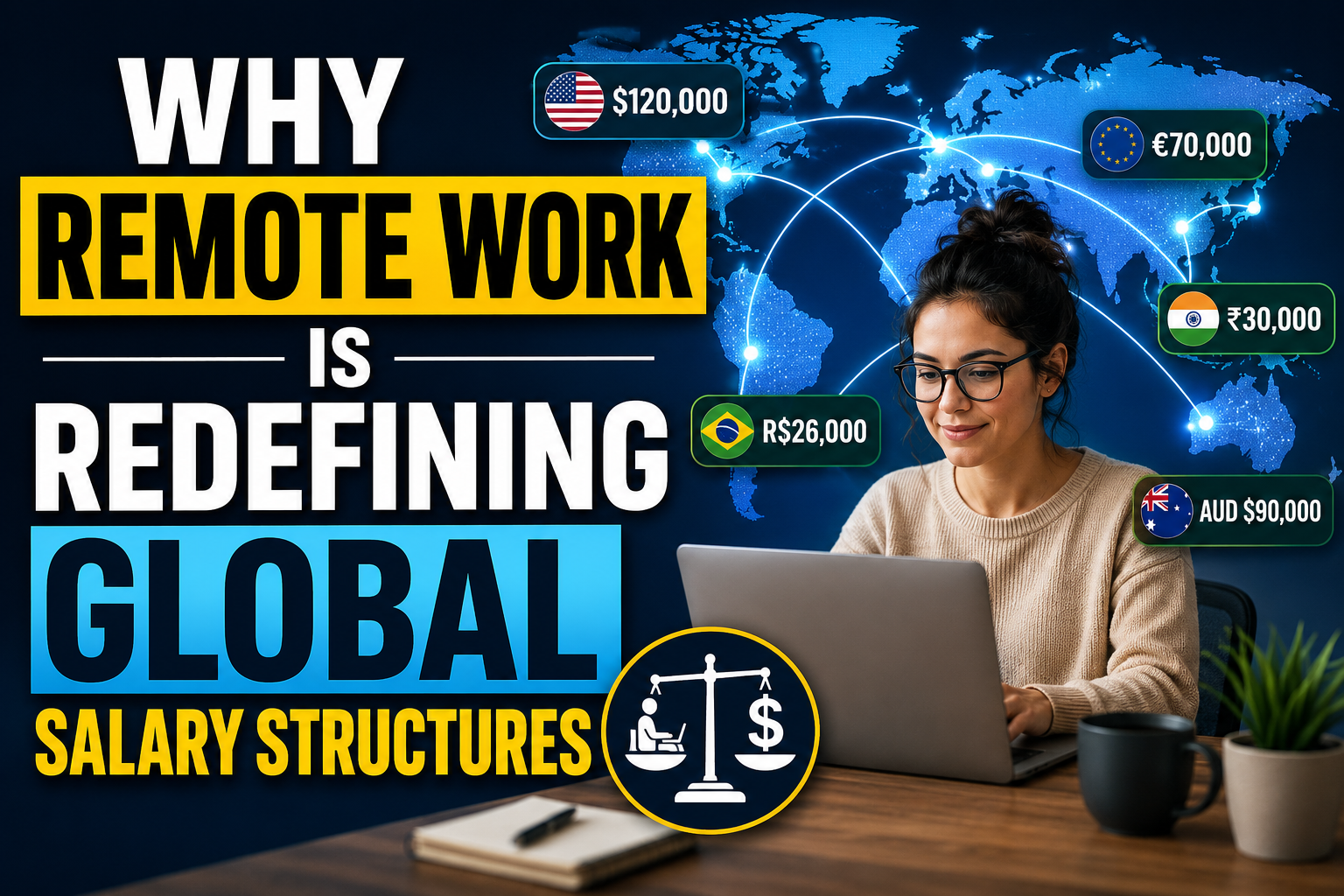
Why Remote Work Is Redefining Global Salary Structures
For decades, salary structures around the world followed a relatively predictable pattern. Workers were paid based largely on where they lived and where their employers operated. Employees in major cities often earned significantly higher wages than those in smaller towns or developing countries because companies needed to compensate for higher living costs and local labor market conditions. This traditional model remained largely unchanged for generations. However, the rapid rise of remote work has disrupted this long standing system and is fundamentally redefining how salaries are determined across the globe.
Remote work has transformed the relationship between geography and income. Before widespread internet connectivity and digital collaboration tools, employers typically hired workers within commuting distance of their offices. This naturally limited the talent pool and created salary structures tied closely to local economic conditions. A software engineer in New York could command a much higher salary than a similarly skilled engineer in another country because employers had limited access to global talent. Today, that reality is changing at an unprecedented pace.
The growth of remote work has effectively turned the global labor market into a much larger and more competitive ecosystem. Companies are no longer restricted to hiring talent within a specific city, state, or even country. Instead, organizations can recruit highly skilled professionals from virtually anywhere with a stable internet connection. This shift has dramatically increased access to talent while simultaneously increasing competition among workers worldwide.
One of the most significant consequences of remote work is the emergence of global salary benchmarking. Employers are increasingly evaluating compensation based on skills, experience, productivity, and market demand rather than solely on geographic location. In many industries, especially technology, digital marketing, design, consulting, and customer support, businesses are beginning to compare candidates from different countries for the same roles. This has led to a reevaluation of what constitutes fair compensation in a borderless work environment.
For workers in developing countries, remote work has created opportunities that were previously unimaginable. Talented professionals can now access jobs with international companies that offer salaries significantly higher than those available in their local markets. A graphic designer in Nigeria, a software developer in India, or a virtual assistant in the Philippines can potentially earn income from clients and employers located in wealthier economies. This has opened new pathways for economic mobility and wealth creation.
At the same time, remote work has introduced new challenges for workers in high income countries. Employers seeking to reduce costs may choose to hire equally qualified professionals from regions with lower wage expectations. As a result, some workers in traditionally high paying locations face increased competition from a global talent pool. This dynamic is encouraging professionals to focus more heavily on specialization, unique skills, and measurable results to maintain their competitive advantage.
Another factor reshaping salary structures is the growing emphasis on value creation rather than physical presence. In traditional office environments, employees were often evaluated based on attendance, visibility, and time spent at work. Remote work shifts the focus toward outcomes, productivity, and performance. Employers are becoming more interested in what employees accomplish rather than where they are located. This change is helping to create compensation models that reward results more directly.
Technology has played a central role in enabling this transformation. Cloud computing, project management platforms, video conferencing tools, and instant communication systems have made it possible for distributed teams to collaborate effectively across continents. As technology continues to improve, the barriers that once justified location based salary differences continue to weaken. Organizations can now manage international teams with efficiency levels that were difficult to imagine just a decade ago.
The rise of remote work has also accelerated the concept of location independent careers. Increasing numbers of professionals are choosing to live in areas with lower costs of living while maintaining employment with companies based in higher paying markets. This trend has created new conversations around salary fairness. Some organizations argue that compensation should reflect local living costs, while others believe employees should be paid according to the value they bring regardless of location.
These differing perspectives have led companies to adopt a variety of compensation strategies. Some businesses maintain location based pay structures, adjusting salaries according to where employees reside. Others use national salary bands, while some have embraced global compensation models that pay employees similarly regardless of geography. Each approach presents advantages and challenges, and there is no universally accepted solution.
Remote work has also highlighted the growing importance of skills over credentials. Employers searching globally for talent often prioritize demonstrated abilities and proven performance rather than educational background alone. As a result, workers who continuously develop valuable skills can compete more effectively in international markets. This shift is encouraging lifelong learning and increasing demand for practical expertise.
The impact extends beyond individual workers and companies. Entire economies are feeling the effects of remote work driven salary shifts. Countries with strong digital infrastructure and growing pools of skilled professionals are attracting more international employment opportunities. Governments are increasingly recognizing the importance of digital education, internet access, and technology investment as critical components of future economic growth.
Urban centers are experiencing changes as well. For decades, major cities attracted workers seeking higher paying jobs concentrated in office districts. Remote work is reducing the necessity of living near corporate headquarters. Some professionals are relocating to smaller cities, suburbs, or rural areas while maintaining competitive salaries. This migration is influencing housing markets, transportation patterns, and local economies.
Employers are benefiting from expanded hiring flexibility. Organizations can access specialized expertise that may not be available locally. This broader talent pool allows businesses to fill critical positions more efficiently while potentially reducing recruitment costs. Companies that successfully build remote teams can gain significant competitive advantages in a rapidly evolving global economy.
However, the transition is not without complications. Differences in labor laws, taxation systems, employment regulations, and cultural expectations can create challenges for organizations hiring across borders. Companies must navigate complex compliance requirements while ensuring fair treatment of employees in diverse regions. These considerations add layers of complexity to global workforce management.
Remote work is also contributing to increased wage transparency. Online platforms, professional networks, and salary comparison websites allow workers to access information about compensation trends more easily than ever before. Greater transparency empowers employees to negotiate more effectively and helps reduce information asymmetry between employers and job seekers.
As competition becomes increasingly global, adaptability is emerging as one of the most valuable professional traits. Workers who embrace continuous learning, technological proficiency, communication skills, and cross cultural collaboration are positioning themselves for success in the remote economy. The ability to deliver consistent results across digital environments is becoming a powerful determinant of earning potential.
The future of salary structures will likely involve a blend of traditional and emerging models. Some industries may continue to rely heavily on geographic compensation frameworks, while others move toward skill based and value based approaches. Hybrid work arrangements may further complicate these decisions as employers seek to balance fairness, competitiveness, and operational efficiency.
What is clear is that remote work has permanently altered the relationship between location and income. The old assumption that salary is determined primarily by where someone lives is gradually being replaced by a more complex system influenced by skills, productivity, market demand, and global competition. This shift represents one of the most significant changes in the modern labor market.
For workers, the message is becoming increasingly evident. Geographic boundaries are no longer the primary limitation they once were. Individuals who invest in valuable skills, embrace digital tools, and adapt to changing workplace dynamics can access opportunities that extend far beyond their local economies. For employers, the challenge is to develop compensation strategies that attract top talent while remaining sustainable in a highly competitive global marketplace.
Remote work is not merely changing where people work. It is redefining how value is measured, how compensation is determined, and how careers are built. As technology continues to connect workers and employers across borders, global salary structures will continue to evolve, creating new opportunities and challenges that will shape the future of work for generations to come.

EarnSmartOnline.com.ng is dedicated to helping readers make smarter financial decisions through practical guides on online income, personal finance, technology, digital business, and wealth creation. Our goal is to provide reliable, easy-to-understand, and actionable content that empowers individuals to earn smarter, build sustainable income streams and achieve long-term financial success.
Recommended: Start Earning Online
- Ultimate Affiliate Marketing Program — learn affiliate marketing with a done-for-you sales system ($15). Check it out
- The Newbie Affiliate Guide — the beginner-friendly starter guide (~$6.68). Check it out
- Easy Dollar Maker — earn in dollars uploading AI images and videos from your phone ($17). Check it out
Disclosure: These are affiliate links. If you buy through them, I may earn a commission at no extra cost to you.



