
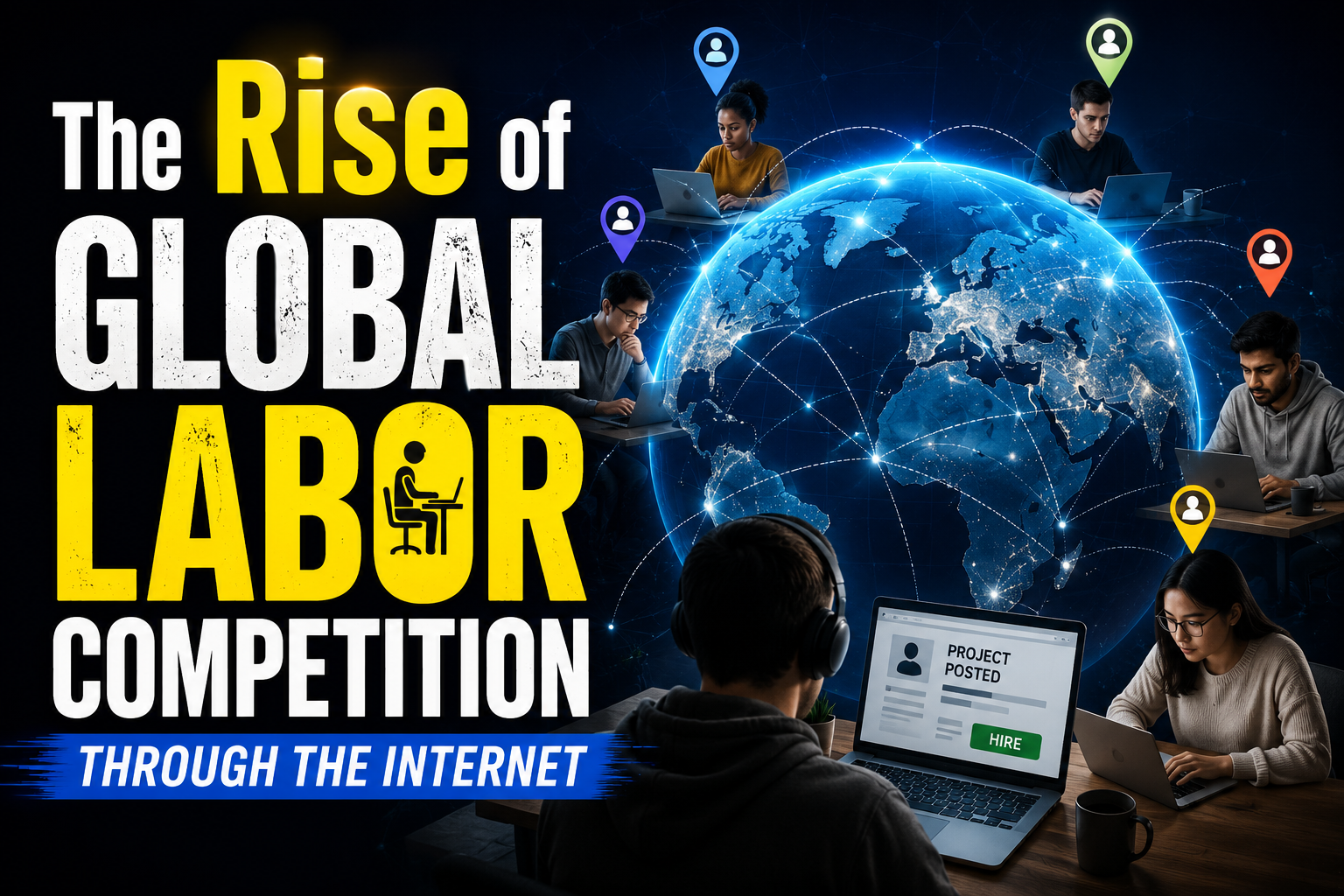
The Rise of Global Labor Competition Through the Internet
The internet has quietly reshaped one of the most fundamental forces in human survival, which is how people compete for work. For most of history, labor competition was local. You competed with people in your town, your city, or at most your country. Your salary, opportunities, and career growth were largely determined by geography. But the rise of the internet has erased those borders in a way that most people are only beginning to understand. Today, labor competition is no longer local or even national. It is global, constant, and increasingly unforgiving.
What this means is simple but powerful. A person in Lagos is no longer only competing with other people in Lagos for digital work. They are competing with someone in India, the Philippines, Pakistan, Eastern Europe, and even freelancers in Western countries who are willing to work remotely. The internet has flattened access, but it has also intensified competition. Employers and clients are no longer limited by location when choosing talent. They now choose based on value, speed, quality, and cost across a global talent pool.
This shift did not happen overnight. It began slowly with outsourcing in the early 2000s when companies realized that certain tasks could be done more cheaply in other countries. Customer service centers, data entry jobs, basic design work, and coding tasks began moving across borders. At first, this was seen as a corporate cost saving strategy. But what started as outsourcing has evolved into a full global labor marketplace where individuals directly compete with each other on digital platforms. The internet removed friction, and in removing friction, it increased competition.
One of the biggest misunderstandings about this new reality is that people still believe their biggest competitors are the people physically around them. This is no longer true for most digital or remote work. A graphic designer is not just competing with designers in their neighborhood. A writer is not just competing with writers in their city. A software developer is not just competing with developers in their country. Every job that can be delivered online has effectively become part of a global auction system where the best combination of price and performance often wins.
This global competition has created both opportunity and pressure. On one hand, it has opened doors for millions of people in developing countries who previously had limited access to high paying work. Someone with strong digital skills can now earn international income without leaving their home. On the other hand, it has placed downward pressure on wages for many roles that are easily replaceable or undifferentiated. When supply increases globally, price naturally adjusts, and in many cases that adjustment favors the buyer of labor rather than the seller.
The psychological impact of this shift is also significant. Many workers are still operating with an outdated mental model where effort alone guarantees reward. But in a global labor market, effort is not enough. Visibility, differentiation, speed, and specialization matter more than ever. The internet does not reward participation. It rewards distinction. If what you offer looks like what thousands of others offer, you are competing in a race to the bottom where price becomes the only deciding factor.
Another important dimension of this change is the rise of platform based labor ecosystems. Freelance websites, remote job boards, and gig platforms have centralized global competition into visible marketplaces. While these platforms provide access, they also expose workers directly to pricing pressure. A job posting can receive dozens or even hundreds of applicants from different countries within hours. This creates an environment where standing out is no longer optional but essential for survival.
However, global competition is not purely a threat. It is also a signal. It reveals the true value of skills in the open market. When you are competing globally, you begin to see which skills are universally demanded and which are locally inflated. You also begin to understand that income is not determined by effort alone but by the scarcity of your skill in a global pool. This realization is uncomfortable for many people, but it is also empowering because it provides clarity on what actually drives economic value.
The internet has also changed the speed at which skills become outdated. In a global labor market, industries evolve quickly because innovation spreads instantly. A technique, tool, or strategy that gives someone an advantage today can become standard knowledge globally within months. This means that continuous learning is no longer optional. It is a requirement for maintaining relevance. Those who stop upgrading their skills do not just fall behind locally, they fall behind globally.
Another overlooked effect of global labor competition is the shift in what employers prioritize. In a local market, employers may consider familiarity, proximity, or long term presence as advantages. In a global market, these factors matter less. What matters more is output, reliability, and measurable results. This has led to a more performance driven environment where traditional markers like degrees or local reputation carry less weight than actual demonstrated ability.
At the same time, this global exposure has created a new hierarchy of opportunity. Those who understand how to position themselves in digital markets can earn disproportionately more than those who do not. Personal branding, online portfolios, and niche specialization have become powerful tools for escaping price based competition. Instead of competing broadly, successful individuals often narrow their focus to very specific problems, industries, or audiences where they can become highly valuable.
There is also a deeper economic truth emerging from this shift. The internet has not made labor equal. It has made labor transparent. And in transparency, differences in skill, speed, communication, and problem solving ability become more visible than ever before. In the past, inefficiency could be hidden by geography or lack of comparison. Today, everything is comparable instantly. This means that excellence is rewarded more quickly, but mediocrity is also exposed more quickly.
For individuals trying to navigate this environment, the key adjustment is mindset. Thinking locally while operating globally is one of the biggest disadvantages a person can have today. Success in this new era requires understanding that your value is not defined by your immediate surroundings but by a worldwide benchmark. This does not mean everyone must compete at a global elite level, but it does mean that awareness of global standards is essential for positioning oneself effectively.
Ultimately, the rise of global labor competition through the internet is not just an economic shift. It is a structural transformation of how work itself is valued and distributed. It has created new winners, new pressures, and new rules. Those who understand it early gain access to opportunities that did not exist before. Those who ignore it often find themselves competing in outdated systems that no longer reflect how the world actually works. The internet did not just connect people. It connected their labor markets, and in doing so, it permanently changed the meaning of work, value, and opportunity.

EarnSmartOnline.com.ng is dedicated to helping readers make smarter financial decisions through practical guides on online income, personal finance, technology, digital business, and wealth creation. Our goal is to provide reliable, easy-to-understand, and actionable content that empowers individuals to earn smarter, build sustainable income streams and achieve long-term financial success.
Recommended: Start Earning Online
- Ultimate Affiliate Marketing Program — learn affiliate marketing with a done-for-you sales system ($15). Check it out
- The Newbie Affiliate Guide — the beginner-friendly starter guide (~$6.68). Check it out
- Easy Dollar Maker — earn in dollars uploading AI images and videos from your phone ($17). Check it out
Disclosure: These are affiliate links. If you buy through them, I may earn a commission at no extra cost to you.



