
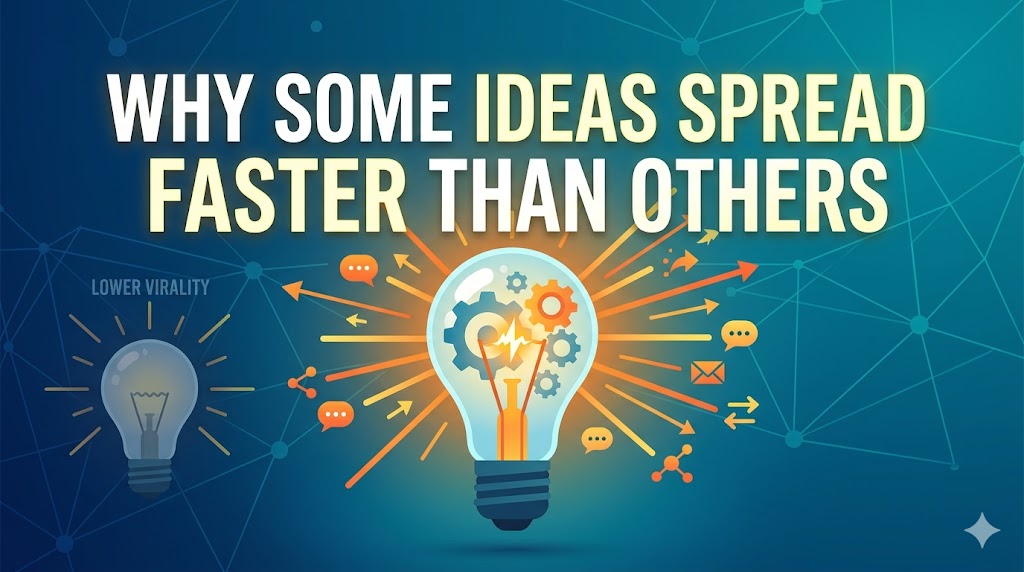
Why Some Ideas Spread Faster Than Others
In every era of human communication, from spoken stories around fires to modern digital platforms, some ideas travel across populations with incredible speed while others barely move beyond their origin. This difference is not random. It is shaped by patterns in human psychology, social structure, and the environments in which ideas are shared. Understanding why some ideas spread faster than others is less about creativity alone and more about how those ideas interact with attention, emotion, identity, and the systems that carry them.
At the center of idea spread is attention. People do not pass on everything they encounter. They pass on what captures their attention strongly enough to interrupt their normal flow of thought. In a world overloaded with information, attention has become the first gatekeeper. Ideas that are simple to notice, easy to understand at a glance, and immediately relevant to daily life tend to survive this gate. Complicated ideas often fail not because they lack value, but because they demand more mental effort than people are willing to spend in a fast moving environment. The easier an idea is to process, the more likely it is to be shared.
Emotion plays an even deeper role. People rarely share information in a neutral state. They share what makes them feel something. Ideas that trigger strong emotional responses such as surprise, fear, joy, anger, or curiosity tend to spread faster because emotion creates urgency. When someone feels something strongly, they want others to feel it too, and sharing becomes a natural extension of that emotional experience. This is why certain stories or statements go viral while more balanced or logical content remains contained. Emotion acts like fuel for transmission.
Closely tied to emotion is identity. People share ideas that reflect who they are or who they want to be seen as. An idea becomes more powerful when it allows someone to signal their beliefs, values, or social alignment. For example, sharing a particular opinion can be a way of saying this is what I stand for or this is the kind of person I am. When an idea aligns with identity, it stops being just information and becomes self expression. This is one of the strongest forces behind rapid idea spread because identity is something people constantly protect and project.
Simplicity also determines how far an idea can travel. Complex ideas tend to slow down because they require explanation, translation, and effort to understand. Simple ideas move faster because they are easy to repeat accurately. Every time an idea is shared, it risks distortion. The more complex it is, the more it changes during transmission. Simple ideas survive this process better. That is why short, clear, and memorable messages often outperform longer and more detailed explanations in terms of reach.
Another important factor is novelty. Humans are naturally drawn to what feels new or different from what they already know. Novel ideas stand out in environments filled with repetition. When something breaks a pattern or challenges expectation, it forces the brain to pay attention. This increased attention increases the likelihood of sharing. However, novelty alone is not enough. If an idea is too unfamiliar or too disconnected from existing understanding, it becomes difficult to relate to and may fail to spread. The most successful ideas often balance novelty with familiarity.
Social proof also plays a major role. People are influenced by what they see others engaging with. When an idea appears to already be popular, it gains credibility and becomes more shareable. This creates a feedback loop where popularity leads to more popularity. Humans are social beings who often look to others for cues on what is important, relevant, or worth paying attention to. When many people are talking about the same idea, it signals value even before the idea is fully understood.
The structure of networks through which ideas travel is another critical factor. Ideas do not spread evenly across populations. They move through clusters of connected individuals. Some people act as bridges between different groups, and when they adopt an idea, they introduce it to entirely new audiences. These network connections can dramatically accelerate spread. An idea that reaches a well connected individual or group can expand far more rapidly than one that remains in isolated circles.
Timing and context also influence how quickly ideas spread. An idea introduced at the right moment can gain momentum simply because it aligns with what people are already thinking about or experiencing. The same idea introduced at the wrong time may be ignored or overlooked. External conditions such as cultural trends, economic pressure, or technological change can create fertile ground for certain ideas to thrive. Timing often determines whether an idea feels relevant or outdated at the moment of exposure.
Platforms and distribution systems further shape idea spread. In modern environments, algorithms determine what content is shown to larger audiences. These systems tend to amplify ideas that generate engagement, such as likes, comments, and shares. As a result, ideas that provoke interaction spread faster than those that are passive or purely informational. The design of the platform becomes part of the idea transmission process, influencing which ideas gain visibility and which remain hidden.
Storytelling is another powerful mechanism behind idea spread. Humans are naturally wired to remember and share stories more than isolated facts. When an idea is embedded within a narrative, it becomes easier to understand, emotionally engaging, and more memorable. Stories provide structure and meaning, helping people connect abstract concepts to real life experiences. This makes them highly effective carriers of ideas across different audiences.
Practical usefulness also increases the likelihood of spread. Ideas that solve immediate problems or provide clear benefits are more likely to be shared because people naturally want to help others or appear helpful themselves. When an idea improves efficiency, saves time, or offers insight that can be applied quickly, it becomes valuable in everyday conversations. Utility gives ideas a reason to move from one person to another beyond entertainment or curiosity.
The ease with which an idea can be shared also matters. If an idea requires effort to explain, translate, or adapt, fewer people will pass it on. But if it can be communicated quickly and accurately, it spreads more efficiently. In environments where communication is fast paced, friction becomes a major barrier. Ideas that fit naturally into conversations, messages, or posts have a much higher chance of movement.
Underlying all of these factors is a deeper principle. Ideas spread faster when they reduce mental effort, increase emotional engagement, and strengthen social connection. They succeed not just because they are true or important, but because they fit human behavior and communication systems. An idea does not need to be the most accurate or the most complete to spread widely. It needs to be the most transferable.
In the end, the speed at which an idea spreads is less about the idea itself and more about how it interacts with people and their environment. Attention decides what is noticed. Emotion decides what is felt. Identity decides what is shared. Networks decide how far it travels. Timing decides when it matters. Platforms decide how it is amplified. When all of these elements align, even a simple idea can reach massive scale. When they do not, even powerful ideas can fade quietly without impact.
Understanding this dynamic changes how we see communication. It shows that influence is not just about having ideas but about shaping them in ways that move naturally through human systems. The ideas that spread fastest are not always the most complex or the most correct. They are the ones that fit best into how people think, feel, and connect with one another.

EarnSmartOnline.com.ng is dedicated to helping readers make smarter financial decisions through practical guides on online income, personal finance, technology, digital business, and wealth creation. Our goal is to provide reliable, easy-to-understand, and actionable content that empowers individuals to earn smarter, build sustainable income streams and achieve long-term financial success.
Recommended: Start Earning Online
- Ultimate Affiliate Marketing Program — learn affiliate marketing with a done-for-you sales system ($15). Check it out
- The Newbie Affiliate Guide — the beginner-friendly starter guide (~$6.68). Check it out
- Easy Dollar Maker — earn in dollars uploading AI images and videos from your phone ($17). Check it out
Disclosure: These are affiliate links. If you buy through them, I may earn a commission at no extra cost to you.



