
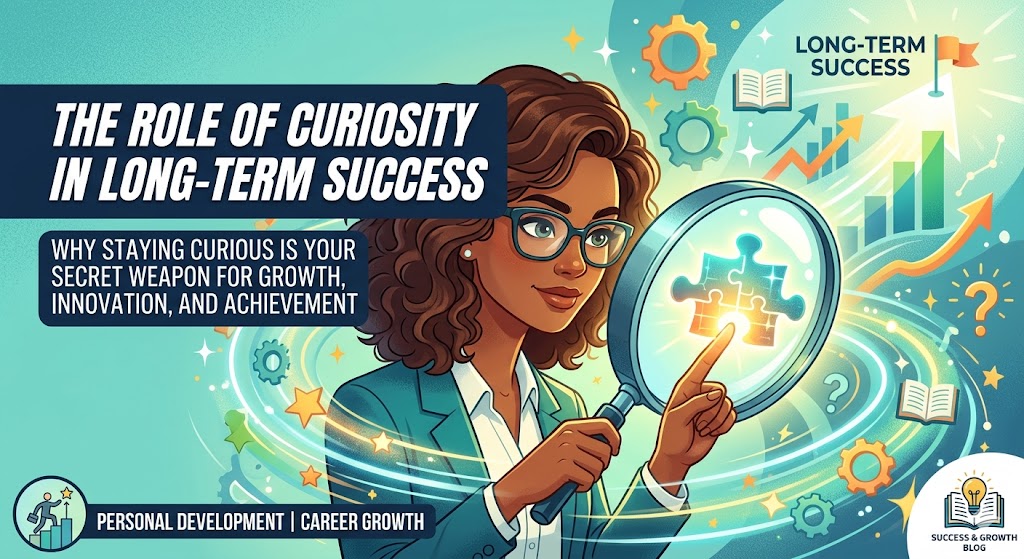
The Role of Curiosity in Long-Term Success
Curiosity is often treated like a soft personality trait, something that belongs to children, artists, or naturally inquisitive minds, but in reality it is one of the strongest drivers of long term success across every field of human achievement. The people who consistently outperform others are not always the most talented or the most disciplined at the beginning, but they are often the ones who refuse to stay satisfied with what they already know. Curiosity pushes individuals to ask better questions, explore deeper solutions, and remain open to change in ways that compound over time. While many people focus on intelligence or hard work as the main ingredients of success, curiosity quietly shapes both of them by determining what a person chooses to learn, how deeply they learn it, and how often they are willing to update their thinking.
At its core, curiosity is a refusal to accept surface level understanding. It is the mental habit of questioning assumptions instead of treating them as fixed truths. In practical terms, this means a curious person does not just learn how something works, they also ask why it works that way, what alternatives exist, and what would happen if conditions changed. This deeper engagement with information creates a more flexible mind, and flexibility becomes extremely valuable in a world where industries, technologies, and opportunities change rapidly. People who lack curiosity tend to memorize information and repeat familiar patterns, but those who are curious build mental models that allow them to adapt quickly when those patterns no longer work.
One of the most important ways curiosity influences long term success is through learning speed. In any competitive environment, the ability to learn faster than others often determines who advances and who falls behind. Curiosity accelerates learning because it turns education from a forced activity into a self driven pursuit. When a person is genuinely curious, they do not wait to be instructed before exploring a topic. They actively seek knowledge, connect ideas from different areas, and continue learning even after formal instruction ends. Over time, this creates a significant gap between individuals who rely only on structured learning and those who continuously explore beyond it.
Curiosity also plays a powerful role in problem solving. Many of the most valuable solutions in business, science, and everyday life come from people who were curious enough to question why a problem existed in the first place. Instead of accepting limitations as permanent, curious individuals tend to investigate the root causes of issues. This deeper investigation often reveals hidden opportunities that others overlook. In many cases, success does not come from doing things harder, but from seeing things differently. Curiosity is what enables that shift in perspective, allowing people to identify solutions that are not immediately obvious.
Another critical dimension of curiosity is its relationship with creativity. Creativity is not just about artistic expression, it is the ability to combine existing ideas in new ways to produce better outcomes. Curiosity feeds creativity by exposing the mind to a wider range of inputs. The more questions a person asks, the more information they gather, and the more connections they are able to form between seemingly unrelated concepts. Over time, this leads to original thinking that stands out in environments where most people are simply repeating established methods. Many breakthroughs in technology, business, and innovation began with someone asking a simple but unusual question that others ignored.
Curiosity also helps individuals avoid the trap of intellectual stagnation. Without curiosity, people tend to settle into fixed ways of thinking and become resistant to change. This creates a false sense of stability, but in reality it often leads to decline as the world evolves around them. Curious individuals, however, remain mentally active. They regularly reassess their beliefs, update their knowledge, and adjust their strategies based on new information. This constant evolution prevents them from becoming outdated in their skills or perspectives, which is essential for long term relevance in any profession or endeavor.
In relationships and communication, curiosity plays an equally important role. People who are curious about others tend to listen more deeply, ask better questions, and understand perspectives that are different from their own. This improves collaboration, reduces conflict, and builds stronger social and professional networks. Success in life is rarely achieved in isolation, and the ability to connect with others meaningfully often opens doors that skill alone cannot. Curiosity strengthens these connections by replacing judgment with understanding, and assumption with exploration.
There is also a strong link between curiosity and resilience. Life inevitably presents setbacks, failures, and unexpected challenges. While many people respond to difficulty with frustration or avoidance, curious individuals respond with inquiry. They ask what went wrong, what can be learned, and what can be improved next time. This mindset transforms failure from a stopping point into a learning opportunity. Over time, this approach builds emotional resilience because setbacks are no longer seen as final judgments, but as part of an ongoing process of growth and discovery.
Curiosity is also deeply connected to opportunity recognition. Many opportunities in life are not obvious at first glance. They often appear hidden within problems, inefficiencies, or emerging trends. A curious person is more likely to notice these patterns because they are actively observing and questioning their environment. While others may overlook subtle signals, curiosity keeps the mind alert to possibilities. This heightened awareness often leads to early action, which is a major advantage in competitive environments where timing can determine success or failure.
Another important aspect of curiosity is its role in personal development. People who remain curious about themselves are more likely to understand their strengths, weaknesses, and motivations. This self awareness allows them to make better decisions about their careers, habits, and goals. Instead of blindly following external expectations, they explore what truly aligns with their interests and abilities. Over time, this leads to more fulfilling and sustainable success because their actions are guided by understanding rather than pressure or imitation.
Curiosity also helps prevent complacency, which is one of the silent barriers to long term success. When people stop asking questions, they often stop growing. They become comfortable with what they already know and resist challenges that could push them further. Curiosity disrupts this comfort by constantly introducing new questions and possibilities. It creates a mindset where growth is continuous rather than occasional. This ongoing development is what separates long lasting success from temporary achievement.
In the long run, curiosity compounds in the same way that interest compounds in finance. Each question leads to new knowledge, each piece of knowledge leads to better decisions, and each better decision leads to improved outcomes. Over time, this chain reaction creates a significant advantage that is difficult to replicate without the same level of inquisitiveness. While talent and discipline are important, they are often amplified by curiosity, which determines how effectively they are applied.
Ultimately, curiosity is not just about seeking information, it is about maintaining a mindset of openness toward life itself. It encourages exploration instead of assumption, learning instead of stagnation, and growth instead of limitation. People who cultivate curiosity do not just accumulate knowledge, they develop a way of thinking that continuously generates progress. In a world that is constantly changing, this ability to keep learning, adapting, and exploring is one of the most reliable foundations for long term success.

EarnSmartOnline.com.ng is dedicated to helping readers make smarter financial decisions through practical guides on online income, personal finance, technology, digital business, and wealth creation. Our goal is to provide reliable, easy-to-understand, and actionable content that empowers individuals to earn smarter, build sustainable income streams and achieve long-term financial success.
Recommended: Start Earning Online
- Ultimate Affiliate Marketing Program — learn affiliate marketing with a done-for-you sales system ($15). Check it out
- The Newbie Affiliate Guide — the beginner-friendly starter guide (~$6.68). Check it out
- Easy Dollar Maker — earn in dollars uploading AI images and videos from your phone ($17). Check it out
Disclosure: These are affiliate links. If you buy through them, I may earn a commission at no extra cost to you.



