
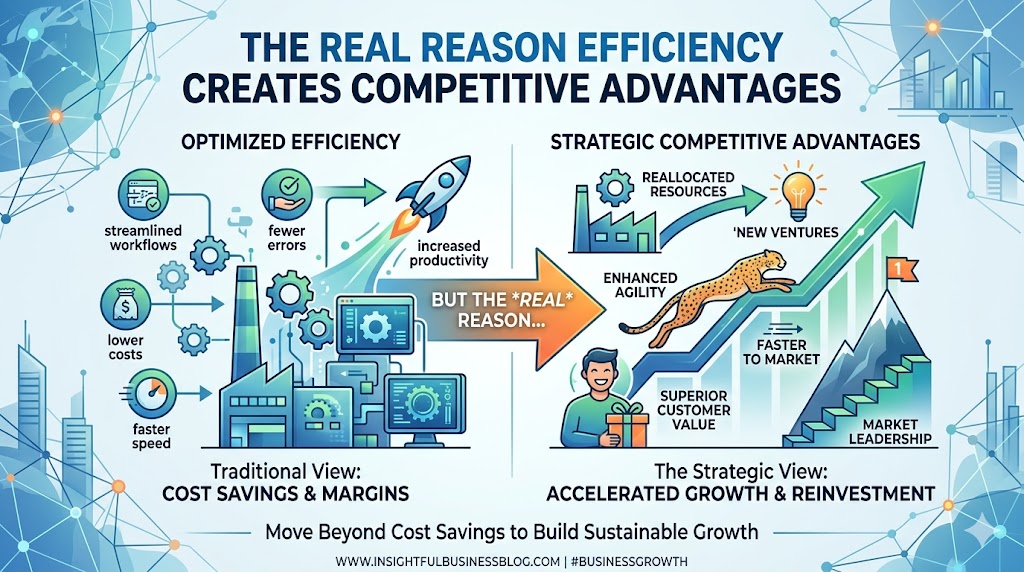
The Real Reason Efficiency Creates Competitive Advantages
Many people believe success is primarily determined by talent, intelligence, capital, or luck. While these factors can certainly play a role, they often overlook one of the most powerful forces behind long-term success: efficiency. Whether in business, personal finance, education, sports, or daily life, efficiency consistently creates advantages that compound over time. The organizations, individuals, and societies that learn how to achieve more with fewer resources often outperform those that simply work harder or spend more.
Efficiency is the ability to produce desired results while minimizing wasted time, energy, money, effort, and resources. It is not about being busy. It is not about doing more activities. Instead, it is about maximizing output while minimizing unnecessary input. This distinction is important because many people confuse hard work with effectiveness. They assume that the person working the longest hours or spending the most money is making the most progress. In reality, efficiency often allows someone to achieve better results with significantly less effort.
The reason efficiency creates competitive advantages is simple. Resources are limited. Time is limited. Money is limited. Human energy is limited. Every individual and organization operates within constraints. Since nobody has unlimited resources, the ability to use available resources more effectively becomes a major advantage. Those who waste less naturally gain more opportunities to grow, adapt, and improve.
Consider two businesses operating in the same industry. Both have access to similar markets and similar customers. However, one company has developed systems that reduce waste, streamline operations, and improve productivity. The other company relies on outdated processes and inefficient practices. Over time, the efficient company spends less money, serves customers faster, and adapts more quickly to changing market conditions. Even if both companies started at the same level, efficiency gradually creates a widening gap between them.
One of the most overlooked aspects of efficiency is its impact on costs. Every wasted minute, every unnecessary process, and every avoidable mistake carries a financial cost. Businesses that eliminate inefficiencies often reduce expenses without sacrificing quality. This creates greater profit margins and allows them to reinvest more resources into innovation, marketing, customer service, and expansion. Competitors who fail to improve efficiency may find themselves constantly struggling to keep up.
Efficiency also creates advantages through speed. In today’s world, speed often determines success. Customers expect quick responses, rapid delivery, and immediate solutions. Organizations that operate efficiently can move faster than their competitors. They can launch products sooner, respond to market changes more quickly, and capitalize on opportunities before others even recognize them. This speed creates momentum that becomes increasingly difficult for competitors to overcome.
Another reason efficiency creates competitive advantages is because it improves consistency. Success is rarely the result of a single achievement. Long-term success depends on the ability to repeatedly deliver quality results. Efficient systems reduce variability and improve reliability. When processes are optimized, outcomes become more predictable. Customers learn to trust businesses that consistently meet expectations, and trust often becomes a powerful competitive advantage.
Efficiency also allows organizations to scale more effectively. Many businesses fail not because they lack demand, but because they cannot handle growth efficiently. As operations expand, inefficiencies become magnified. Small problems turn into major obstacles. Companies that establish efficient systems early are often able to grow without experiencing the same level of operational chaos. Their processes can accommodate increased demand while maintaining quality and profitability.
The competitive advantages of efficiency extend far beyond business. Individuals who learn to use their time efficiently often achieve remarkable results. Two people may have the same number of hours in a day, yet one consistently accomplishes more meaningful work. The difference is not necessarily effort. It is often efficiency. Efficient individuals focus on high-value activities, eliminate distractions, and develop systems that help them maintain productivity over long periods.
Time management provides a perfect example. Many people spend hours reacting to interruptions, switching between tasks, and engaging in activities that contribute little to their goals. Others structure their schedules intentionally and focus on activities that generate the greatest results. Over weeks, months, and years, these differences create significant gaps in achievement. Small improvements in efficiency accumulate into major advantages.
Technology has amplified the importance of efficiency. Modern tools allow individuals and organizations to automate repetitive tasks, analyze data more effectively, and communicate instantly across vast distances. Those who embrace technologies that improve efficiency often gain substantial advantages over those who resist change. History repeatedly demonstrates that organizations that adapt to more efficient methods tend to outperform those that cling to outdated practices.
Efficiency also influences innovation. Contrary to popular belief, innovation is not simply about creating new ideas. It is often about finding better ways to accomplish existing tasks. Many groundbreaking innovations emerged because someone identified an inefficient process and developed a superior solution. The pursuit of efficiency has driven advancements in transportation, communication, manufacturing, healthcare, and countless other industries.
Another important reason efficiency creates competitive advantages is resilience. Economic conditions change. Markets fluctuate. Unexpected challenges arise. Efficient organizations are often better positioned to withstand adversity because they have fewer unnecessary costs and stronger operational foundations. During difficult periods, inefficient competitors may struggle to survive while efficient organizations continue operating effectively.
Resource allocation is another area where efficiency plays a critical role. Every decision involves trade-offs. Resources invested in one area cannot be invested elsewhere. Efficient organizations allocate resources toward activities that generate the greatest value. They prioritize initiatives with the highest potential returns and avoid wasting resources on low-impact activities. This disciplined approach allows them to achieve more without requiring significantly greater resources.
Efficiency also improves decision-making. When processes are organized and information flows smoothly, leaders can make better decisions more quickly. Inefficient systems often create confusion, delays, and information bottlenecks. These obstacles reduce the quality of decisions and increase the likelihood of costly mistakes. Efficient organizations benefit from clearer insights and faster responses to emerging challenges.
The relationship between efficiency and customer satisfaction is equally important. Customers value convenience, reliability, and speed. Businesses that operate efficiently often provide superior customer experiences because they can deliver products and services with fewer delays and errors. Satisfied customers are more likely to remain loyal, recommend the business to others, and contribute to long-term growth.
Many people assume efficiency means cutting corners or sacrificing quality. In reality, true efficiency often improves quality. When wasteful processes are eliminated, employees can focus their attention on activities that matter most. Resources are directed toward value creation rather than problem correction. As a result, efficiency and quality frequently reinforce each other rather than compete against each other.
Competitive advantages created by efficiency are often difficult to replicate. Competitors can copy products, marketing campaigns, and pricing strategies. However, replicating deeply embedded systems, organizational cultures, and operational excellence is far more challenging. Companies that build efficiency into their culture develop advantages that persist over time because they are rooted in habits, processes, and ways of thinking rather than isolated tactics.
Efficiency also contributes to employee satisfaction. Inefficient workplaces often create frustration, confusion, and burnout. Employees waste time navigating unnecessary obstacles and dealing with preventable problems. Efficient environments allow employees to focus on meaningful work and achieve better results with less stress. Higher satisfaction often leads to improved retention, stronger performance, and greater organizational stability.
At a broader level, entire economies benefit from efficiency. Nations that improve productivity can generate more goods and services with the same amount of labor and resources. This increased productivity often leads to higher living standards, greater economic growth, and improved quality of life. Throughout history, many of the world’s most prosperous societies achieved success by continuously improving efficiency across multiple sectors.
The compounding nature of efficiency may be its greatest advantage. A small improvement may seem insignificant in the short term. Saving a few minutes each day or reducing costs by a small percentage may not appear transformative. However, these gains accumulate over time. Small efficiencies repeated consistently can produce extraordinary results. This compounding effect explains why efficient individuals and organizations often pull further ahead as years pass.
Ultimately, the real reason efficiency creates competitive advantages is because it allows individuals and organizations to maximize the value generated from limited resources. In a world where time, money, energy, and attention are finite, the ability to accomplish more with less becomes an increasingly powerful advantage. Efficiency improves profitability, accelerates growth, strengthens resilience, enhances customer satisfaction, supports innovation, and creates opportunities that would otherwise remain out of reach.
Success is not always determined by who has the most resources. More often, it is determined by who uses available resources most effectively. Those who understand this principle recognize that efficiency is not merely a business concept. It is a fundamental driver of progress, achievement, and long-term competitive advantage. In every field, from entrepreneurship to personal development, efficiency remains one of the most reliable pathways to sustainable success.

EarnSmartOnline.com.ng is dedicated to helping readers make smarter financial decisions through practical guides on online income, personal finance, technology, digital business, and wealth creation. Our goal is to provide reliable, easy-to-understand, and actionable content that empowers individuals to earn smarter, build sustainable income streams and achieve long-term financial success.
Recommended: Start Earning Online
- Ultimate Affiliate Marketing Program — learn affiliate marketing with a done-for-you sales system ($15). Check it out
- The Newbie Affiliate Guide — the beginner-friendly starter guide (~$6.68). Check it out
- Easy Dollar Maker — earn in dollars uploading AI images and videos from your phone ($17). Check it out
Disclosure: These are affiliate links. If you buy through them, I may earn a commission at no extra cost to you.



