
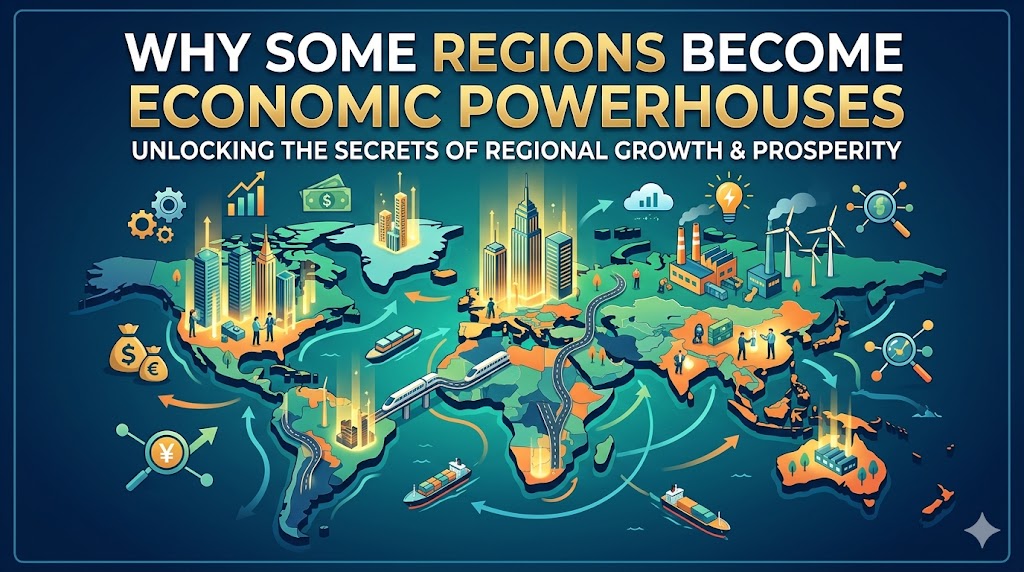
Why Some Regions Become Economic Powerhouses
Across the world, certain regions consistently outperform others in terms of economic growth, wealth creation, innovation, and opportunity. These places attract businesses, investors, entrepreneurs, and skilled workers, transforming themselves into centers of prosperity while other regions struggle to achieve similar success. The difference is often so striking that neighboring areas within the same country can experience vastly different economic realities. Understanding why some regions become economic powerhouses reveals important lessons about growth, development, and the forces that shape prosperity.
Many people assume that natural resources are the primary reason some regions become wealthy. While resources can certainly contribute to economic growth, they are rarely the complete explanation. History provides countless examples of regions blessed with abundant resources that remain economically weak, while resource-poor areas become global leaders in wealth creation. This demonstrates that economic success depends on much more than what lies beneath the ground. The real drivers of prosperity are often found in human decisions, institutions, infrastructure, innovation, and the ability to create value.
One of the most important factors behind the rise of economic powerhouses is strategic location. Throughout history, regions located near major trade routes have enjoyed significant advantages. Access to ports, rivers, transportation hubs, and international markets makes it easier for businesses to move goods and services efficiently. When trade becomes easier, economic activity increases. Merchants, manufacturers, and investors naturally gravitate toward places where commerce can flourish. Over time, this concentration of activity creates momentum that attracts even more growth.
Infrastructure plays an equally critical role in determining economic success. Roads, railways, airports, ports, power systems, telecommunications networks, and digital connectivity form the foundation upon which economic activity is built. Businesses need reliable systems to operate effectively. When infrastructure is strong, companies can reduce costs, improve efficiency, and expand their operations. Regions that invest heavily in infrastructure often create environments where businesses can thrive, attracting both domestic and international investment.
Education is another major contributor to regional prosperity. Economic powerhouses typically invest heavily in developing human capital. Skilled workers drive productivity, innovation, and competitiveness. Universities, technical schools, research institutions, and vocational training centers help create a workforce capable of adapting to changing economic conditions. Regions that prioritize education often produce entrepreneurs, engineers, scientists, and professionals who contribute to economic growth through new ideas and improved productivity.
Innovation is frequently the hidden engine behind economic transformation. Regions that encourage creativity, experimentation, and problem-solving tend to generate new industries and technologies. Innovation creates entirely new markets while improving efficiency within existing ones. Economic powerhouses often develop ecosystems where entrepreneurs, investors, researchers, and businesses collaborate to turn ideas into profitable ventures. This continuous cycle of innovation helps sustain long-term growth even as industries evolve.
Government policies also influence whether a region becomes an economic leader. Stable governance, transparent regulations, property rights, and predictable legal systems create confidence among investors and businesses. Economic activity flourishes when people believe their investments will be protected and contracts will be enforced fairly. Regions that reduce unnecessary bureaucracy and encourage entrepreneurship often attract greater levels of economic activity than those burdened by excessive regulations and uncertainty.
Access to capital is another crucial ingredient. Businesses require funding to start, expand, and innovate. Economic powerhouses usually develop strong financial systems that connect investors with entrepreneurs and growing companies. Banks, venture capital firms, stock markets, and private investors provide the resources necessary for businesses to scale. When capital flows efficiently, opportunities can be transformed into productive enterprises that create jobs and wealth.
The concentration of talent within a region often creates a powerful economic advantage. Skilled individuals tend to move toward areas offering better opportunities, higher incomes, and stronger professional networks. As talented people gather in one place, they create an environment that attracts even more talent. Businesses follow skilled workers, and skilled workers follow opportunities. This self-reinforcing cycle can transform a region into a magnet for innovation and economic activity.
Economic powerhouses also benefit from what economists call network effects. When businesses within the same industry cluster together, they often become more productive. Suppliers, service providers, customers, and skilled workers are located nearby, making collaboration easier and reducing costs. This clustering effect explains why certain industries dominate specific regions. Once an industry reaches a critical mass, the region develops specialized expertise and infrastructure that further strengthens its competitive position.
Cultural attitudes toward work, entrepreneurship, and risk-taking can also influence regional economic performance. Some regions cultivate environments where innovation, ambition, and business creation are encouraged and rewarded. People are more willing to start companies, pursue new opportunities, and invest in uncertain ventures when the culture supports such behavior. Over time, these attitudes contribute to higher levels of economic dynamism and growth.
Population density can create additional economic advantages. Larger populations provide businesses with bigger markets, more workers, and greater opportunities for specialization. Dense urban centers often generate economic activity at levels that smaller communities cannot easily match. The close proximity of businesses, consumers, and institutions facilitates the exchange of ideas and resources, accelerating innovation and productivity.
Another important factor is adaptability. Economic powerhouses rarely remain successful by doing the same thing forever. Markets change, technologies evolve, and consumer preferences shift. Regions that adapt quickly to these changes are more likely to maintain their economic strength. Flexibility allows economies to transition from declining industries to emerging opportunities. The ability to reinvent and evolve often separates long-term economic leaders from regions that experience temporary success.
Global connectivity has become increasingly important in the modern economy. Regions integrated into international trade networks gain access to larger markets, foreign investment, advanced technologies, and global talent pools. Businesses operating in globally connected regions can reach customers far beyond their local markets. This access expands opportunities for growth and increases competitiveness on the world stage.
Trust and social stability also contribute significantly to economic development. Businesses function more efficiently in environments where trust exists between individuals, organizations, and institutions. High levels of trust reduce transaction costs, encourage cooperation, and facilitate long-term investment. Social stability creates an environment where businesses can plan for the future with confidence, supporting sustained economic growth.
Economic diversification further strengthens regional resilience. Regions dependent on a single industry are vulnerable to economic shocks when that industry declines. Economic powerhouses typically develop multiple sectors that contribute to growth. Diversification reduces risk and creates new opportunities as markets evolve. A balanced economy can better withstand challenges while continuing to generate prosperity.
Leadership often plays a decisive role in shaping regional outcomes. Visionary leaders in government, business, and civil society can help create conditions that support growth. Effective leadership encourages investment, promotes innovation, improves infrastructure, and addresses obstacles to economic development. While no single leader can create prosperity alone, strong leadership can accelerate progress and coordinate efforts toward shared goals.
Technology adoption has become one of the defining characteristics of successful regions. Economic powerhouses are often early adopters of technologies that improve productivity and efficiency. Whether through automation, digital platforms, artificial intelligence, or advanced manufacturing techniques, technology enables businesses to produce more value with fewer resources. Regions that embrace technological change position themselves to compete more effectively in a rapidly evolving global economy.
Migration patterns provide another clue to understanding economic success. People generally move toward opportunity. When large numbers of individuals relocate to a particular region, they bring skills, knowledge, ambition, and purchasing power. This influx of human capital strengthens the local economy while creating demand for housing, services, and infrastructure. Regions that attract talent often experience sustained growth over extended periods.
The accumulation of small advantages over time can eventually create enormous economic disparities. A region that consistently invests in education, infrastructure, innovation, and business development may not appear dramatically different from its neighbors at first. However, decades of smart decisions can produce powerful results. Economic powerhouses are often built gradually through a series of strategic choices rather than a single transformative event.
Perhaps the most important lesson is that prosperity is rarely accidental. Economic success emerges from a combination of favorable conditions, effective institutions, strategic investments, and the willingness to adapt to changing circumstances. While geography and resources may provide initial advantages, long-term prosperity depends largely on how people organize, innovate, and create value.
Why some regions become economic powerhouses ultimately comes down to their ability to attract talent, encourage innovation, build strong institutions, and continuously adapt to new realities. These regions create environments where businesses can grow, individuals can succeed, and opportunities can multiply. Their success serves as a reminder that economic prosperity is not simply inherited or discovered. It is built through vision, effort, cooperation, and a relentless focus on creating value. Regions that understand and embrace these principles position themselves not only for growth but for lasting economic leadership that can endure for generations.

EarnSmartOnline.com.ng is dedicated to helping readers make smarter financial decisions through practical guides on online income, personal finance, technology, digital business, and wealth creation. Our goal is to provide reliable, easy-to-understand, and actionable content that empowers individuals to earn smarter, build sustainable income streams and achieve long-term financial success.
Recommended: Start Earning Online
- Ultimate Affiliate Marketing Program — learn affiliate marketing with a done-for-you sales system ($15). Check it out
- The Newbie Affiliate Guide — the beginner-friendly starter guide (~$6.68). Check it out
- Easy Dollar Maker — earn in dollars uploading AI images and videos from your phone ($17). Check it out
Disclosure: These are affiliate links. If you buy through them, I may earn a commission at no extra cost to you.



