
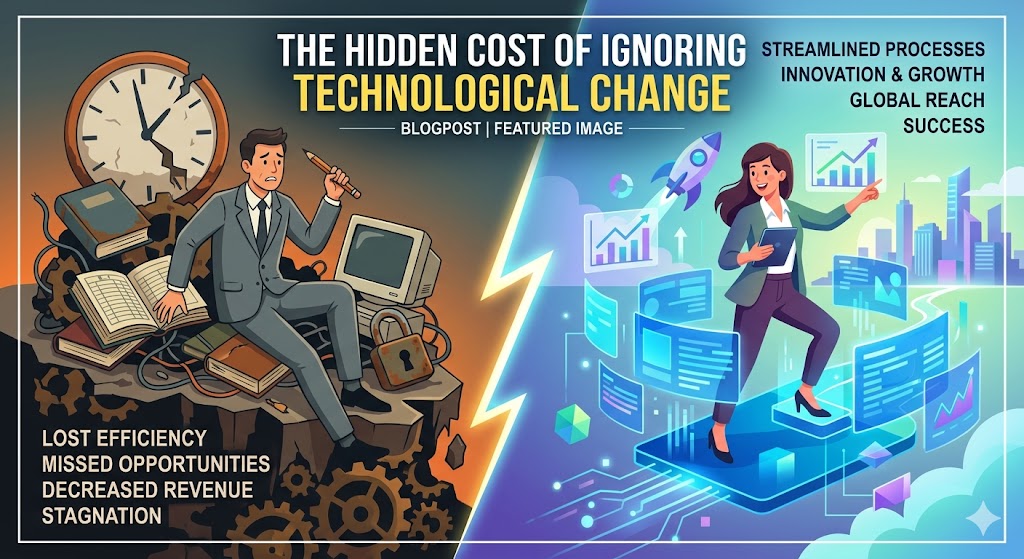
The Hidden Cost of Ignoring Technological Change
Technology has always been one of the most powerful forces shaping human progress. From the invention of the wheel to the rise of the internet, every major leap in civilization has been driven by technological advancement. Yet despite its undeniable impact, many individuals, businesses, and even entire societies often resist technological change. Some view new technologies as unnecessary distractions, while others fear the uncertainty that comes with adapting to unfamiliar tools and systems. Although this resistance may seem harmless in the short term, the hidden cost of ignoring technological change can be enormous.
One of the greatest misconceptions people have is believing that technological change only affects large corporations or highly technical industries. In reality, technology influences nearly every aspect of modern life. The way people communicate, work, learn, shop, travel, manage finances, and even build relationships has been transformed by technological innovation. Those who fail to recognize these changes often find themselves struggling to keep up in a rapidly evolving world.
The hidden cost often begins with lost opportunities. Every technological breakthrough creates new possibilities while simultaneously making older methods less effective. People who ignore emerging technologies frequently miss opportunities that could improve their productivity, income, education, or quality of life. While others are learning new skills, exploring digital platforms, and leveraging innovative tools, those who resist change may continue relying on outdated methods that gradually become less valuable.
In the workplace, technological ignorance can have serious consequences. Employers increasingly seek workers who can adapt to modern tools and systems. Whether it involves data analysis, digital communication, automation software, cloud computing, artificial intelligence, or remote collaboration platforms, technology has become deeply integrated into professional environments. Employees who fail to update their skills risk becoming less competitive in the job market. Over time, their opportunities for promotion, career advancement, and financial growth may decline significantly.
The same principle applies to business owners. History is filled with examples of businesses that failed not because they lacked customers, but because they failed to adapt to technological shifts. Consumer expectations evolve as technology advances. Customers increasingly expect convenience, speed, accessibility, and personalized experiences. Businesses that continue operating as if the world has not changed often lose market share to competitors who embrace innovation. The cost is not always immediate, but it accumulates steadily until the gap becomes impossible to ignore.
Another hidden cost of ignoring technological change is reduced efficiency. Technology often exists to solve problems, eliminate repetitive tasks, and increase productivity. Modern tools can automate processes that once required hours of manual effort. Communication platforms allow teams to collaborate instantly across different locations. Data management systems organize information more effectively than traditional methods. By refusing to adopt these improvements, individuals and organizations often waste valuable time, energy, and resources performing tasks that could be completed faster and more accurately.
Financial consequences are another major factor. Many people focus only on the visible cost of adopting new technology, such as purchasing software, upgrading devices, or investing in training. However, they often overlook the hidden cost of doing nothing. Lost productivity, missed opportunities, declining competitiveness, and inefficient operations can cost far more over time than the initial investment required to adapt. In many cases, the greatest expense is not technological adoption but technological stagnation.
Education has also been transformed by technology. Access to knowledge is now more widespread than at any point in human history. Online courses, digital libraries, educational platforms, and virtual communities provide opportunities for continuous learning regardless of geographical location. Individuals who ignore these resources may unknowingly limit their personal and professional growth. Meanwhile, those who embrace technological learning tools gain access to information, skills, and networks that can dramatically improve their future prospects.
The social consequences of ignoring technological change are often overlooked as well. Communication methods continue to evolve rapidly. Social media platforms, messaging applications, video conferencing tools, and digital communities have become essential parts of modern interaction. While excessive dependence on technology can create its own challenges, complete disengagement may lead to isolation from important conversations, opportunities, and relationships. Understanding technology does not require constant participation, but it does require awareness.
One of the most significant technological developments in recent years has been the rise of artificial intelligence. Many people initially dismissed AI as a futuristic concept with limited practical relevance. Today, AI is reshaping industries ranging from healthcare and finance to education, marketing, manufacturing, and customer service. Those who ignore these developments may underestimate how dramatically their industries could change. As automation and intelligent systems continue to evolve, individuals who understand how to work alongside these technologies will likely have a significant advantage over those who do not.
Fear is often the primary reason people resist technological change. New technologies can feel intimidating, especially when they disrupt familiar routines. Learning new systems requires effort, and adapting to change can create temporary discomfort. However, history consistently demonstrates that resisting technological progress rarely prevents change from occurring. Instead, it often leaves individuals unprepared when the transformation becomes unavoidable.
Another hidden cost lies in declining relevance. Skills, knowledge, and methods that were highly valuable in the past may gradually lose importance as technology evolves. This does not mean that experience becomes worthless. On the contrary, experience remains extremely valuable when combined with adaptability. The most successful individuals are often those who blend established wisdom with modern tools. They understand that technological change does not eliminate the need for human judgment, creativity, or leadership. Instead, it enhances the ability to apply those qualities more effectively.
Small businesses are particularly vulnerable when technological change is ignored. Unlike large corporations with extensive resources, small businesses often operate with tighter margins and fewer opportunities to recover from strategic mistakes. Failure to adopt digital payment systems, online marketing, e-commerce platforms, customer relationship management software, or data analytics tools can significantly limit growth potential. Competitors who embrace these technologies often gain advantages in efficiency, customer acquisition, and operational performance.
Entire industries can also be disrupted by technological innovation. Companies that once dominated their markets have disappeared because they failed to recognize changing trends. The lesson is not that every new technology will succeed, but that ignoring technological shifts entirely creates significant risk. Adaptability has become one of the most important qualities for long-term survival in both business and personal development.
The hidden cost of ignoring technological change extends beyond economics and productivity. It can also affect confidence and self-esteem. Individuals who feel left behind by technological advancements may become reluctant to engage with new opportunities. They may avoid learning new skills because they believe they are too old, too inexperienced, or too far behind. This mindset can create a self-reinforcing cycle where avoidance leads to greater knowledge gaps, making future adaptation even more difficult.
Technological literacy is increasingly becoming a basic life skill. Just as reading, writing, and arithmetic were once essential for participating in society, understanding technology is becoming necessary for navigating the modern world. This does not mean everyone must become a programmer, engineer, or technology expert. It simply means developing enough familiarity with emerging tools and trends to make informed decisions and remain adaptable.
The future will almost certainly bring even faster technological change. Advances in artificial intelligence, robotics, biotechnology, renewable energy, virtual reality, and other fields will continue reshaping industries and daily life. The pace of innovation is unlikely to slow down. Those who cultivate a habit of learning and adaptation will be better positioned to benefit from these developments, while those who resist change may face increasing challenges.
Ultimately, the hidden cost of ignoring technological change is not merely financial. It includes lost opportunities, reduced competitiveness, declining efficiency, limited growth, weakened adaptability, and diminished relevance in an increasingly connected world. Technology itself is neither inherently good nor bad. Its value depends on how people choose to use it. However, choosing to ignore technological change altogether can be far more costly than many people realize.
The individuals, businesses, and societies that thrive in the future will not necessarily be those with the most advanced technology. They will be those willing to understand change, learn continuously, and adapt when circumstances evolve. In a world where innovation constantly reshapes the landscape, adaptability is no longer optional. It is one of the most valuable assets anyone can possess.

EarnSmartOnline.com.ng is dedicated to helping readers make smarter financial decisions through practical guides on online income, personal finance, technology, digital business, and wealth creation. Our goal is to provide reliable, easy-to-understand, and actionable content that empowers individuals to earn smarter, build sustainable income streams and achieve long-term financial success.
Recommended: Start Earning Online
- Ultimate Affiliate Marketing Program — learn affiliate marketing with a done-for-you sales system ($15). Check it out
- The Newbie Affiliate Guide — the beginner-friendly starter guide (~$6.68). Check it out
- Easy Dollar Maker — earn in dollars uploading AI images and videos from your phone ($17). Check it out
Disclosure: These are affiliate links. If you buy through them, I may earn a commission at no extra cost to you.



