
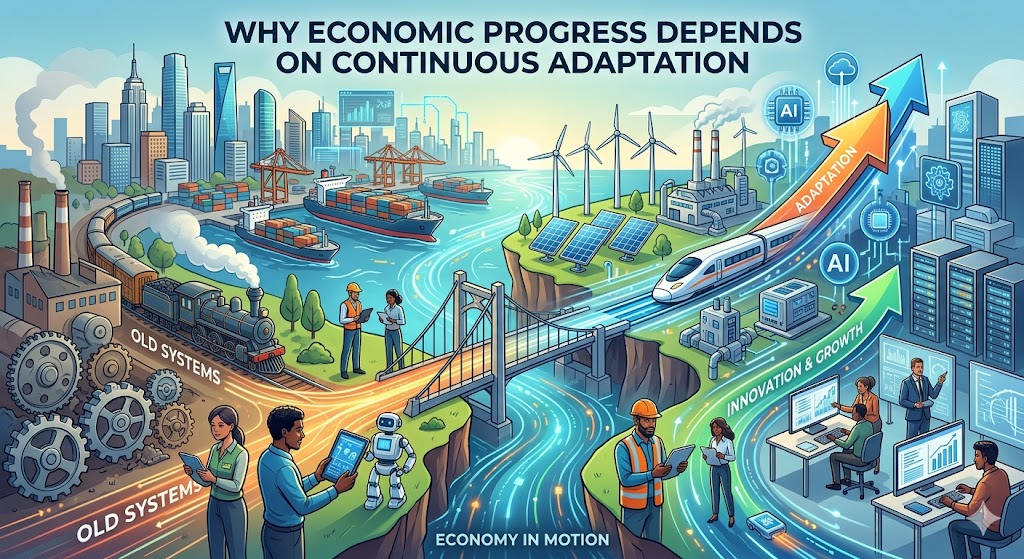
Why Economic Progress Depends on Continuous Adaptation
Economic progress is often viewed as the result of hard work, investment, innovation, or favorable government policies. While all these factors contribute to growth, there is one underlying force that connects them all: adaptation. Throughout history, societies, businesses, and individuals that have adapted to changing circumstances have consistently outperformed those that resisted change. Economic progress is not a destination that can be reached and permanently maintained. Instead, it is a continuous process that requires constant adjustment to new realities, emerging technologies, shifting consumer preferences, and evolving market conditions.
The world has never remained static for long. Every generation faces unique challenges and opportunities that require different solutions from those that worked in the past. The agricultural societies that once dominated the global economy eventually gave way to industrial economies. Industrial economies later transformed into information-driven economies. Today, digital technologies, artificial intelligence, automation, and global connectivity are reshaping industries at a pace that would have seemed unimaginable just a few decades ago. In such an environment, economic progress depends not on preserving old methods but on embracing new ones.
One of the most important reasons adaptation drives economic progress is that markets are constantly changing. Consumer needs evolve over time as lifestyles, incomes, and expectations shift. Products and services that were once highly desirable can quickly become obsolete. Companies that fail to recognize these changes often struggle to survive. On the other hand, businesses that pay attention to emerging trends and adjust accordingly position themselves for long-term success. The ability to identify changing demands and respond effectively creates new opportunities for growth and profitability.
Technology provides one of the clearest examples of why adaptation matters. Technological advancements continuously redefine the way people work, communicate, produce goods, and access information. Businesses that adopt new technologies often improve efficiency, reduce costs, and expand their reach. Those that refuse to modernize frequently lose their competitive advantage. History is filled with examples of once-dominant companies that disappeared because they failed to adapt to technological shifts. Their downfall was not necessarily caused by poor products or lack of resources, but by their inability to recognize that the environment around them had changed.
Economic progress also depends on adaptation because resources are limited while human wants are virtually unlimited. Societies must constantly find more efficient ways to allocate resources, improve productivity, and increase output. Adaptation enables individuals and organizations to discover better methods of production, distribution, and management. When people learn from experience and adjust their strategies, they create systems that generate greater value with fewer resources. This improvement in efficiency forms the foundation of sustainable economic growth.
Globalization further reinforces the importance of adaptation. Modern economies are deeply interconnected, and events occurring in one region can influence markets across the world. Businesses now compete not only with local rivals but also with international competitors. This increased competition creates pressure to innovate, improve quality, and enhance customer experiences. Companies that adapt to global standards and changing market dynamics are more likely to thrive, while those that rely solely on outdated practices often find themselves left behind.
Workforce development is another area where continuous adaptation plays a critical role. The skills that were valuable twenty years ago may no longer guarantee success today. Technological advancements have transformed entire industries, creating demand for new capabilities while reducing the need for others. Workers who continuously learn and develop relevant skills increase their employability and earning potential. In contrast, individuals who resist learning often face greater economic uncertainty. Lifelong learning has become one of the most important forms of adaptation in the modern economy.
The relationship between adaptation and innovation is also significant. Innovation rarely emerges from rigid thinking or strict adherence to tradition. Instead, it often results from recognizing new possibilities and responding creatively to changing circumstances. Economic progress accelerates when individuals and organizations are willing to experiment, take calculated risks, and explore alternative solutions. Every major innovation, from the steam engine to the internet, emerged because people adapted to existing challenges and sought better ways to solve problems.
Governments must also adapt if they wish to promote economic growth. Economic policies that were effective in one era may become less effective in another. Rapid technological changes, demographic shifts, environmental concerns, and evolving global trade patterns require policymakers to remain flexible. Governments that adapt their regulations, infrastructure investments, educational systems, and economic strategies are better positioned to support growth and improve living standards. Failure to adapt can lead to stagnation, inefficiency, and missed opportunities.
Continuous adaptation is equally important during periods of economic disruption. Recessions, financial crises, natural disasters, and unexpected global events can dramatically alter economic conditions. While such disruptions create challenges, they also reveal the resilience of adaptable individuals and organizations. Businesses that adjust their operations, diversify revenue streams, or embrace new business models often recover more quickly than those that remain fixed in their approach. Adaptability transforms uncertainty from a threat into an opportunity for growth.
Entrepreneurs understand the importance of adaptation perhaps better than anyone else. Successful entrepreneurs rarely achieve lasting success by following a rigid plan. Instead, they continuously gather feedback, evaluate results, and make adjustments. Markets often behave differently than expected, and customer preferences can change rapidly. Entrepreneurs who adapt their products, pricing, marketing strategies, and business models increase their chances of success. This flexibility allows them to remain relevant even as circumstances evolve.
Consumer behavior itself demonstrates why economic progress depends on adaptation. People’s preferences are influenced by cultural trends, technological developments, economic conditions, and social values. Businesses that understand these shifts can create products and services that better meet customer needs. The ability to anticipate and respond to changing consumer expectations often separates industry leaders from those struggling to maintain market share.
Adaptation also contributes to economic progress by encouraging competition. Competitive markets reward businesses that improve efficiency, enhance quality, and deliver greater value. This constant pressure to adapt drives innovation and productivity growth across entire industries. Consumers benefit from better products, lower prices, and improved services, while businesses gain incentives to continually improve. The result is a dynamic economic environment where progress becomes an ongoing process rather than a temporary achievement.
The digital economy offers a powerful illustration of adaptation in action. Many of today’s largest companies achieved success because they recognized opportunities created by technological change. They understood that traditional business models were evolving and adjusted accordingly. Meanwhile, countless organizations that ignored digital transformation struggled to remain relevant. The lesson is clear: economic progress belongs to those who recognize change early and respond effectively.
At the individual level, adaptation often determines financial success. Career paths are becoming less predictable than in previous generations. Many people will change professions multiple times throughout their lives. New industries continue to emerge while others decline. Individuals who remain curious, develop new skills, and stay informed about changing economic trends are more likely to identify opportunities and navigate uncertainty successfully. Adaptability has become one of the most valuable personal assets in the modern economy.
Another important aspect of adaptation is resilience. Economic progress is rarely a smooth, uninterrupted journey. Setbacks, failures, and unexpected obstacles are inevitable. Adaptable individuals and organizations do not view failure as a permanent defeat. Instead, they treat it as valuable feedback that can guide future improvements. This willingness to learn from mistakes and adjust course enables long-term growth and success.
Environmental and sustainability challenges further highlight the need for continuous adaptation. As populations grow and natural resources face increasing pressure, economies must develop more sustainable ways of producing and consuming goods. Businesses that adapt to environmental realities by embracing cleaner technologies and sustainable practices are often better positioned for future growth. Economic progress increasingly depends on balancing prosperity with responsible resource management.
Ultimately, economic progress is not achieved by resisting change but by responding to it intelligently. Every advancement in productivity, technology, education, and living standards has been driven by individuals and institutions willing to adapt to new circumstances. The economies that flourish are those that remain flexible, innovative, and open to continuous improvement.
The future will undoubtedly bring new challenges that cannot be fully predicted today. Emerging technologies, demographic shifts, environmental concerns, and changing global dynamics will continue to reshape the economic landscape. In such a world, the ability to adapt is no longer merely an advantage; it is a necessity. Those who embrace change, learn continuously, and remain responsive to evolving conditions will be the ones who drive economic progress forward. Continuous adaptation is not simply a component of economic growth. It is the very foundation upon which lasting prosperity is built.

EarnSmartOnline.com.ng is dedicated to helping readers make smarter financial decisions through practical guides on online income, personal finance, technology, digital business, and wealth creation. Our goal is to provide reliable, easy-to-understand, and actionable content that empowers individuals to earn smarter, build sustainable income streams and achieve long-term financial success.
Recommended: Start Earning Online
- Ultimate Affiliate Marketing Program — learn affiliate marketing with a done-for-you sales system ($15). Check it out
- The Newbie Affiliate Guide — the beginner-friendly starter guide (~$6.68). Check it out
- Easy Dollar Maker — earn in dollars uploading AI images and videos from your phone ($17). Check it out
Disclosure: These are affiliate links. If you buy through them, I may earn a commission at no extra cost to you.



