
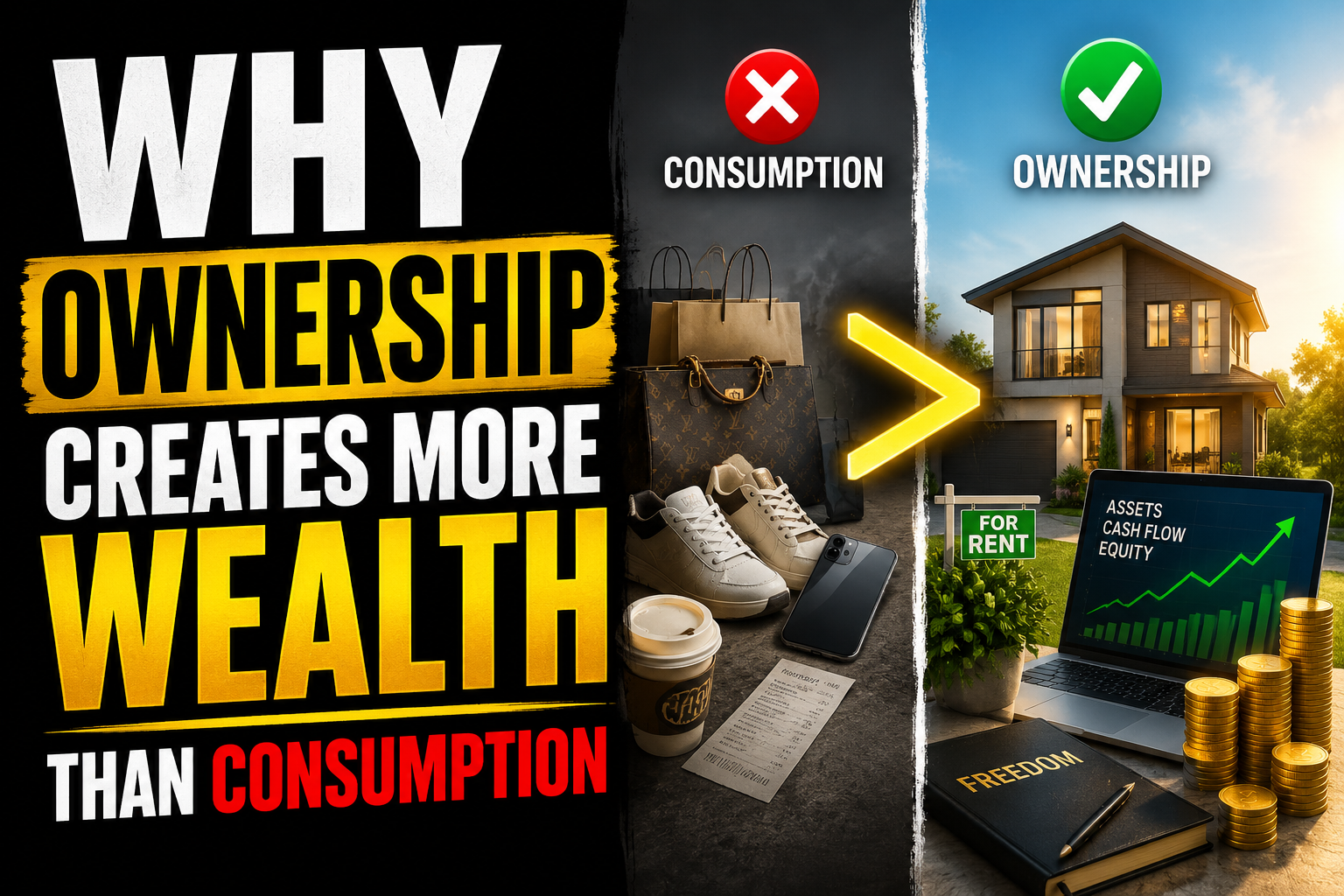
Why Ownership Creates More Wealth Than Consumption
Most people grow up thinking wealth is about how much money comes in and how comfortably it can be spent. That idea feels natural because consumption is immediate, visible, and emotionally rewarding. When someone buys a phone, wears new clothes, or moves into a nicer apartment, the result is instant and easy to understand. Ownership, on the other hand, is slower, less flashy, and often misunderstood. Yet the real divide between people who build lasting financial security and those who remain financially stuck is not income alone but what they choose to own versus what they choose to consume. Wealth is not primarily created through spending power. It is created through control, equity, and assets that continue to generate value even when you are not actively working.
Consumption gives comfort, but it does not multiply itself. Once money is spent on consumption, it leaves your financial system permanently. You receive the experience, enjoyment, or convenience, but there is no return loop. Ownership works differently because it allows money to become productive. Instead of disappearing after use, it becomes a tool that can generate more money. This is why two people with the same income can end up in completely different financial realities over time. One focuses on improving lifestyle through consumption, while the other redirects a portion of income into ownership. Over years, that difference compounds into entirely separate outcomes.
Ownership creates wealth because it introduces leverage. When you own an asset, you are no longer limited to trading time for money. The asset begins to work on your behalf. This can come in many forms such as a business, real estate, intellectual property, or even equity in a growing company. The key idea is that ownership breaks the direct link between effort and income. Instead of income stopping when work stops, assets continue producing value. This is the foundation of financial freedom, even though many people overlook it because it does not deliver immediate gratification like consumption does.
One of the most overlooked truths in personal finance is that consumption is designed to feel urgent, while ownership requires patience. Marketing systems are built around triggering desire in the present moment. Advertisements rarely encourage long term thinking. They focus on emotional satisfaction, identity expression, and social comparison. Ownership, however, requires delayed gratification. It demands that a person says no to certain short term pleasures in order to say yes to long term growth. This is where most financial journeys split. The ability to delay consumption in favor of ownership becomes one of the strongest predictors of future wealth.
Another important difference is that ownership compounds while consumption resets. Every time you invest in an asset, it has the potential to grow in value or generate ongoing returns. A business can expand its revenue, a property can appreciate and generate rent, and a portfolio can grow through reinvested gains. These effects multiply over time. Consumption does not behave this way. A purchase made today does not grow tomorrow. In fact, most consumable goods lose value immediately after purchase. This contrast explains why wealth tends to concentrate among those who prioritize accumulation of assets rather than accumulation of experiences through spending.
People often misunderstand ownership because they associate it only with large investments or high income levels. In reality, ownership is more about direction than size. Even small beginnings matter. Owning a small stake in a business, investing in a simple asset, or building a digital product can begin the process of wealth creation. What matters is the shift in mindset from being a permanent consumer to becoming a participant in value creation. Once this shift happens, financial decisions begin to change. Instead of asking what can be bought next, the question becomes what can be owned that will continue to produce value later.
Consumption is not inherently bad. It is necessary for living and enjoying life. The problem arises when consumption consistently takes priority over ownership. Many people unknowingly build lifestyles where almost all income is directed toward maintaining comfort rather than building assets. This creates a cycle where income must always be earned actively because nothing is being built to support future income. In such a system, financial pressure increases over time, especially when unexpected events occur. Ownership breaks this cycle by introducing stability and independence.
The psychological difference between owners and consumers is also significant. Consumers tend to focus on immediate satisfaction and external validation. Owners tend to focus on systems, growth, and long term outcomes. This difference in thinking shapes every financial decision. A consumer asks what can make life better today. An owner asks what can make life better continuously. Over time, this small difference in thinking leads to large differences in financial outcomes. Wealth is less about the amount of money earned and more about the habits that determine what happens to that money after it is received.
Ownership also creates opportunities that consumption cannot. When you own something valuable, it can open doors to partnerships, influence, and additional income streams. Businesses attract other opportunities, assets can be leveraged for credit or expansion, and intellectual property can be monetized in multiple ways. Consumption does not create these pathways because it ends at the point of transaction. It does not expand or generate additional leverage. This is why people who focus on ownership often find that opportunities begin to multiply naturally over time.
Another important factor is control. Ownership gives control over outcomes, while consumption gives temporary access without control. When you own assets, you can decide how they are used, developed, or expanded. This control allows you to shape your financial future more directly. With consumption, control ends after purchase. You cannot influence the future value or productivity of what has been consumed. This difference in control is one of the reasons why ownership consistently leads to stronger financial positioning over time.
It is also important to recognize that ownership builds resilience. In uncertain economic conditions, those who rely only on consumption and active income are more vulnerable to disruption. Those who own income producing assets have additional layers of security. Their financial systems are not dependent on a single source of effort. This resilience becomes more important as life becomes more unpredictable. Ownership acts as a buffer that stabilizes financial life even when external conditions change.
At its core, the difference between ownership and consumption is the difference between short term satisfaction and long term empowerment. Consumption gives comfort in the moment, but ownership builds capacity for the future. One depletes resources while the other multiplies them. This is why people who eventually achieve financial independence are not necessarily those who earned the most, but those who consistently chose to own rather than only consume. Wealth is not simply the presence of money. It is the presence of assets that continue to create value beyond the moment they were acquired.
Understanding this distinction changes how financial decisions are made. Every income received becomes an opportunity to decide between temporary enjoyment and long term growth. The challenge is not eliminating consumption but balancing it in a way that ownership always remains a priority. Over time, even small consistent ownership decisions accumulate into significant financial transformation. That is the quiet mechanism behind wealth creation that many overlook until much later in life.
Ultimately, ownership is what transforms money from something you spend into something that works for you. It is the bridge between earning and freedom. Without ownership, income remains trapped in cycles of consumption. With ownership, income becomes the foundation for expansion, stability, and long term wealth. The difference may seem subtle at first, but over time it becomes the most important financial divide in a person’s life.

EarnSmartOnline.com.ng is dedicated to helping readers make smarter financial decisions through practical guides on online income, personal finance, technology, digital business, and wealth creation. Our goal is to provide reliable, easy-to-understand, and actionable content that empowers individuals to earn smarter, build sustainable income streams and achieve long-term financial success.
Recommended: Start Earning Online
- Ultimate Affiliate Marketing Program — learn affiliate marketing with a done-for-you sales system ($15). Check it out
- The Newbie Affiliate Guide — the beginner-friendly starter guide (~$6.68). Check it out
- Easy Dollar Maker — earn in dollars uploading AI images and videos from your phone ($17). Check it out
Disclosure: These are affiliate links. If you buy through them, I may earn a commission at no extra cost to you.



