
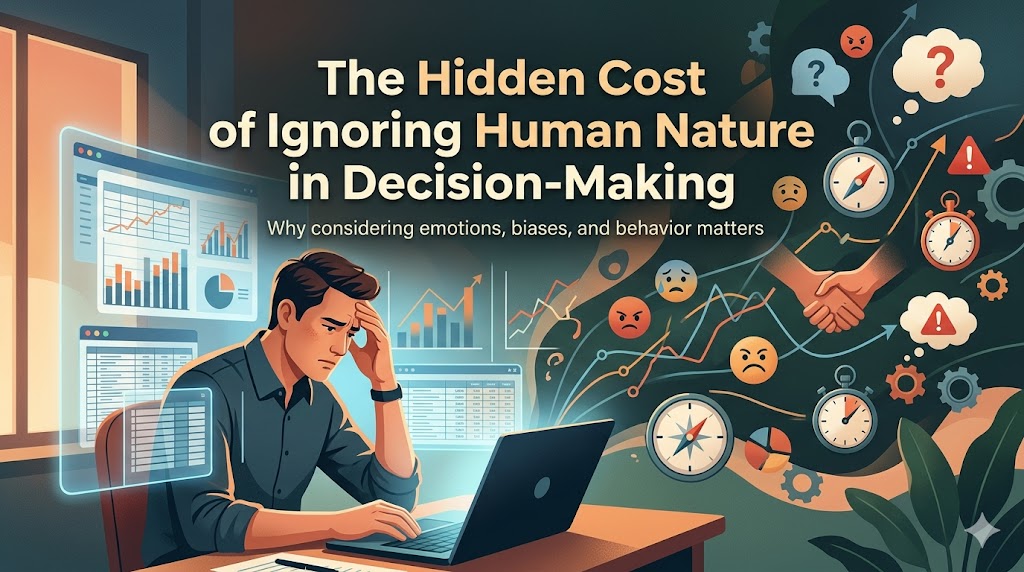
The Hidden Cost of Ignoring Human Nature in Decision-Making
Most people believe that better choices come from logic alone. They assume that if they gather enough information, remove emotions, and think carefully, they will naturally arrive at the best outcome. Yet in reality, many poor outcomes in life do not come from lack of information. They come from ignoring how people actually behave. Human nature is not a side factor in decision making. It is the main driver. When individuals or organizations ignore it, they end up making decisions that look correct on paper but fail in real life. The hidden cost of this mistake is not always immediate. It often appears slowly through repeated losses, missed opportunities, and patterns of regret that seem confusing until you trace them back to behavior instead of logic.
Human beings are not purely rational actors. They are emotional, habitual, social, and deeply influenced by comfort and fear. Even when someone believes they are thinking objectively, their choices are shaped by pressure from peers, desire for approval, fear of loss, and attraction to immediate reward. Ignoring this reality leads to systems and plans that depend on perfect behavior. For example, a financial plan that assumes consistent discipline without accounting for temptation or stress is fragile. When real life introduces pressure, people break from the plan. The cost is not just failure of the plan itself, but the wasted time, missed growth, and erosion of trust in future planning.
One of the most common hidden costs comes from misunderstanding motivation. Many decisions assume that people will always act in their own long term best interest. In practice, people often prioritize what feels easier right now over what benefits them later. This is not a flaw unique to a few individuals. It is a widespread pattern in human behavior. When leaders, businesses, or individuals ignore this, they create strategies that depend on constant self control. Over time, those strategies collapse under pressure. The result is frustration, repeated restarts, and the false belief that people are simply not disciplined enough, when in fact the system was never designed around real behavior.
Another hidden cost appears in communication. When human nature is ignored, people assume that clear information alone is enough to change behavior. This leads to instructions, advice, and plans that are logically correct but emotionally disconnected. People do not act on what they understand alone. They act on what they feel, what they trust, and what aligns with their current identity. When messages fail to connect with these deeper layers, they are ignored or forgotten. This creates a gap between knowledge and action. Over time, this gap becomes expensive because it leads to repeated explanations, repeated mistakes, and repeated failures that could have been avoided with better understanding of how people actually process information.
In relationships and teamwork, ignoring human nature often creates invisible tension. People are not just task executors. They seek respect, recognition, fairness, and belonging. When decisions are made purely on efficiency without considering these needs, cooperation weakens. Even if results appear stable at first, resentment builds quietly. Eventually, productivity drops or people disengage completely. The hidden cost here is not only loss of output but also loss of trust. Once trust is damaged, even simple decisions become harder to implement. Energy that should be used for progress gets redirected into managing conflict and repairing relationships that were damaged by ignoring basic human psychology.
Consumer behavior also reveals how expensive this oversight can be. Many products and services fail not because they are useless, but because they do not align with how people actually make choices. People do not evaluate every option logically before buying. They rely on shortcuts such as emotion, familiarity, social proof, and perceived simplicity. When creators ignore this and focus only on technical superiority, they often lose to less advanced but more psychologically appealing alternatives. The cost is lost market share, wasted innovation, and frustration from not understanding why better offerings do not automatically win.
Time perception is another area where ignoring human nature becomes costly. People do not experience time evenly in their minds. They overvalue immediate outcomes and undervalue distant ones. This shapes everything from savings behavior to health decisions. Plans that assume equal weighting of time periods tend to fail because they do not match how attention actually works. When this is ignored, individuals repeatedly choose short term comfort over long term benefit. The hidden cost accumulates silently through missed investments, delayed growth, and opportunities that never materialize because action was postponed too often.
Fear is another powerful force that is frequently underestimated. Many decisions assume that if something is beneficial, people will move toward it naturally. However fear of failure, fear of judgment, and fear of uncertainty often prevent action even when potential reward is high. When systems do not account for fear, they rely on unrealistic expectations of courage. This leads to low participation, slow adoption, and abandonment of promising ideas. The cost is not just inefficiency but lost potential at both individual and collective levels.
Identity plays a deeper role than most decision frameworks acknowledge. People do not simply choose based on outcomes. They choose based on who they believe they are. If a decision conflicts with self image, it is often rejected even if it is beneficial. Ignoring this leads to advice and strategies that technically make sense but feel unacceptable to the person receiving them. The hidden cost is resistance that appears irrational on the surface but is actually rooted in identity protection. Without addressing this layer, even the best guidance struggles to produce change.
Social influence also shapes decisions far more than most people admit. Individuals constantly adjust their behavior based on what others around them are doing. When decision makers ignore this, they create plans that assume independence in thinking that does not exist in practice. This leads to unexpected outcomes where groups move in directions that were never predicted by logic alone. The cost is strategic misalignment, poor forecasting, and repeated surprises that could have been avoided by studying social patterns more carefully.
Ultimately, ignoring human nature in decision making creates a silent tax on every area of life. It does not show up as one obvious failure but as many small inefficiencies that accumulate over time. Missed opportunities, repeated mistakes, broken systems, and stalled progress all trace back to the same root issue. When decisions are designed without considering how people actually think, feel, and behave, they become fragile. The real advantage comes from aligning logic with behavior, structure with psychology, and plans with reality. Once human nature is placed at the center of decision making, choices become more durable, outcomes become more predictable, and progress becomes less dependent on constant struggle against oneself and others.

EarnSmartOnline.com.ng is dedicated to helping readers make smarter financial decisions through practical guides on online income, personal finance, technology, digital business, and wealth creation. Our goal is to provide reliable, easy-to-understand, and actionable content that empowers individuals to earn smarter, build sustainable income streams and achieve long-term financial success.
Recommended: Start Earning Online
- Ultimate Affiliate Marketing Program — learn affiliate marketing with a done-for-you sales system ($15). Check it out
- The Newbie Affiliate Guide — the beginner-friendly starter guide (~$6.68). Check it out
- Easy Dollar Maker — earn in dollars uploading AI images and videos from your phone ($17). Check it out
Disclosure: These are affiliate links. If you buy through them, I may earn a commission at no extra cost to you.



