
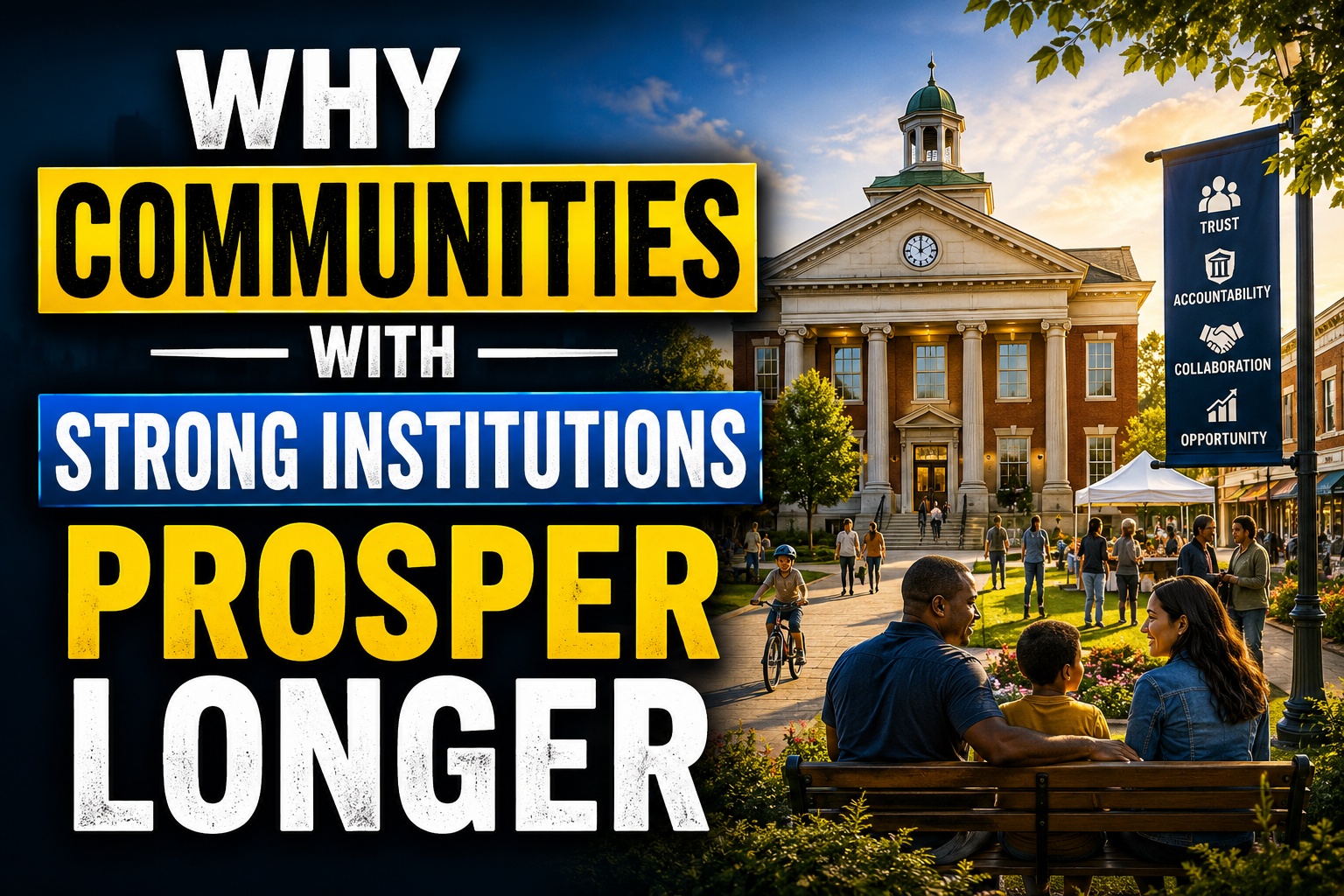
Why Communities With Strong Institutions Prosper Longer
When you look across the world, it becomes clear that some communities consistently grow wealthier, more stable, and more developed over time, while others struggle through cycles of poverty, corruption, and stagnation. The difference is not always natural resources, population size, or even geography. In many cases, the deciding factor is the strength of institutions within those communities. Institutions refer to the systems, rules, structures, and organizations that shape how people interact, how resources are managed, and how decisions are made. When these institutions are strong, fair, and consistent, prosperity tends to last longer and spread wider.
Strong institutions create predictability in society. People are more willing to invest their time, money, and energy when they believe that rules will be enforced fairly and consistently. For example, if property rights are protected, individuals feel safe building homes, starting businesses, or improving land because they know their efforts will not be arbitrarily taken away. This sense of security encourages long term thinking instead of short term survival behavior. In contrast, where institutions are weak, people often focus only on immediate gain because the future feels uncertain.
Another important role of strong institutions is reducing corruption. When systems are transparent and accountability mechanisms are in place, it becomes harder for individuals in positions of power to misuse resources for personal benefit. Corruption is one of the fastest ways to destroy public trust and economic development. When people believe that success depends more on connections or bribery than on effort and innovation, motivation declines. Over time, talented individuals either leave or stop trying, and the entire community suffers from a loss of productivity and creativity.
Strong institutions also support fair access to opportunities. Education systems, legal systems, and economic frameworks that are well structured help ensure that people can rise based on merit rather than background or privilege. This does not eliminate inequality completely, but it creates a pathway for upward mobility. When individuals believe that hard work and talent can lead to improvement in their living conditions, they are more likely to invest in skill development and personal growth. This leads to a more dynamic and competitive society that continuously improves itself over time.
Economic growth is deeply tied to institutional strength. Businesses thrive in environments where contracts are enforced, regulations are clear, and disputes can be resolved fairly. Without these systems, trade becomes risky and expensive. Investors hesitate, entrepreneurship slows down, and innovation suffers. However, in communities with strong legal and financial institutions, businesses can operate with confidence. They can plan long term, form partnerships, and expand operations without fear of sudden disruption or unfair interference.
Education systems are another critical institution that influences long term prosperity. Communities with strong educational institutions tend to produce more skilled workers, innovative thinkers, and capable leaders. Education does not only transfer knowledge but also shapes values such as discipline, responsibility, and cooperation. When education systems are weak or inconsistent, it creates gaps in skills and knowledge that limit economic development. Over generations, this gap becomes more difficult to close, trapping communities in cycles of underdevelopment.
Health institutions also play a major role in sustaining prosperity. A healthy population is more productive, more creative, and better able to contribute to economic activity. Strong healthcare systems reduce the burden of disease, increase life expectancy, and improve overall quality of life. When health systems fail, communities face frequent disruptions caused by illness, loss of productivity, and high medical costs. This reduces economic stability and slows long term development.
Trust is one of the hidden outcomes of strong institutions. When people trust that systems will work as expected, they are more likely to cooperate with one another. Trust reduces the need for excessive enforcement and lowers the cost of transactions in society. In low trust environments, people spend more time protecting themselves than building value. This slows down progress significantly. Strong institutions build trust by consistently applying rules and delivering fair outcomes.
Another important factor is stability. Strong institutions help societies survive leadership changes, economic shocks, and external pressures without collapsing. When systems are built to function independently of any single individual, communities become more resilient. This stability attracts investment and encourages long term planning. Without it, even small disruptions can lead to major setbacks.
Strong institutions also encourage innovation. When rules are clear and protections exist for intellectual property, individuals feel safer experimenting with new ideas. Innovation requires risk, and people are only willing to take risks when they believe the system will not unfairly punish failure. Over time, this leads to technological advancement, improved services, and new industries that drive further prosperity.
Cultural development is also influenced by institutional strength. Over time, strong institutions shape norms and behaviors that support productivity, responsibility, and cooperation. People begin to internalize values such as punctuality, accountability, and fairness because these values are reinforced by the systems they interact with daily. Weak institutions, on the other hand, often reinforce negative behaviors such as avoidance of responsibility, shortcuts, and distrust.
It is also important to understand that strong institutions do not emerge by accident. They are built through consistent effort, leadership, and collective agreement over time. Many successful communities have gone through periods of instability before developing systems that work. This means that institutional strength is not just a starting condition but a continuous process of improvement and maintenance.
One of the most powerful effects of strong institutions is intergenerational prosperity. When systems are stable and fair, wealth, knowledge, and opportunity can be passed from one generation to another without significant loss. Children grow up in environments where education, safety, and opportunity are accessible, giving them a better starting point in life. This creates a compounding effect where each generation builds on the progress of the previous one.
In contrast, communities with weak institutions often experience repeated cycles of loss. Even when progress is made, it is often reversed due to instability, corruption, or lack of enforcement. This prevents long term accumulation of wealth and knowledge. As a result, each generation must start almost from scratch, which limits overall development.
Ultimately, the prosperity of a community is not determined only by what it has, but by how well it is organized. Strong institutions act as the foundation upon which everything else is built. They shape behavior, guide decision making, and ensure that resources are used effectively. Without them, even communities with great potential can struggle to achieve lasting success.
In conclusion, communities with strong institutions prosper longer because they create stability, trust, fairness, and opportunity. They reduce uncertainty and encourage long term thinking, allowing individuals and businesses to invest in the future with confidence. Over time, this leads to sustained economic growth, social development, and inter-generational progress. The strength of institutions is not just a political or administrative issue, but a fundamental driver of human prosperity and collective success.

EarnSmartOnline.com.ng is dedicated to helping readers make smarter financial decisions through practical guides on online income, personal finance, technology, digital business, and wealth creation. Our goal is to provide reliable, easy-to-understand, and actionable content that empowers individuals to earn smarter, build sustainable income streams and achieve long-term financial success.
Recommended: Start Earning Online
- Ultimate Affiliate Marketing Program — learn affiliate marketing with a done-for-you sales system ($15). Check it out
- The Newbie Affiliate Guide — the beginner-friendly starter guide (~$6.68). Check it out
- Easy Dollar Maker — earn in dollars uploading AI images and videos from your phone ($17). Check it out
Disclosure: These are affiliate links. If you buy through them, I may earn a commission at no extra cost to you.



