
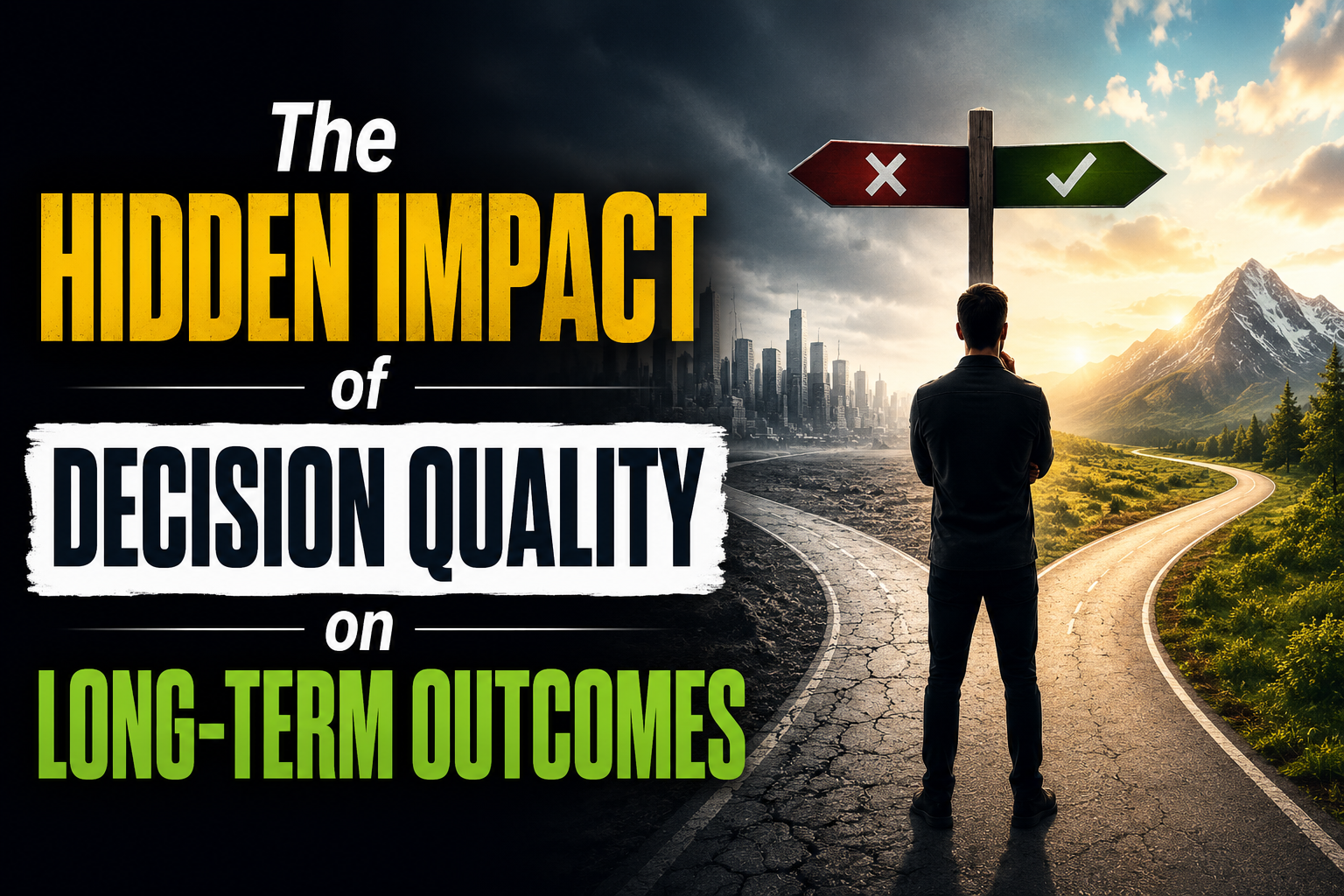
The Hidden Impact of Decision Quality on Long-Term Outcomes
Most people go through life believing that their outcomes are determined by big moments such as landing a high paying job, starting a business, meeting the right person, or getting a lucky break. While those events do matter, they are not the true foundation of long term success or failure. What quietly shapes a person’s financial stability, relationships, health, and overall life direction is something far less visible but far more powerful. It is the quality of their daily decisions. Decision quality is not about making perfect choices every time, but about consistently making choices that move you closer to long term benefit rather than short term comfort. Over time, these small decisions accumulate into outcomes that feel like luck to outsiders but are actually the result of repeated judgment patterns.
The hidden impact of decision quality is that it compounds silently. Just like interest in finance grows gradually and becomes significant over time, the results of decisions also build on each other. A single poor decision may not destroy a life, just as a single good decision may not transform it. But repeated patterns of slightly better or slightly worse decisions create entirely different life trajectories. For example, choosing to spend rather than save may seem harmless in the moment, but over years it creates financial fragility. Choosing to learn rather than procrastinate may seem insignificant at first, but over time it builds competence that opens doors. The compounding effect of decisions is often invisible until the gap between two individuals becomes too large to ignore.
One of the most overlooked aspects of decision quality is timing. A good decision made too late can produce weaker results than a decent decision made at the right time. Many people underestimate how opportunity is often tied to timing rather than perfection. In careers, relationships, and investments, delays in decision making often reduce potential returns. People wait for certainty before acting, but certainty rarely arrives in advance. Those who develop the ability to make reasonably informed decisions under uncertainty tend to outperform those who wait endlessly for perfect clarity. Over time, this difference in timing creates significant divergence in outcomes between individuals with similar intelligence or background.
Another hidden layer of decision quality is emotional influence. Many decisions are not made logically but emotionally justified afterward. Fear, pride, jealousy, anxiety, and excitement often guide choices more than rational analysis. For instance, fear can prevent someone from taking necessary risks, while excitement can push someone into impulsive commitments. When emotions consistently override reasoning, decision quality declines even when intentions are good. The long term impact is not immediately visible because emotional decisions often feel right in the moment. However, as time passes, the accumulation of emotionally driven choices tends to create instability, regret, or missed opportunities.
Decision quality is also deeply connected to information processing. People are constantly exposed to information, but not everyone evaluates it with the same level of depth. Some individuals accept information at face value, while others question assumptions, verify sources, and consider long term consequences. The ability to filter noise from useful insight significantly improves decision outcomes. In a world overloaded with opinions and distractions, those who can slow down their thinking enough to properly evaluate choices often gain a long term advantage. Poor decisions are frequently the result of incomplete or misinterpreted information rather than lack of intelligence.
Another important factor is the influence of habits on decision making. Many decisions are not conscious at all but automated through repeated behavior. When someone builds strong habits, they reduce the number of critical decisions they must make daily. However, when habits are poor, they repeatedly produce low quality decisions without reflection. For example, a habit of procrastination leads to rushed decisions under pressure, while a habit of preparation leads to calmer and more thoughtful choices. Over time, habits effectively determine the average quality of decisions a person makes without requiring constant effort or awareness.
Social environment also plays a powerful role in shaping decision quality. People often adjust their decisions based on the behavior and expectations of those around them. If someone is surrounded by individuals who make impulsive or short term focused choices, they are more likely to adopt similar patterns. Conversely, being in an environment where long term thinking is valued encourages better decision making. The hidden impact of environment is that it quietly normalizes certain behaviors, making them feel reasonable even when they are not optimal. This is why two individuals with similar potential can end up with very different outcomes based solely on their surroundings.
Another dimension of decision quality is the ability to understand consequences beyond the immediate moment. Many poor decisions come from focusing only on short term gain while ignoring long term cost. This includes financial decisions, lifestyle choices, career moves, and even relationships. The human mind is naturally wired to prioritize immediate rewards, which makes long term thinking a learned skill rather than an instinct. Those who train themselves to consistently evaluate future consequences develop a significant advantage. They may appear slower in decision making, but their outcomes tend to be more stable and sustainable over time.
The accumulation of decision quality also shapes identity. People often become the sum of their repeated decisions rather than their intentions. Someone who repeatedly chooses discipline over comfort gradually becomes disciplined. Someone who repeatedly chooses avoidance over responsibility gradually becomes avoidant. Identity is not fixed but formed through patterns of behavior reinforced over time. This means that improving decision quality is not just about achieving better outcomes but also about becoming a different kind of person. The transformation is gradual, but it is deeply structural.
One of the most powerful effects of decision quality is its impact on opportunity recognition. People with strong decision making patterns tend to recognize valuable opportunities earlier because they are mentally trained to evaluate tradeoffs and long term value. On the other hand, poor decision makers often miss opportunities not because they are absent, but because they are not recognized or are dismissed too quickly. Over time, this creates a widening gap where some individuals seem consistently lucky while others feel consistently unlucky, even though the underlying difference is in perception and judgment.
Decision quality also determines resilience during difficult periods. Life inevitably includes setbacks, uncertainty, and failure. When decision quality is strong, individuals are more likely to respond to challenges with adaptive thinking rather than emotional reaction. They assess the situation, adjust strategy, and continue moving forward. When decision quality is weak, setbacks often trigger panic, avoidance, or repetitive mistakes. This difference in response patterns significantly influences long term outcomes because resilience determines how quickly someone can recover and continue progressing.
Ultimately, the hidden impact of decision quality is that it operates quietly but relentlessly over time. It does not announce itself in dramatic moments, nor does it deliver instant results. Instead, it builds slowly through repetition until the consequences become undeniable. People often look for external explanations for success or failure, but the deeper truth is that life outcomes are largely shaped by the accumulation of small decisions made consistently over years. Improving decision quality does not require perfection, but it does require awareness, reflection, and a willingness to prioritize long term outcomes over short term comfort. Over time, this single shift can transform not just results, but the entire direction of a person’s life.

EarnSmartOnline.com.ng is dedicated to helping readers make smarter financial decisions through practical guides on online income, personal finance, technology, digital business, and wealth creation. Our goal is to provide reliable, easy-to-understand, and actionable content that empowers individuals to earn smarter, build sustainable income streams and achieve long-term financial success.
Recommended: Start Earning Online
- Ultimate Affiliate Marketing Program — learn affiliate marketing with a done-for-you sales system ($15). Check it out
- The Newbie Affiliate Guide — the beginner-friendly starter guide (~$6.68). Check it out
- Easy Dollar Maker — earn in dollars uploading AI images and videos from your phone ($17). Check it out
Disclosure: These are affiliate links. If you buy through them, I may earn a commission at no extra cost to you.



