
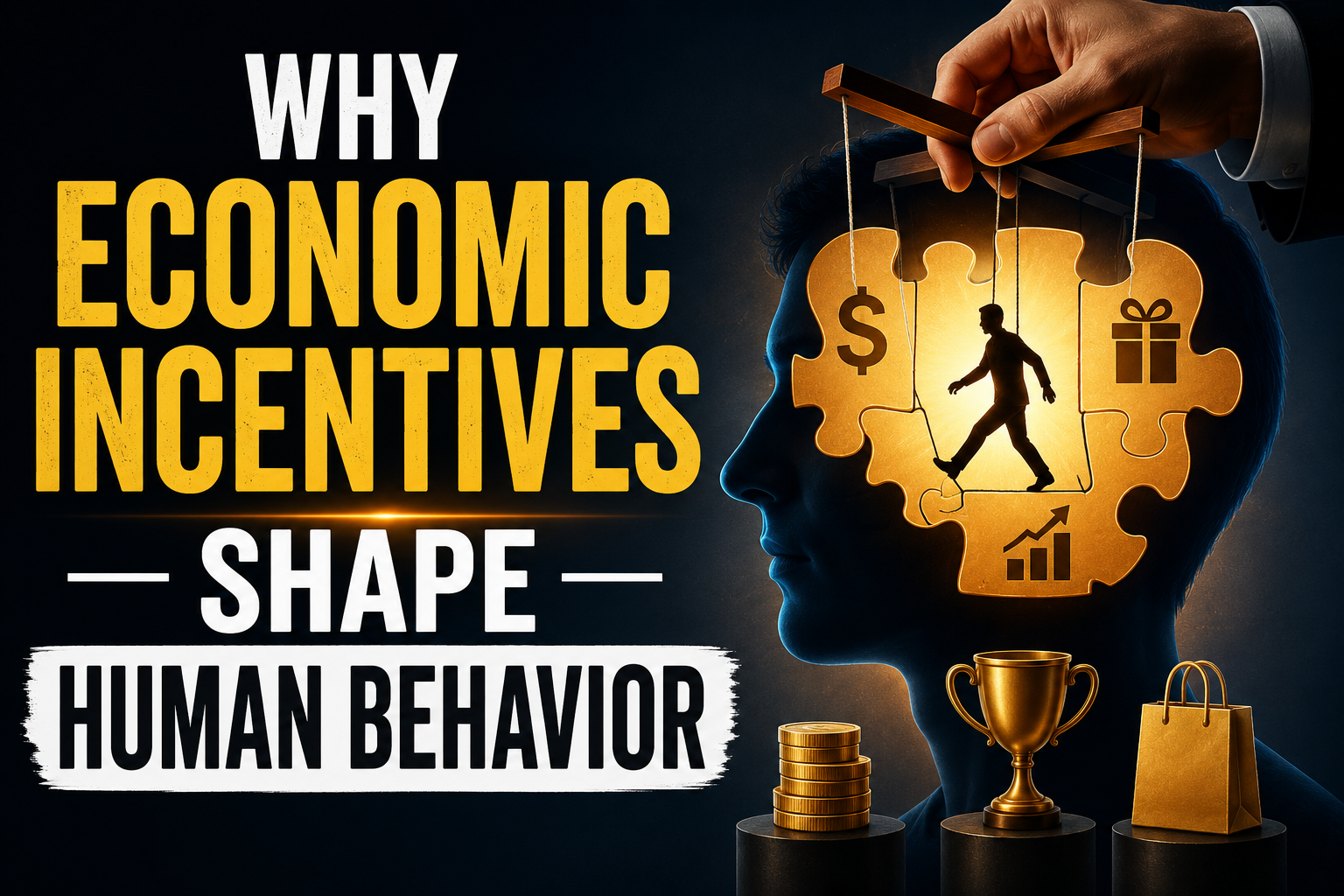
Why Economic Incentives Shape Human Behavior
Human behavior is often viewed through the lens of emotions, personal values, culture, and individual experiences. While these factors undoubtedly influence the decisions people make, there is another powerful force operating behind the scenes that affects nearly every choice individuals make each day. That force is economic incentives. Whether people realize it or not, economic incentives play a major role in shaping behavior, influencing decisions, and determining outcomes across societies, businesses, families, and entire nations.
An economic incentive is anything that motivates an individual or organization to act in a particular way because of the potential for gain or the desire to avoid loss. These incentives can be financial, material, social, or even psychological. At their core, incentives exist because people generally respond to rewards and consequences. Human beings naturally seek benefits while trying to minimize costs, risks, and discomfort. This simple principle explains much of the behavior observed in everyday life.
One of the clearest examples of economic incentives can be seen in the workplace. Employees work because they receive wages or salaries in exchange for their time and effort. The promise of income motivates people to wake up early, commute long distances, acquire new skills, and remain productive. If compensation increases through bonuses, promotions, or raises, workers often become even more motivated to improve performance. Conversely, if rewards are removed or reduced, motivation frequently declines. This demonstrates how incentives directly influence behavior.
Businesses also operate according to economic incentives. Companies exist primarily to generate profits. This incentive drives innovation, efficiency, and competition. Organizations invest in research, improve products, and seek better ways to serve customers because doing so can increase revenue and market share. When businesses discover opportunities to reduce costs while maintaining quality, they often pursue them aggressively because the financial rewards are significant. The desire for profit shapes countless decisions made by business leaders every day.
Consumers are equally influenced by incentives. People constantly make purchasing decisions based on perceived value. Discounts, promotions, loyalty programs, and special offers exist because businesses understand how incentives affect buying behavior. A customer who might not purchase a product at full price may quickly decide to buy it when offered a substantial discount. The incentive changes the decision. This principle explains why sales events attract large crowds and why companies spend enormous amounts designing pricing strategies.
Governments also rely heavily on incentives to influence behavior. Tax policies, subsidies, grants, and penalties are all forms of economic incentives. Governments may provide tax breaks to encourage investment, offer subsidies to promote renewable energy, or impose taxes on harmful products such as tobacco and alcohol. Rather than forcing behavior directly, policymakers often attempt to create incentives that make desired actions more attractive and undesirable actions more costly.
The influence of economic incentives extends beyond financial matters and into education. Students often work harder when they believe their efforts will lead to better grades, scholarships, career opportunities, or social recognition. The incentive of future success motivates many individuals to invest years in education despite the challenges involved. Without clear rewards, maintaining long-term commitment to difficult goals becomes much harder.
One reason economic incentives are so powerful is that they align with basic human nature. People generally seek to improve their circumstances. They want more security, comfort, opportunities, and freedom. Incentives provide a pathway toward these objectives. When individuals perceive that a particular action will improve their situation, they become more likely to pursue it. This behavior occurs regardless of age, culture, or social background.
The concept of incentives also helps explain why unintended consequences often occur. When incentives are poorly designed, they can encourage behavior opposite to what was originally intended. For example, if employees are rewarded solely based on quantity rather than quality, they may focus on producing more work at the expense of standards. Similarly, if government programs create benefits that unintentionally discourage productivity, people may respond in ways policymakers did not anticipate. Human behavior often follows incentives more faithfully than instructions.
Economic incentives play a crucial role in entrepreneurship as well. Entrepreneurs take risks because they see the possibility of future rewards. Starting a business requires significant investment of time, money, and effort. Many ventures fail, yet individuals continue pursuing entrepreneurial opportunities because the potential gains can be substantial. The prospect of financial independence, wealth creation, and personal achievement motivates countless entrepreneurs around the world.
Investment behavior provides another illustration of incentive-driven decision making. Investors allocate capital toward opportunities they believe will generate favorable returns. The possibility of earning profits motivates individuals and institutions to take calculated risks. Financial markets themselves are built upon incentive structures that encourage the movement of resources toward productive activities. Without incentives, much of the economic growth experienced in modern societies would not occur.
Even charitable behavior can be influenced by incentives. While many people donate out of compassion and generosity, incentives such as tax deductions, public recognition, or social approval can increase participation in charitable activities. This does not diminish the sincerity of giving, but it highlights the reality that incentives often reinforce behaviors society wishes to encourage.
The relationship between incentives and behavior becomes especially visible during periods of economic change. When unemployment rises, people may seek additional training or alternative sources of income. When wages increase in a particular industry, workers often migrate toward those opportunities. When housing prices rise, developers build more homes. In each case, incentives influence how individuals and organizations respond to changing conditions.
Technology companies have become masters at understanding incentives. Many digital platforms are carefully designed to encourage specific behaviors through rewards, notifications, points, badges, and personalized experiences. Users often spend more time engaging with platforms because incentives are embedded into the system. These incentives may not always involve money, but they still operate according to the same principle of rewarding desired behavior.
The power of incentives also explains why habits are often difficult to change. People tend to repeat behaviors that produce immediate rewards even when those behaviors have negative long-term consequences. Spending money impulsively can provide temporary satisfaction despite causing future financial stress. Similarly, procrastination may offer short-term comfort while creating long-term problems. Effective behavior change often requires altering the incentive structure so that positive actions become more rewarding.
Incentives influence relationships as well. Trust, cooperation, and mutual support often grow when individuals perceive benefits from maintaining healthy interactions. In workplaces, communities, and families, people are more likely to contribute positively when incentives encourage collaboration rather than conflict. Understanding these dynamics helps explain why successful organizations invest heavily in creating environments that reward teamwork and shared goals.
Economic history provides numerous examples of incentives shaping entire societies. Nations that protect property rights, encourage entrepreneurship, and reward innovation often experience stronger economic growth than those that do not. Individuals respond to opportunities when they believe their efforts will be fairly rewarded. Over time, these responses accumulate and contribute to broader economic development.
However, it is important to recognize that incentives are not the only factor influencing behavior. Values, ethics, emotions, traditions, and personal beliefs also play significant roles. Human beings are not robots who respond solely to financial rewards. Nevertheless, ignoring the influence of incentives would provide an incomplete understanding of how decisions are made. In many situations, incentives serve as the bridge between intention and action.
One of the most valuable lessons individuals can learn is to pay close attention to incentives, both their own and those of others. Understanding incentives makes behavior more predictable. It helps explain why businesses act as they do, why governments implement certain policies, why consumers make particular choices, and why markets evolve over time. People who understand incentives often make better decisions because they recognize the forces driving outcomes.
The ability to identify incentives can also improve personal success. By creating incentives that support positive habits, individuals can increase productivity, improve financial discipline, strengthen relationships, and achieve long-term goals. Successful people often design environments where desirable behaviors are rewarded and undesirable behaviors become less attractive.
Ultimately, economic incentives shape human behavior because they tap into a fundamental aspect of human nature. People respond to opportunities, rewards, costs, and consequences. These responses influence actions ranging from everyday purchases to major life decisions. Whether in business, government, education, investing, or personal development, incentives remain one of the most powerful forces guiding human behavior.
Understanding this reality provides valuable insight into how societies function and why people make the choices they do. Those who learn to recognize and work with incentives rather than ignore them gain a deeper understanding of economics, decision making, and human nature itself. In a world where every action carries potential rewards and consequences, economic incentives will continue shaping behavior for generations to come.

EarnSmartOnline.com.ng is dedicated to helping readers make smarter financial decisions through practical guides on online income, personal finance, technology, digital business, and wealth creation. Our goal is to provide reliable, easy-to-understand, and actionable content that empowers individuals to earn smarter, build sustainable income streams and achieve long-term financial success.
Recommended: Start Earning Online
- Ultimate Affiliate Marketing Program — learn affiliate marketing with a done-for-you sales system ($15). Check it out
- The Newbie Affiliate Guide — the beginner-friendly starter guide (~$6.68). Check it out
- Easy Dollar Maker — earn in dollars uploading AI images and videos from your phone ($17). Check it out
Disclosure: These are affiliate links. If you buy through them, I may earn a commission at no extra cost to you.



