
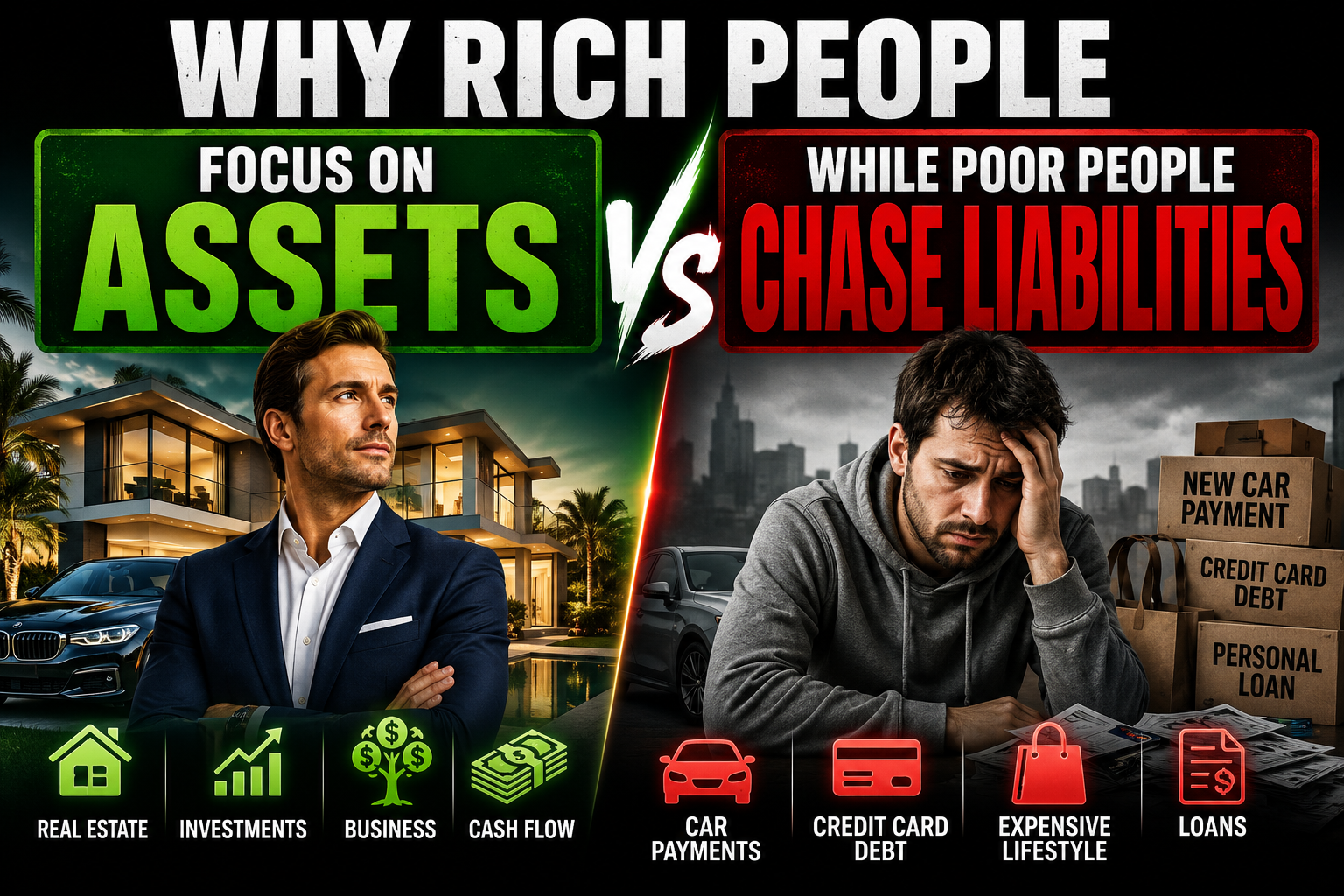
Why Rich People Focus on Assets While Poor People Chase Liabilities
Rich people and poor people do not become different overnight. The difference between them is often not just income, education, or opportunities, but how they understand and relate to money over time. One of the most important financial truths that separates wealth builders from those who remain financially stuck is the idea of assets versus liabilities. This concept, while simple on the surface, has a deep impact on how people live their financial lives, make decisions, and ultimately determine their future. Why Rich People Focus on Assets While Poor People Chase Liabilities
An asset is anything that puts money into your pocket. A liability is anything that takes money out of your pocket. This definition may sound overly simple, but its simplicity is exactly why it is powerful. Rich people understand this principle and structure their financial decisions around it. Poor and middle income individuals often focus more on immediate satisfaction or appearance rather than long term financial benefit, which leads them to accumulate liabilities while believing they are building wealth.
For example, a wealthy person may buy a house not just to live in, but also because it can generate rental income or increase in value over time. They may invest in businesses, stocks, real estate, or digital assets that generate passive income. Every financial move is evaluated based on one question: will this put money back into my pocket in the future or take money out continuously without return?
On the other hand, many people who struggle financially often prioritize items that appear valuable but do not generate income. This includes expensive cars, luxury gadgets, fashionable clothing beyond their means, or houses that consume a large portion of their income without generating any returns. These are not bad things in themselves, but when they dominate financial decisions, they create long term pressure instead of financial growth. Why Rich People Focus on Assets While Poor People Chase Liabilities
The problem is not desire for comfort or quality of life. The real issue is misunderstanding the long term impact of financial choices. A car, for example, is often seen as a symbol of success. However, in financial reality, it is usually a depreciating asset. It loses value over time, requires maintenance, insurance, fuel, and other expenses. While it may provide comfort and convenience, it does not generate income. For someone trying to build wealth, repeatedly upgrading cars without building income generating assets keeps them in a cycle of spending rather than growing.
Rich people think differently because they prioritize financial independence over appearance. Instead of asking what looks impressive, they ask what produces income. This mindset shift is subtle but powerful. It means choosing to invest surplus money into assets rather than increasing lifestyle expenses. Over time, these assets compound, creating multiple streams of income that eventually reduce the need to actively work for money.
Poor financial behavior is often driven by social pressure and emotional spending. Many people feel the need to “look successful” even when they are not financially stable. This leads to spending money on liabilities to maintain image, rather than building a foundation that creates real wealth. Social media has made this worse, as people constantly compare their lives to curated highlights of others, pushing them into unnecessary financial stress.
Another major difference lies in delayed gratification. Wealthy individuals are more willing to postpone immediate pleasure in exchange for future financial security. Instead of spending money immediately on consumption, they channel it into investments. Poor financial habits often involve spending first and thinking later, which leaves little room for wealth accumulation.
It is also important to understand that assets are not limited to physical investments like real estate or stocks. In today’s world, assets can include skills, intellectual property, digital businesses, and online platforms. A skill that allows you to earn consistently is an asset because it generates income. A blog that attracts traffic and earns advertising revenue is an asset. A business system that runs without your constant presence is an asset. Wealthy individuals focus heavily on building or acquiring these types of income generating systems.
Liabilities, however, extend beyond obvious expenses. Subscriptions that are not useful, debts with high interest rates, and lifestyle inflation all act as financial drains. When income increases, many people immediately increase their spending rather than their investment capacity. This is one of the main reasons why even high income earners sometimes remain financially unstable. More money does not automatically lead to wealth if spending increases at the same rate.
The wealth building mindset is not about denying enjoyment or living a life of hardship. It is about balance and awareness. Rich people still enjoy life, but they ensure that enjoyment is funded by assets rather than at the expense of future financial stability. They build systems that allow them to earn continuously, which gives them freedom to enjoy life without financial fear.
Understanding this distinction requires a shift in perspective. Instead of thinking “Can I afford this?” the better question becomes “What is the long term financial impact of this decision?” If every financial decision is filtered through this lens, behavior begins to change naturally. Spending becomes more intentional, and investing becomes more consistent.
Another key insight is that wealth is not built by income alone but by retention and multiplication of money. Many people earn money but do not keep or grow it. Wealthy individuals focus on how money is stored, invested, and expanded. This is why they prioritize assets, because assets work even when they are not actively working.
Financial education plays a crucial role in this difference. Many people were never taught how money works beyond earning and spending. Schools often focus on academic knowledge rather than practical financial literacy. As a result, people enter adulthood knowing how to earn money but not how to multiply it. This gap in understanding leads to lifelong financial struggle for many.
To move from a liability focused mindset to an asset focused mindset, a gradual change is necessary. It begins with awareness of spending patterns. Then it moves to intentional saving. After that comes consistent investment into income generating opportunities. Over time, these small decisions accumulate into financial transformation.
It is also important to note that building assets requires patience. Unlike liabilities which provide immediate satisfaction, assets often take time to generate returns. This is why many people avoid them. However, those who stay consistent eventually experience exponential growth. The earlier this habit is developed, the stronger the long term outcome. Why Rich People Focus on Assets While Poor People Chase Liabilities
Another important factor is discipline. Wealth building requires resisting unnecessary spending and focusing on long term goals. This does not mean living without joy, but rather choosing meaningful and sustainable enjoyment over temporary satisfaction that creates financial strain.
Ultimately, the difference between rich and poor financial behavior is not intelligence or luck, but consistency in decision making. Rich people repeatedly choose assets even in small amounts. Poor financial habits repeatedly choose liabilities, even when income increases. Over time, these small choices create completely different financial realities.
In conclusion, the principle of assets versus liabilities is one of the most powerful financial lessons anyone can learn. Rich people focus on building and acquiring things that generate income, while poor people often focus on consumption and appearances that drain resources. Understanding and applying this principle is the foundation of financial transformation. Once a person begins to consistently prioritize assets over liabilities, no matter how small the starting point is, their financial future begins to change in a meaningful and lasting way. Why Rich People Focus on Assets While Poor People Chase Liabilities

EarnSmartOnline.com.ng is dedicated to helping readers make smarter financial decisions through practical guides on online income, personal finance, technology, digital business, and wealth creation. Our goal is to provide reliable, easy-to-understand, and actionable content that empowers individuals to earn smarter, build sustainable income streams and achieve long-term financial success.
Recommended: Start Earning Online
- Ultimate Affiliate Marketing Program — learn affiliate marketing with a done-for-you sales system ($15). Check it out
- The Newbie Affiliate Guide — the beginner-friendly starter guide (~$6.68). Check it out
- Easy Dollar Maker — earn in dollars uploading AI images and videos from your phone ($17). Check it out
Disclosure: These are affiliate links. If you buy through them, I may earn a commission at no extra cost to you.



