
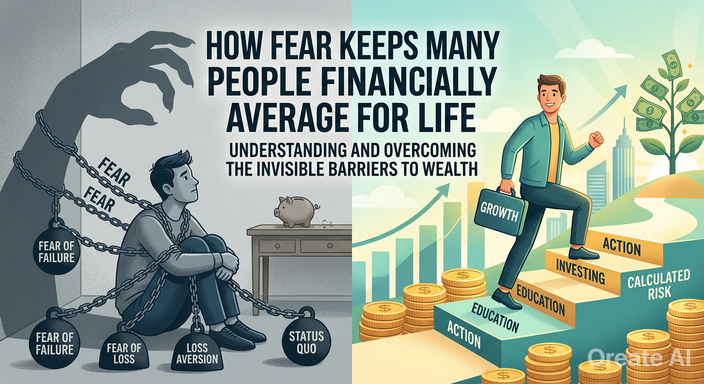
How Fear Keeps Us Comfortably Broke for Life
How Fear Keeps Many People Financially Average for Life. You know that feeling when you’re scrolling through Twitter (or X, whatever we call it today) and you see a 24-year-old tech bro talking about how they just bought their second house in Lekki? How Fear Keeps Many People Financially Average for Life
Your first instinct might be to say “Sapa, nice to meet you” or type “Lord, am I a spoon?” in the comments. But after the jokes fade, a quiet realization settles in. You work hard. You wake up by 5:00 AM to beat Third Mainland Bridge traffic, or you log into your remote job and stare at a screen until your eyes burn. You aren’t lazy.
So why does it feel like your finances are perpetually on “manpower” stuck in one place, just surviving?
The truth is hard to swallow, but we need to talk about it over a cold bottle of malt.
It’s not just inflation. It’s not just the exchange rate (though God knows those don’t help).
The biggest thing holding most hardworking Nigerians back from true wealth is fear.
We have been conditioned by our environment, our upbringing, and our culture to play defense with money. We are so terrified of losing what we have that we never take the calculated risks required to get what we actually want. We choose to stay financially average because average feels safe.
Let’s unpack exactly how this fear operates in our daily lives, and how it’s quietly sabotaging your financial future.
1. The Survival Trait That Became a Trap
To understand why we fear financial risk so much, we have to look at Nigeria itself. Living here is an extreme sport. The system does not give you a soft landing. There is no working student loan system that doesn’t feel like a trap, no reliable social security net, and if you get sick, your “health insurance” is often just family contributions on WhatsApp.
When you grow up in an environment where things can go from 100 to 0 real quick, your brain develops a survival mechanism: Hold tightly to what you have.
[Economic Instability] ➔ [Trauma/Fear of Loss] ➔ [Hyper-Conservative Choices] ➔ [Financial Stagnation]
This is why our parents’ ultimate dream for us was always a “secure government job” or a role in a Tier-1 bank. To them, a steady salary, even one that inflation eats for breakfast every month, is the holy grail.
But here is the trap: Survival mode keeps you alive; it doesn’t make you wealthy.
When you operate from a place of fear, your entire financial strategy is based on not losing. You become like a football team that parks the bus, puts 11 players in the eighteen-yard box, and hopes for a 0-0 draw. You won’t get humiliated by conceding 5 goals, sure. But guess what? You will never score, and you will never win the league.
2. The Tragedy of the “Fixed Deposit” Mindset
Let’s look at how this fear manifests in how we handle the little money we manage to save.
Imagine you’ve worked hard and saved up ₦2,000,000. It’s sitting in your traditional bank account. You feel good. You open your banking app just to look at the zeros and breathe a sigh of relief.
Then, a friend comes to you with a legitimate business opportunity or an investment idea, maybe a tech stock package, real estate crowdfunding, or an expansion of a thriving local business. They show you the numbers, the risks, and the potential returns.
Your heart rate spikes. Your mind immediately flashes to all the MMM stories you heard in 2016. You remember your uncle who lost his gratuity to a fake agricultural scheme. Fear whispers: “What if they run away with your money? What if you go back to zero?”
So, you tell your friend, “Ah, my brother, things are tight oh. God bless the hustle.”
Instead, you leave that ₦2,000,000 in a regular savings account or lock it in a fixed deposit yielding 7% annual interest. You feel safe.
But let’s look at the real math. If inflation is sitting comfortably at over 20-30%, your “safe” investment is actually losing value every single day.
The Invisible Leak: By keeping your money “safe” from nominal loss, you are actively choosing a guaranteed loss in purchasing power. ₦2,000,000 today cannot buy what ₦2,000,000 bought two years ago. Fear makes us blind to the biggest thief of wealth: inflation.
Wealthy people don’t look for absolute safety; they look for calculated risk. Average people avoid risk entirely, not realizing that avoiding risk is the biggest risk of all.
3. The “God Forbid” and “I Reject It” Wealth Shield
We cannot talk about the Nigerian financial psyche without talking about spirituality and culture. We are a deeply religious people, which is beautiful. But we frequently use faith as an excuse to avoid doing financial heavy lifting.
How many times have you heard someone say:
- “I can’t write a will, God forbid, I’m not dying anytime soon.”
- “Why should I buy life insurance or health insurance? I reject sickness and premature death in Jesus’ name / by Allah’s grace!”
- “Let me just buy this asset, God will figure out the exit strategy.”
Fear makes us treat financial planning like a spiritual attack. Because we are afraid of worst-case scenarios, we refuse to look them in the eye and plan for them.
True financial maturity means recognizing that bad days happen to good people. Buying insurance isn’t a lack of faith; it’s a structural barrier that keeps one medical emergency from sending your entire extended family back into poverty.
When you refuse to manage risk because you are afraid to think about it, you are setting yourself up to remain average. Wealthy people build structures, wills, trusts, insurance, diversified portfolios, specifically because they understand that life happens.
4. The Fear of “What Will People Say?” (The High-Maintenance Average Lifestyle)
Sometimes, the fear isn’t about losing money to an investment; it’s the fear of social exclusion. In Nigeria, status is everything. We love Aso Ebi, we love grand entries, and we love looking like “money missed road.”
A lot of people stay financially average because they are terrified of being perceived as broke.
- You live in an apartment in a high-brow area where the rent takes 60% of your annual income, because you can’t bear the thought of telling your friends you moved to a more affordable suburb to save money.
- You bought a car you can barely maintain because walking or taking an Uber-Share feels like a downgrade in the eyes of your peers.
- You spend ₦150,000 every weekend at clubs or lounges just to maintain the “big boy” or “big girl” image.
This is fear of shame.
[Fear of Social Shame] ➔ [Overspending on Status Symbols] ➔ [Zero Investment Capital] ➔ [Perpetual Financial Mediocrity]
The irony is that the truly wealthy are often busy hiding their wealth to avoid unnecessary attention, while the financially average are busy spending every kobo they have to look wealthy.
If you are too afraid to hear people say “Ah, Chief, things are tough for you oh?” for six months while you radically cut expenses to invest in a business or skill, you will remain average for the next sixty years. True financial freedom requires a thick skin. You must be willing to look broke today so you can be genuinely wealthy tomorrow.
5. Analysis: The Financial Growth Spectrum
To see where you currently stand, let’s look at how different mindsets handle the exact same financial situations.
| Financial Situation | The Fearful Mindset (Stays Average) | The Calculated Mindset (Builds Wealth) |
| Extra Income / Windfall | Saves it all in a regular bank account or buys a lifestyle upgrade to look good. | Splits it: emergency cash cushion + investing the rest in income-generating assets. |
| Career Progression | Stays in a stagnant, low-paying job for 8 years because “at least the salary is sure.” | Continuously upskills, networks, and takes calculated leaps to high-growth roles or businesses. |
| Investment Opportunity | Asks: “What if I lose my capital?” and backs out immediately without checking details. | Asks: “What is the risk-to-reward ratio? Can I afford to lose this specific amount to win big?” |
| Lifestyle Choices | Spends money to match the expectations of extended family, friends, and neighbors. | Lives below their means, invests quietly, and focuses on building asset columns. |
6. Shifting From Fear to Calculated Risk: The Action Plan
If you read the table above and felt a small sting in your chest, don’t worry. It means you’re human, and it means you’re paying attention. Recognizing that fear has been driving your financial car is the first step to taking the steering wheel back.
How do we break the cycle? You don’t do it by becoming a reckless gambler. You do it by building an internal financial system that turns paralyzing fear into calculated courage.
Step 1: Build a “Fear Buffer” (Emergency Fund)
The reason a ₦500,000 investment loss feels like it will kill you is because that ₦500,000 is all you have. If you lose it, you can’t pay rent.
Before you start taking big investment risks, kill the foundational fear by building a fully funded emergency fund. This should be 3 to 6 months of your bare-minimum living expenses kept in an accessible, yield-earning account.
Once you know that your rent, food, and utility bills are secure for the next 6 months no matter what happens, your brain stops panicking. You can now look at investments with clear, analytical eyes, rather than desperate, fearful ones.
Step 2: Pay the “Ignorance Tax” Through Education
We fear what we do not understand. If you don’t know how the stock market works, how real estate flipping operates, or how global mutual funds generate yield, any investment opportunity will look like a scam.
Stop avoiding finance conversations because they make you feel overwhelmed.
- Read financial books tailored to developing markets.
- Follow credible, no-nonsense financial educators who don’t promise “overnight wealth.”
- Learn the language of money.
When you understand the mechanics of an asset class, your fear converts into risk management. You move from “They want to eat my money” to “Okay, these are the three factors that could make this fail, and here is how we mitigate them.”
Step 3: Start Small, But Start Active
You do not need ₦10,000,000 to start investing and overcoming financial fear. If you wait until you have a massive sum, you will never start because the fear scales up with the amount.
Start with what you can afford to lose without crying yourself to sleep. Use modern, regulated investment platforms to buy fractional global stocks with ₦20,000. Put ₦50,000 into a vetted dollar-denominated fund.
The goal here isn’t to get rich from that small amount; it’s to train your psychological muscles. When you see your investment fluctuate, go down slightly, go up, and pay dividends, your mind gets used to the rhythm of risk. You realize that market dips aren’t the end of the world.
Final Thoughts: The Price of Safety
At the end of the day, everything in life carries a price tag.
If you choose the path of maximum safety, never starting that side business, never investing in high-growth assets, never upgrading your skills because of the cost, never saying “no” to expensive social gatherings, you will pay a price.
That price is the permanent ceiling on your life. You will always be just one major emergency away from financial distress. You will always look at your bank account with a slight sense of anxiety. You will remain comfortably, safely, predictably average.
True financial freedom isn’t the absence of fear. It’s looking at your fears, validating them, and saying: “I see the risk. But the risk of staying exactly where I am is much bigger than the risk of moving forward.”
Take that leap today. Your future self will look back and thank you for being brave.

EarnSmartOnline.com.ng is dedicated to helping readers make smarter financial decisions through practical guides on online income, personal finance, technology, digital business, and wealth creation. Our goal is to provide reliable, easy-to-understand, and actionable content that empowers individuals to earn smarter, build sustainable income streams and achieve long-term financial success.
Recommended: Start Earning Online
- Ultimate Affiliate Marketing Program — learn affiliate marketing with a done-for-you sales system ($15). Check it out
- The Newbie Affiliate Guide — the beginner-friendly starter guide (~$6.68). Check it out
- Easy Dollar Maker — earn in dollars uploading AI images and videos from your phone ($17). Check it out
Disclosure: These are affiliate links. If you buy through them, I may earn a commission at no extra cost to you.



