
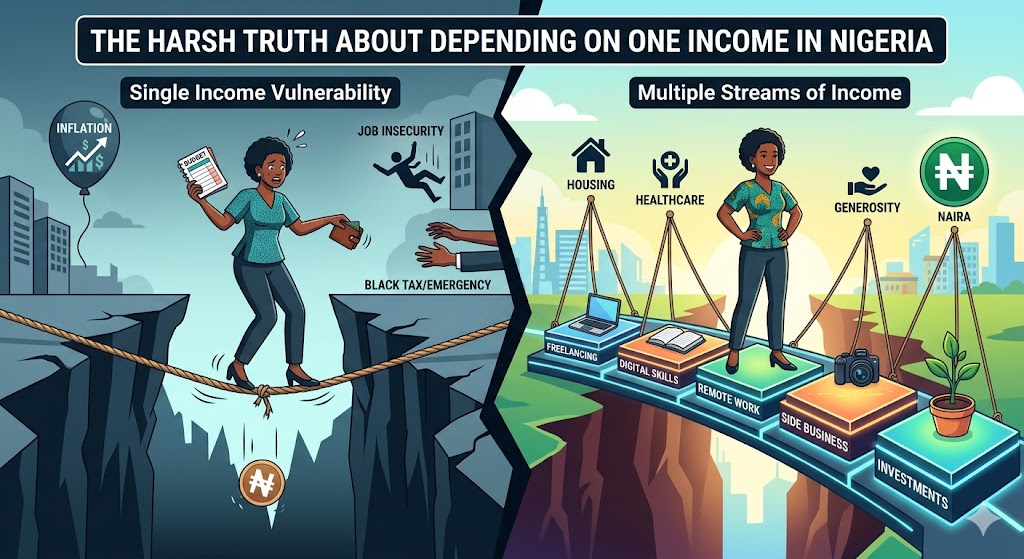
The Harsh Truth About Depending on One Source of Income
In today’s Nigeria, relying on a single source of income is the financial equivalent of trying to balance a fully loaded Lagos yellow bus (danfo) on two wheels while navigating a third mainland bridge pothole. It is a high-wire act where the wind is always blowing against you. The Harsh Truth About Depending on One Source of Income
Whether you are an entry-level analyst in Victoria Island, a secondary school teacher in Ibadan, or a business developer working remotely from Enugu, the reality of 2026 has made one thing abundantly clear: the single-income stream is an endangered species.
Let’s skip the textbook economic theories and look at the actual reality on the ground. This is the honest, unvarnished truth about why depending on one salary or one business line in Nigeria isn’t just risky, it’s a financial emergency.
1. The “Inflation vs. Salary” Wrestling Match (Spoiler: The Salary is Losing)
Let’s be completely honest. If your income only comes from that alert you receive between the 25th and 30th of every month, your purchasing power is actively shrinking while you sleep.
Think back to what ₦100,000 could buy just two or three years ago versus what it buys today at the local market or supermarket. The price of a basket of tomatoes, a bag of rice, and a carton of eggs didn’t just crawl up; they took a supersonic flight. Meanwhile, that monthly salary alert stayed exactly the same, or if you were incredibly lucky, it got a modest 10% adjustment.
The Math of Survival: When inflation runs at double digits and your salary growth sits at 0%, you are technically taking a pay cut every single month.
Depending on one income means you are constantly playing defense. You spend your weekends calculating how to trim an already skeletal budget. You start cutting out the things that make life enjoyable, reducing your existence to just paying bills and surviving till the next payday. A single income traps you in a cycle of running as fast as you can just to stay in the exact same place.
2. The Mirage of Job Security
For a long time, the ultimate Nigerian dream sold to us by our parents was simple: go to school, get good grades, and secure a “safe” corporate job. Get into a bank, an oil company, a telecom firm, or a government parastatal, and you are set for life.
But if the corporate world has taught us anything recently, it’s that “permanent and pensionable” is largely a myth.
Companies restructure. Tech disruptions render entire departments obsolete overnight. Mergers happen, and suddenly, roles are duplicated. When a company needs to protect its bottom line, the easiest line item to slash is human capital.
[Your Entire Financial Stability] ──> [One Employer's Bottom Line] = High Risk
If your employer decides to downsize tomorrow, or if the business faces a sudden regulatory hurdle that halts operations, your income goes from 100% to exactly 0% in a single day. Facing a sudden job loss with zero alternative streams of income doesn’t just create a financial gap, it creates a mental and emotional crisis, especially when black tax and family expectations are waiting at the door.
3. The Weight of Black Tax and Extended Family Expectations
In Nigeria, your income is rarely yours alone. We operate in a beautiful, yet financially heavy, communal culture.
The moment your family knows you have a “good job,” you automatically become a mini-insurance policy for an entire ecosystem of relatives. There’s always an uncle needing medical assistance, a younger sibling whose school fees are short by ₦40,000, a naming ceremony contribution, or a community developmental levy.
                  ┌─── Sibling's Tuition
                  ├─── Parents' Healthcare
[Your Single Salary] ───┼─── Unexpected Family Emergencies
                  └─── Personal Survival Cost
When you have only one source of income, these requests, no matter how genuine or urgent, start to feel like an attack on your financial survival. You are forced to choose between being labeled “stingy” or “wicked” by extended family, or emptying your own meager savings to help them.
Multiple streams of income give you a buffer. It separates your “survival money” from your “support money,” allowing you to be generous without putting your own financial future in jeopardy.
4. The Mental Prison of the Single Income
There is a specific type of bold confidence that comes with knowing that if your primary job disappears today, you won’t starve tomorrow. Conversely, there is a deep, quiet panic that settles into the mind of anyone who knows they are exactly one bad month away from total financial ruin.
Depending on one income puts you in a mental prison where you tolerate toxic environments because you literally cannot afford to leave:
- You swallow insults from an abusive boss because the rent is due next month.
- You stay at a company that hasn’t paid salaries on time in four months because you don’t have the breathing room to pause and pivot.
- You work 14-hour days, burning through your physical and mental health, because you are terrified of being replaced.
When you have a side hustle, a freelance gig, a digital skill you monetize, or a small trading business running on the side, your relationship with your main job changes. You stop working out of raw, desperate fear and start working out of professional commitment. It gives you the leverage to say “no” to toxic work conditions.
5. The Currency Devaluation Trait
If all your income is earned strictly in local currency and spent entirely within an import-dependent economy, you are vulnerable to global market shocks. Almost everything we consume, from the phones in our pockets to the software we use for work, down to the refined fuel that powers our generators, is tied directly to global currency metrics.
When you rely entirely on a fixed local salary, your wealth can be halved on the international stage without your income dropping by a single Naira.
This is why diversification isn’t just about having more sources of income; it’s also about having different types of income. Earning even a small fraction of your income from international freelancing, digital products, remote consulting, or foreign investments acts as a natural hedge against local currency fluctuations.
How to Build a Multi-Stream Income Framework (Without Crashing)
The standard response to this reality is usually: “But I am already exhausted! I work 9-to-5, look at Lagos traffic, when do I have the time to build another business?”
This is a valid complaint. If you try to run a demanding full-time job and simultaneously open a physical retail shop that requires your physical presence, you will experience severe burnout within three months, and both streams will suffer.
The secret is to build an income portfolio based on your current lifestyle, skills, and energy levels. Here is a practical blueprint for diversifying without losing your mind:
Phase 1: The Skills-Based Stream (Freelancing & Consulting)
Look at what you do for your 9-to-5. Are you a human resources professional? You can offer resume restructuring and interview prep packages for young graduates on weekends. Are you an accountant? Small businesses need help balancing their books, setting up spreadsheets, or managing tax filings on a freelance basis.
- The Advantage: Zero capital required. You are simply monetizing knowledge you already possess.
- Where to start: Offer services to friends of friends, build a presence on professional platforms, or take on small consulting projects.
Phase 2: The Digital & Educational Stream (Create It Once, Sell It Often)
If you have a skill that people constantly ask you to teach them, stop giving it away in random chats. Package it.
- If you understand website development, design a structured, short-form weekend bootcamp or record a step-by-step video course.
- If you understand logistics or supply chain management, write a comprehensive e-book detailing how to import goods safely without getting scammed by customs agents.
- The Advantage: Digital products carry zero inventory costs and can be sold repeatedly while you sleep.
Phase 3: The Collaborative/Hands-Off Stream
You don’t have to build every business from scratch yourself. If you have a trusted partner, a sibling, or a friend who has the time but lacks the capital, you can co-invest. You provide the financial backing or strategic guidance, while they manage the day-to-day operations of a small retail, agricultural, or service-based enterprise.
- The Advantage: Leverages other people’s time while diversifying your capital.
Moving from Awareness to Action
Relying on one income source in Nigeria is no longer a viable long-term strategy, it is a structural vulnerability. The goal of building multiple streams of income isn’t to become an overnight billionaire or to buy a house in Banana Island next week. The goal is simple: Peace of mind.
It is about knowing that if the company goes under, you can still buy groceries. It is about knowing that if a medical emergency hits the family, you can pay the hospital deposit without begging on social media or borrowing from predatory loan apps. It is about taking back control of your financial narrative.
Start small. Master one side stream before jumping into another. In an economy that is constantly shifting, the best safety net you can ever have is the one you build with your own hands.

EarnSmartOnline.com.ng is dedicated to helping readers make smarter financial decisions through practical guides on online income, personal finance, technology, digital business, and wealth creation. Our goal is to provide reliable, easy-to-understand, and actionable content that empowers individuals to earn smarter, build sustainable income streams and achieve long-term financial success.
Recommended: Start Earning Online
- Ultimate Affiliate Marketing Program — learn affiliate marketing with a done-for-you sales system ($15). Check it out
- The Newbie Affiliate Guide — the beginner-friendly starter guide (~$6.68). Check it out
- Easy Dollar Maker — earn in dollars uploading AI images and videos from your phone ($17). Check it out
Disclosure: These are affiliate links. If you buy through them, I may earn a commission at no extra cost to you.



