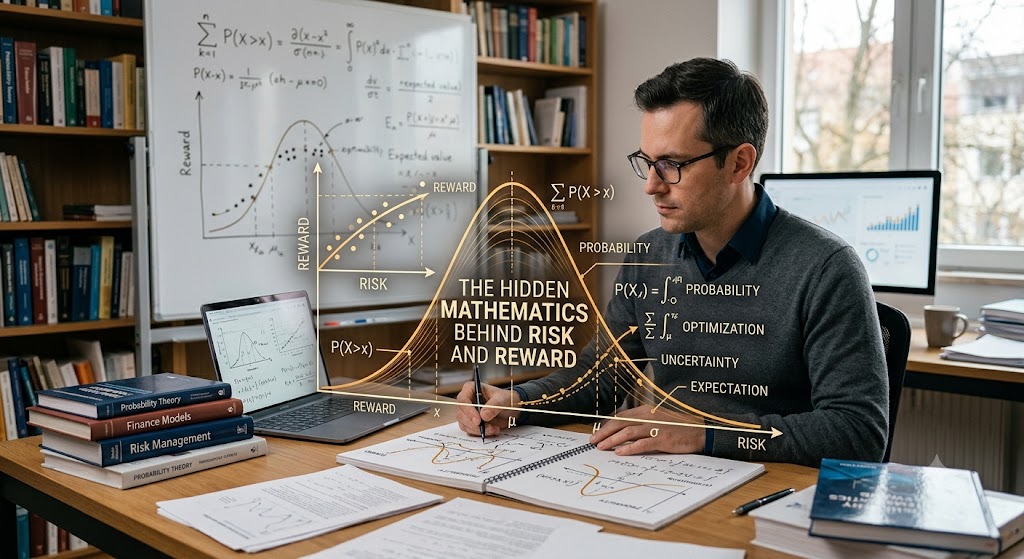
The Hidden Mathematics Behind Risk and Reward
Every decision you make in life carries a hidden equation. Most people never see it because it is not written on paper, displayed on a calculator, or taught in everyday conversations. Yet it quietly influences every success story, every financial breakthrough, every failed business, every investment, every relationship, every career move, and almost every opportunity that changes a person’s life. This invisible equation is the mathematics behind risk and reward. It is not simply about numbers. It is about probability, timing, discipline, patience, consistency, and the willingness to accept uncertainty in exchange for the possibility of something greater.
Many people spend their entire lives trying to avoid risk without realizing that avoiding risk is itself one of the biggest risks they can take. Every time someone refuses to learn a new skill because they fear failure, they choose the certainty of remaining where they are. Every time someone keeps postponing a business idea because they want everything to be perfect, they trade future opportunities for present comfort. Every time a person refuses to invest in knowledge, they unknowingly invest in ignorance instead. The mathematics of life always balances itself. If you refuse one cost, you almost always pay another.
People often assume that reward should come immediately after effort. This expectation is one of the biggest reasons why so many people quit too early. Hidden beneath every meaningful reward is a period where the numbers appear unfair. You work without visible results. You study without recognition. You write articles that almost nobody reads. You upload videos that receive very few views. You build a business that struggles to attract customers. During this stage, the mathematics seems broken because the inputs appear much larger than the outputs.
The truth is that the equation is still working. You are simply measuring the wrong variables.
Nature itself demonstrates this principle repeatedly. A farmer plants hundreds of seeds knowing that not every seed will grow. An investor builds a portfolio knowing that not every investment will become profitable. A scientist performs countless experiments expecting many failures before discovering one breakthrough. These people understand something that beginners usually ignore. Success rarely depends on winning every time. It depends on winning enough times that the successful outcomes outweigh the unsuccessful ones.
This is why probability matters more than perfection. Many successful entrepreneurs do not have perfect businesses. Many successful investors do not make perfect investment decisions. Many successful bloggers do not write perfect articles. They simply understand that consistency increases the probability of success. Every action becomes another entry into the hidden equation.
Imagine flipping a coin once. Predicting the outcome is almost impossible. Flip it one thousand times and patterns begin to appear. The more attempts you make, the closer reality moves toward mathematical expectations. Life often works in a surprisingly similar way. One interview may end in rejection. One business proposal may fail. One blog article may receive almost no visitors. But repeated intelligent effort gradually changes the probability of success.
Unfortunately, society celebrates outcomes while ignoring the calculations behind them. People see a successful business but overlook the years of uncertainty that came before it. They admire wealthy investors but rarely examine the countless decisions, mistakes, corrections, and calculated risks that built that wealth. They applaud famous authors without seeing the rejected manuscripts. They envy successful bloggers without realizing how many articles were written before search engines began sending consistent traffic.
Risk is frequently misunderstood because people only measure what they can immediately lose. They rarely calculate what they could lose by doing nothing. Someone who refuses to start learning artificial intelligence because it seems difficult may believe they are avoiding risk. In reality, they may be risking years of missed opportunities. Someone who avoids investing because markets fluctuate may unknowingly accept the certainty of inflation reducing the value of their savings over time. Every choice has a cost whether that cost is visible or hidden.
This is one of the most important mathematical principles in life. Every decision has an opportunity cost. Choosing one path automatically means giving up another. Time spent watching endless entertainment cannot simultaneously be invested in building valuable skills. Money spent on unnecessary luxuries cannot simultaneously be invested in assets that produce future income. Energy spent complaining cannot simultaneously be invested in solving problems.
The hidden mathematics behind risk and reward becomes even clearer when you understand compounding. Most people think success grows in straight lines. Reality is very different. Success often grows exponentially. In the beginning, progress appears painfully slow. Improvements are almost invisible. Then something remarkable happens. Small consistent gains begin multiplying each other until the results suddenly appear dramatic.
Consider someone who improves by only one percent every day. That tiny improvement feels meaningless today. It feels insignificant tomorrow. It still appears unimportant after several weeks. Yet over long periods, those tiny improvements compound into extraordinary growth. The mathematics rewards patience long before it rewards speed.
This explains why disciplined people often appear lucky. Their luck is usually the visible result of invisible accumulation. They kept learning while others stopped. They kept writing while others quit. They kept investing while others hesitated. They kept improving while others remained comfortable. Eventually the mathematics reached a tipping point where years of small gains suddenly became impossible to ignore.
Fear often distorts our understanding of probability. Human beings naturally exaggerate unlikely disasters while underestimating likely rewards. Someone may refuse to start a business because they imagine losing money. Yet they rarely calculate the probability that developing entrepreneurial skills could increase their lifetime earning potential regardless of whether the first business succeeds. The mind often magnifies immediate pain while minimizing long term benefits.
This explains why calculated risk differs from reckless gambling. Gambling depends largely on chance. Calculated risk depends on preparation, knowledge, research, experience, and informed decision making. A professional investor studies markets before committing capital. A successful entrepreneur studies customers before launching products. A skilled blogger researches keywords before publishing articles. These actions do not eliminate uncertainty, but they significantly improve the mathematical odds.
Another hidden principle involves asymmetrical risk and reward. Some opportunities have limited downside but unlimited upside. Learning a valuable skill is an excellent example. The financial cost of learning may be relatively small compared to the income opportunities that skill could generate throughout an entire career. Starting a blog may require time and consistent effort, but a single article can continue attracting readers and generating revenue for years. The initial investment remains fixed while the potential reward continues growing.
This is why many wealthy individuals focus on opportunities with favourable risk to reward ratios rather than guaranteed outcomes. They understand that certainty often comes with limited growth while uncertainty frequently creates the greatest opportunities. The objective is not to eliminate risk but to ensure that potential rewards justify the risks involved.
Patience is another variable most people fail to include in the equation. Society encourages instant gratification. Businesses promise overnight success. Social media highlights immediate achievements. Real life rarely follows those timelines. Meaningful accomplishments usually require enough time for the mathematics to work in your favour. Every day of consistent effort slightly increases the probability of success even when visible progress appears minimal.
Consider blogging as an example. Many beginners publish ten articles and become discouraged because traffic remains low. They mistakenly conclude that blogging does not work. Experienced bloggers understand that search engines require time to evaluate content, establish trust, and reward consistency. They continue publishing because they know the mathematics favours persistence. One hundred well written articles have dramatically different probabilities of success compared to ten.
The same principle applies to investing. Market fluctuations discourage inexperienced investors because they focus on daily price movements instead of long term growth. Experienced investors recognise that temporary volatility is part of the equation. They understand that decades of disciplined investing historically produce better outcomes than emotional reactions to short term market changes.
There is also the mathematics of preparation. Opportunities rarely announce their arrival in advance. They often appear suddenly, rewarding those who prepared before the opportunity existed. Someone who spends years mastering programming is ready when technology companies expand. Someone who consistently builds an online audience is ready when brands seek partnerships. Someone who continuously improves communication skills is prepared when leadership opportunities appear.
To an outsider these moments appear fortunate. In reality they are mathematical consequences of preparation meeting opportunity. The years of unseen work eventually become visible in a single breakthrough moment.
Failure itself has mathematical value. Every mistake provides information. Every unsuccessful attempt eliminates ineffective strategies. Every setback improves future decision making if lessons are extracted correctly. Individuals who learn from failure steadily improve their probability of future success because each experience refines their understanding of reality.
Those who fear failure often reduce their total number of attempts. Fewer attempts naturally reduce their overall probability of success. Ironically, trying to avoid failure frequently increases the likelihood of long term disappointment because success usually requires numerous attempts before meaningful results appear.
Confidence also follows mathematical principles. Genuine confidence is rarely blind optimism. It grows from accumulated evidence. Each completed project, each solved problem, each acquired skill, and each overcome challenge becomes another data point supporting future confidence. This explains why experienced professionals remain calm under pressure. Their confidence is supported by years of successful repetitions rather than wishful thinking.
The hidden mathematics behind risk and reward ultimately teaches a powerful lesson about life itself. Every meaningful achievement demands payment before delivery. The payment may come in the form of discipline, patience, education, consistency, sacrifice, rejection, or uncertainty. Those unwilling to pay these costs rarely receive the rewards they desire. Those willing to invest consistently eventually discover that the mathematics has been working quietly in the background all along.
Success is therefore less mysterious than it appears. It is often the predictable outcome of repeatedly making decisions where expected long term rewards exceed temporary discomfort. Every book read, every useful article written, every new skill learned, every productive habit maintained, and every calculated risk taken becomes another positive entry into the equation.
The people who consistently win over decades are rarely those who avoid every mistake. They are the ones who understand the numbers beneath everyday choices. They recognise that losses are temporary, experience is cumulative, knowledge compounds, discipline multiplies opportunities, and persistence steadily shifts probability in their favour. They stop chasing certainty and begin pursuing intelligent risk because they know that extraordinary rewards almost always hide behind ordinary uncertainty.
The next time you face an important decision, resist the temptation to ask only what you might lose. Ask what you might gain, what you might learn, what opportunities could emerge, and what the long term mathematics suggests. When viewed through this lens, many decisions become clearer. Comfort often provides immediate satisfaction but limited growth. Calculated risk may introduce temporary uncertainty, yet it frequently unlocks possibilities that comfort never can.
Life is constantly solving equations whether we notice them or not. Every habit adds a number. Every decision changes the probability. Every day compounds previous actions. Every opportunity carries hidden variables. Those who understand these invisible calculations position themselves to benefit from them instead of becoming victims of them. The mathematics behind risk and reward is not merely an economic principle or a business strategy. It is one of the fundamental laws governing progress itself. Those who learn to respect it, work with it, and remain patient enough for it to unfold place themselves in the strongest possible position to build lasting success, enduring wealth, meaningful relationships, and a life that reflects not random luck but the powerful consequences of wise and consistent decisions.

EarnSmartOnline.com.ng is dedicated to helping readers make smarter financial decisions through practical guides on online income, personal finance, technology, digital business, and wealth creation. Our goal is to provide reliable, easy-to-understand, and actionable content that empowers individuals to earn smarter, build sustainable income streams and achieve long-term financial success.
Recommended: Start Earning Online
- Ultimate Affiliate Marketing Program — learn affiliate marketing with a done-for-you sales system ($15). Check it out
- The Newbie Affiliate Guide — the beginner-friendly starter guide (~$6.68). Check it out
- Easy Dollar Maker — earn in dollars uploading AI images and videos from your phone ($17). Check it out
Disclosure: These are affiliate links. If you buy through them, I may earn a commission at no extra cost to you.